Moonshot Plan
Full-service digital marketing management combining SEO, ads, socials, and analytics.
The Moonshot Plan is Aidxn Design's premium marketing management package — a comprehensive approach to digital growth that coordinates SEO, Google Ads, Facebook/Instagram advertising, social media content, and performance analytics into a single managed service. Rather than treating each channel in isolation, the Moonshot Plan orchestrates them as a unified system where each channel reinforces the others, maximizing return on every marketing dollar spent. For Gold Coast businesses struggling with fragmented marketing efforts — one vendor handling SEO, another running ads, social media being neglected — the Moonshot Plan consolidates strategy under one expert who understands how all channels interact and compound each other's results.
SEO + Google Ads + Social + Analytics
Every marketing channel working together.
A coordinated multi-channel marketing system where SEO, paid ads, and social media compound each other's results. The Moonshot Plan operates from a fundamental belief: siloed marketing is inefficient. A business running Google Ads without SEO leaves money on the table because paid spend could be redirected to profitable organic channels once they're established. A business doing social media without analytics has no idea what's working or whether it's driving actual business results. The Moonshot Plan breaks down these silos, treating digital marketing as an integrated system where data flows between channels and informs strategy across all of them.

Multi-Channel Strategy
Coordinated campaigns across every digital touchpoint.
The Moonshot approach starts with SEO as the foundation — technical audits, content strategy, and link building that compounds over time. Google Ads captures high-intent search traffic immediately while organic rankings build. Facebook and Instagram campaigns drive awareness and retargeting, keeping the brand visible between search interactions. Each channel feeds data back into the others: search query data informs social content, social engagement signals inform ad targeting, and paid traffic data reveals which pages convert best for SEO prioritization. The SEO foundation is critical because it's the only channel where success compounds indefinitely. When you stop paying for Google Ads, traffic stops. When you stop posting on social media, engagement drops. But when you stop actively working on SEO, rankings persist. The authority you've built through high-quality content and backlinks continues to generate traffic years later. This long-term sustainability makes SEO the most efficient channel once established, though it requires patience — 3-6 months for meaningful results in competitive industries. The Google Ads channel bridges this gap, providing immediate traffic while SEO builds. A business might spend $2,000/month on ads while investing $1,500/month in SEO. After 6 months, organic traffic might have grown from zero to 50% of paid traffic. After 12 months, it might be 80% of paid traffic. At that point, ad spend can be reduced while redirecting to SEO expansion in new markets or keyword areas. Facebook and Instagram fit into the funnel differently. Paid search captures high-intent visitors (people actively searching for solutions). Paid social drives awareness and interest (showing your products to people who match your customer profile but aren't actively searching). Retargeting on social keeps your brand visible to people who've visited your website but haven't converted yet. This combination covers the entire customer journey. A customer might discover you through a social media ad (awareness), then see you again while browsing (retargeting), then search for you directly and click your Google Ad (high-intent), and finally convert. Multiple channels touched that customer before conversion. Understanding which channels played which role in the journey is essential to allocating budget correctly. The data connections between channels are sophisticated. When someone searches for your brand name, they're likely either a returning visitor or someone who's seen your ads. The search query data reveals that brand searches increased 40% month-over-month — that's likely because of increased social media advertising. The social engagement data shows that your latest campaign got 3x more shares and comments than average — that content might deserve amplification through paid promotion or featured on your website. The paid traffic data shows your product comparison page converts at 8% while your top-level product pages convert at 2% — that insight should inform SEO strategy to prioritize the high-converting content in internal linking and featured content placement.
Analytics and Optimization
Data-driven decisions, transparent reporting.
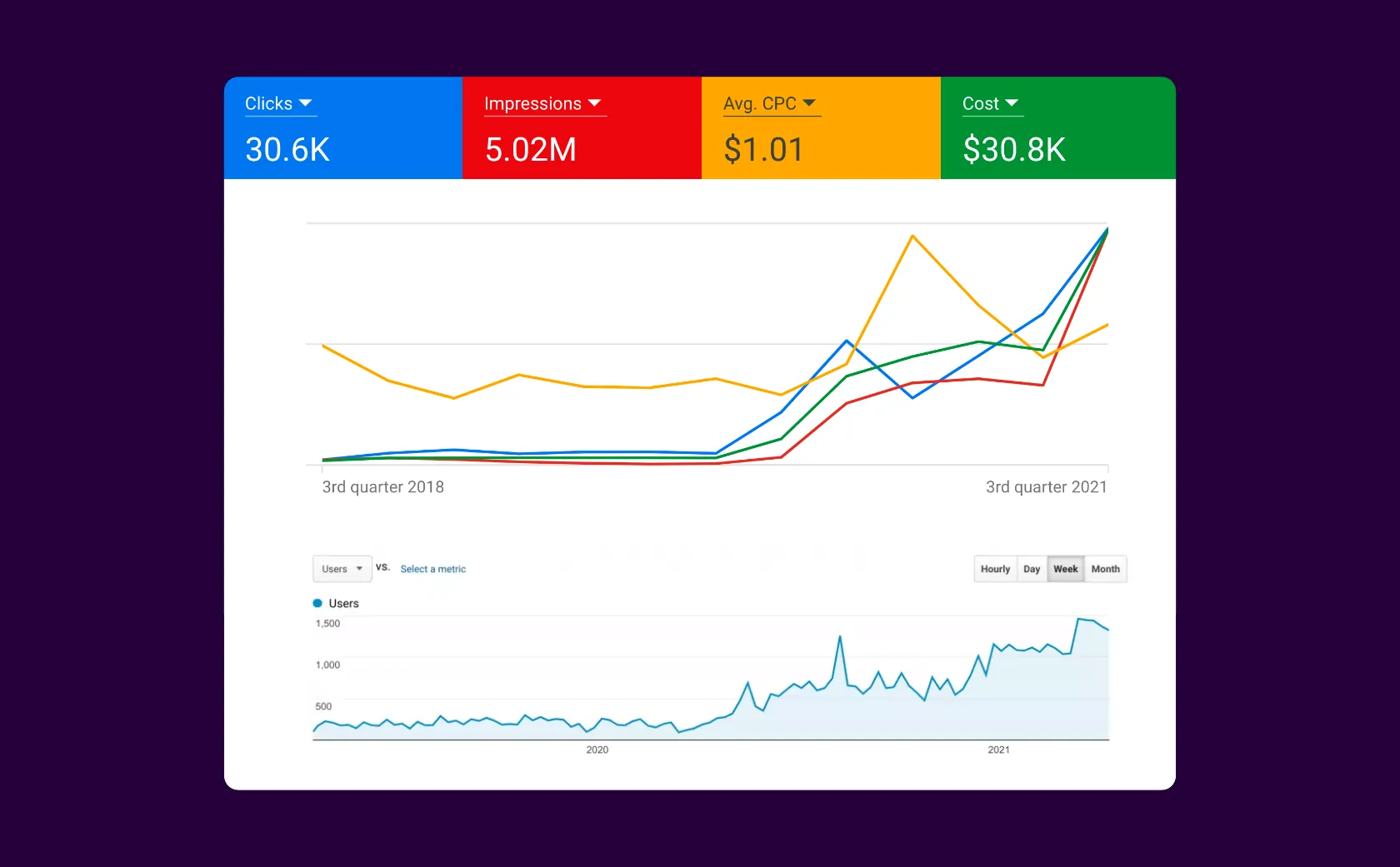
Every Moonshot Plan client receives a custom analytics dashboard pulling data from Google Analytics, Google Ads, Facebook Business Manager, and Search Console into a unified view. The dashboard tracks the metrics that matter — cost per acquisition, return on ad spend, organic traffic growth, and conversion rates by channel and campaign. Monthly strategy sessions review performance data and adjust budget allocation, creative direction, and targeting based on what the numbers show. This is where agency partnership becomes valuable. It's not just about having access to data — it's about having someone dedicated to interpreting that data and making strategic recommendations. An in-house marketer juggling multiple responsibilities might not have time to deeply analyze how yesterday's campaign changes affected today's performance. A dedicated agency partner analyzes these patterns relentlessly, spotting opportunities and risks before they become obvious. The optimization philosophy is aggressive but disciplined. Ad creative is tested continuously — different headlines, images, copy angles, and calls-to-action are deployed and measured. Winning variants are doubled down on. Underperformers are paused quickly. Rather than running the same ads for months, the approach is to find what works through rapid iteration and lean into those winners. This requires volume — enough budget to test multiple variants and enough reach to get statistical significance. Small budgets constrain this optimization velocity; larger budgets enable faster iteration. For a business with $20,000/month ad spend, testing 5 creative variations gives each 4,000 impressions to gather data. For a business with $2,000/month spend, that same test only gives each 400 impressions — too few to determine winners and losers reliably. The landing page optimization follows a similar principle. Data from paid traffic reveals which pages convert best. SEO strategy then prioritizes those pages for organic ranking growth. If your product comparison page converts 8% of paid traffic but your category page only converts 2%, SEO effort should flow to the comparison page — building links to it, improving its search ranking, featuring it prominently in internal linking. This creates a positive feedback loop: SEO improves rankings, more organic traffic flows to high-converting pages, conversion rate increases, CAC decreases, more budget can be allocated to growth channels. The same optimization logic applies to audience targeting and messaging. What message resonates with your highest-value customer segment? Double down on that message. What demographic segment converts at 10% CPA lower than others? Expand targeting to similar audiences. What page type converts the best? Create more of that content. The reporting cadence is monthly because that's the right timeframe for meaningful pattern detection. Weekly noise — a single day's performance variance — shouldn't drive strategy changes. Monthly data smooths out daily fluctuations and reveals genuine trends. A campaign that performs poorly one week but excellently the next might deserve deeper investigation rather than immediate pausal. Monthly reviews also provide a natural checkpoint for strategic planning. At the start of each month, review the previous month's performance, adjust budget allocation based on results, plan new tests to run in the coming month, and set targets for the month ahead. This structure creates accountability and ensures strategic consistency while allowing agility to respond to what data reveals.
The optimization cycle runs continuously: ad creative A/B testing produces winning variants that inform organic social content. Top-performing landing pages get additional SEO investment. Underperforming campaigns are paused and budget reallocated within days, not months. The result is a marketing engine that improves every month as the data compounds, with clients typically seeing 30-50% CPA improvements within the first quarter as campaigns optimize against real conversion data rather than assumptions. This improvement curve continues — month two often shows additional 15-20% improvement as optimization compounds. By month six, a client that started with $50 CPA might be operating at $30 CPA on the same products with the same target customer. The difference isn't that the market changed or competitors disappeared; it's that optimization through data has revealed inefficiencies and systematically eliminated them. That's the Moonshot Plan in action — not a collection of separate marketing tasks, but an integrated system optimizing toward a single goal: sustainable, profitable customer acquisition.
Ready for the Moonshot Plan?
Let's connect.




From the blog
Latest thinking
Tech news, design insights, and development deep-dives from the Gold Coast.