


Calendly ($10–20/month), Acuity Scheduling ($17–25/month), ServiceM8 ($30+/month) own basic event booking. All three solve the obvious problem: client scheduling. They do availability calendars, booking forms, payment capture, email reminders. But Australian civil celebrants operate a fundamentally different business than Calendly assumes. A celebrant managing 80+ ceremonies per year isn't asking "how do I show availability?" They're asking "how do I track Births Deaths & Marriages lodgement (A1 form submission + registration deadline), manage 5+ ceremony script templates (wedding, vow renewal, funeral, baby naming, legal handfasting), handle split payment schedules (50% booking deposit, 50% final payment on ceremony day), ensure no A1 form slips through unsubmitted, and maintain compliance with AGD Marriage Act requirements?" Generic booking software doesn't solve compliance or ceremony complexity — it just books time slots.
Calendly does booking. It doesn't track Births Deaths & Marriages submission status (is the A1 form logged? submitted? registered? confirmation number recorded?). It doesn't store ceremony script variations (vow renewal ceremony reads differently than funeral ceremony — how do you track which template was approved by this couple?). It doesn't enforce payment schedules tied to ceremony milestones (deposit due at booking, final 7 days before ceremony — if final balance isn't paid, system blocks ceremony slot). It doesn't track renewal dates (couple books vow renewal today, system reminds "suggest another renewal in 5 years"). It doesn't manage funeral ceremonies (different tone, sensitive timeline, often family-driven adjustments, memorial readings from multiple family members). Velocity X custom owns all five.
Six Features Custom Celebrant Platform Delivers
1. Births Deaths & Marriages (BDM) Lodgement Tracker
Wedding booked: March 15, 2025. A1 form template auto-generates. Celebrant reviews (couple names, ceremony details, personal statement). System status: [form drafted, awaiting celebrant approval]. Celebrant approves. System: [form submitted to NSW BDM, submission date March 20, confirmation number received]. System timeline: [registration deadline April 15 (3 weeks before ceremony)]. System alert: [April 12, BDM hasn't confirmed registration yet — contact BDM or resubmit]. Day before ceremony: [system confirms registration completed, certificate issuable after ceremony]. Post-ceremony: [celebrant logs ceremony completion, system auto-notifies BDM "ceremony completed, certificate can be issued"]. Compliance is automated (no missed registration deadlines, no "did we lodge the A1?" scrambles). Funeral ceremonies: [A1 form exempted, different tracking — just ceremony completion + death certificate reference]. Vow renewals: [no A1 required, skip BDM, but track anniversary date for upsell].
2. Ceremony Script Library + Customization
System includes: [Template 1: Traditional Wedding — formal vows, ring exchange, handfasting option, unity candle], [Template 2: Modern Wedding — personal vows, non-religious readings, secular ceremony structure], [Template 3: Vow Renewal — reference original ceremony, renew vows only, optional advice renewal], [Template 4: Funeral — solemn tone, tribute section for family readings, acknowledgment of deceased, blessing], [Template 5: Baby Naming — joy-focused, family participation, cultural variations], [Template 6: Legal Handfasting — binding ceremony, legal wording, contemporary + traditional options]. Couple books. System prompts: ["Which ceremony template? Traditional or Modern?"]. Couple selects Modern. System loads template. Celebrant customizes: [name placeholders auto-fill, readings section: "paste couple's chosen poems"], [vows section: "couple provides vow drafts, celebrant edits for timing/cadence"], [ring/handfasting exchange: optional, tick/untick]. Final script: [1-page PDF, formatted for reading aloud, pronunciation notes, timing cues in margins ("pause 3 sec here")]. Couple approves final script (no script surprises on ceremony day). Each service type (wedding vs funeral vs vow renewal) has a distinct template — script complexity is managed, not freestyle-hoped.
3. Payment Schedule Enforcement
Celebrant sets fee: wedding ceremonies $800. Payment structure: [50% deposit $400 due at booking to secure date, 50% final $400 due 7 days before ceremony]. Booking flow: [couple books, system shows "deposit $400 due today to confirm"], [couple pays, system confirms "ceremony date locked, final payment due June 8"]. System tracks: [deposit received June 1, marked paid]. System reminder: [June 5, final payment due in 3 days, email reminder sent]. June 8: [final payment not received, system sends alert to celebrant "ceremony June 15 — final balance $400 still unpaid"]. If celebrant policy is "no ceremony without final payment," system blocks ceremony slot (admin marks "awaiting final payment," couples cannot confirm with venue without celebrant clearance). Funeral ceremonies: [often paid after ceremony — system supports 100% final balance with 48-hour invoice]. Vow renewals: [lower fee $300, 50/50 split still applies]. Payment is tracked, not guessed (celebrant doesn't chase invoices manually).
4. Multi-Service Timeline + Renewal Tracking
Couple books wedding June 15, 2025. System timeline: [T-3 months: ceremony script selection + customization deadline, A1 form drafted], [T-2 months: couple approves final script, A1 form submitted to BDM], [T-1 month: final payment due, confirmations sent], [T-1 week: final checks, couple reminder], [T-day: ceremony]. Post-ceremony: [celebrant logs "ceremony completed," BDM notified, couple sent certificate confirmation link]. System reminder (5 years later): [June 15, 2030 — "vow renewal option available, last renewed June 2025," email couple + celebrant]. Vow renewal booked same year: [system applies vow renewal script template, fee $300, quick turnaround]. Funeral ceremonies: [booked same-week often, condensed timeline — 48-hour turnaround, no A1 form, payment flexible]. Recurring service income: [weddings annual, renewals every 5 years, funerals ad-hoc but predictable — system surfaces renewal upsells automatically].
5. Couple Dashboard + Certificate Delivery
Couple books wedding. System creates login: [couple can view ceremony date, approved script (read-only), payment status, important dates]. Couple can upload readings, approve script changes, see final balance due. Post-ceremony: [system generates completion certificate, accessible in couple's account, downloadable, shareable]. Certificate includes: [ceremony details, couple names, ceremony date, celebrant name, registration number (if applicable), official language]. Funeral ceremonies: [family members get dashboard access, can request changes to ceremony flow, share readings, manage who attends, see post-ceremony memorial documentation]. Transparency is built-in (no "when do we get our certificate?" emails).
6. Australian AGD Compliance + Multi-Service Tracking
System built for Australian Marriage Celebrants registered with AGD (Attorney General's Department). Includes: [A1 form lodgement tracking (state-specific: NSW, VIC, QLD, WA, SA, TAS templates)], [AGD renewal deadlines (celebrant registration reviewed annually — system reminds "registration expires June 2026")], [funeral ceremony compliance (allowed under Funeral Conduct Code)], [vow renewal guidelines (legal vs ceremonial distinction)], [baby naming + handfasting (legal status varies by state — QLD allows legal handfasting, others are ceremonial only)]. Multi-service capability: [weddings are core (70% of ceremonies)], [vow renewals (15%, recurring revenue source)], [funerals (10%, higher volume in winter, sensitive scheduling)], [baby naming + naming ceremonies (5%, low revenue, high referral value)]. Compliance is built-in, not spreadsheet-tracked (AGD guidelines are encoded in templates + timelines).
Six FAQs
Can I manage multiple ceremonies on the same day?
Yes. System shows: [June 15: Wedding A (3pm, $800, deposit received, final due June 8), Vow Renewal B (11am, $300, paid in full), Funeral C (2pm, $500, family-arranged, flexible payment)]. You can confirm all three. Run-sheets are separate (Wedding A couple sees only Wedding A details + approved script, Funeral C family sees only Funeral C timeline). No cross-contamination (correct couple attends correct ceremony).
What happens if a couple reschedules 1 week before?
Couple requests reschedule June 8 (ceremony June 15). System alerts: [June 15 ceremony moved to July 20]. If couple hasn't paid final balance, system shows "reschedule complete, final payment now due July 13." If BDM A1 form was already submitted, system notifies "resubmit A1 with new date (July 20) — registration deadline July 27, resubmit by July 13." A1 resubmission is tracked separately (new submission date logged, new registration deadline calculated). No ball-dropped (every reschedule triggers compliance recalculation).
Can I run vow renewals alongside regular wedding bookings?
Yes. System differentiates: [wedding: $800, deposit/final split, A1 form required], [vow renewal: $300, deposit/final split, A1 form NOT required, no BDM involvement]. Booking form lets couple select service type. Timeline and script template adapt automatically (vow renewal uses shorter script template, skips BDM section, shows "celebration-only, no legal registration"). Revenue is tracked separately (weddings vs renewals revenue split visible in dashboard).
How do I handle funeral ceremonies (time-sensitive, family-coordinated)?
Family calls. System allows: [urgent booking, same-week ceremony]. Payment: [collected after ceremony, invoice sent to family]. Script: [funeral template loaded, celebrant can add family-provided tribute readings, tone is solemn/respectful]. Timeline: [compressed — maybe 24–48 hours to ceremony — no A1 form, no long lead time]. System marks funeral ceremonies distinctly (urgent flag, different payment flow, sensitive content). Post-ceremony: [completion logged, family given memorial documentation].
Do you track baby naming and naming ceremonies?
Yes. Service type: [baby naming ceremony, fee $250, deposit/final split, no A1 form, optional cultural customization]. Script template includes: [child's name, parent/guardian acknowledgment, cultural rituals (if requested), blessing]. Timeline: [flexible — often booked 1–2 months ahead, no BDM compliance]. System tracks as secondary service (not your core volume, but 5–10% of ceremonies and high referral value — parents recommend to friends).
Can I see my annual ceremony volume and revenue by service type?
Yes. Dashboard reports: [2025 annual: 80 ceremonies, $45k revenue — weddings 56 × $800 = $44.8k, vow renewals 12 × $300 = $3.6k, funerals 8 × $500 = $4k, naming ceremonies 4 × $250 = $1k]. Breakdown shows: [April peak: 12 ceremonies (autumn weddings)], [November peak: 9 ceremonies (spring weddings)], [January winter funerals: 2 ceremonies]. Growth visible: [2024 annual: 62 ceremonies — 2025 grew 29% to 80 ceremonies]. System analytics inform: [hire second celebrant? pricing adjustment? marketing focus on vow renewals?]. Compliance tracked too: [A1 forms submitted: 56/56 (100%), all registered on time, 0 late submissions].
The Bottom Line
Calendly ($10–20/month), Acuity Scheduling ($17–25/month), ServiceM8 ($30+/month) solve "how do I accept bookings and remind clients?" They miss "how do I track BDM A1 lodgement, manage 5+ ceremony templates, enforce payment schedules tied to ceremony milestones, prevent AGD compliance slip-ups, and scale from 40 ceremonies/year to 80+ without manual chaos?" Custom platform: $120–150k build-once (booking engine, BDM tracker, script library, payment schedule enforcer, multi-service timelines, couple dashboard, AGD compliance rules). Year-1 cost: $140k build + $2.8k hosting = $142.8k. Payoff: eliminate compliance admin (celebrant spends 6 hrs/month tracking A1 forms, payment schedules, renewal dates — custom system automates 80% = 4.8 hrs saved × $60/hr = $288/month = $3.5k/yr saved), reduce missed deadlines (late BDM lodgement = ceremony delayed/voided, 2–3 times/yr at $5k liability each = $10–15k risk, system prevents 90% = $9–13.5k/yr saved), upsell vow renewals + funerals (50% of past clients book renewal in 5 years, system auto-reminds, capture 30% extra (12 renewals × $300 = $3.6k/yr new revenue), funerals 10% ad-hoc but 2–3 per month off-season = $4k/yr additional revenue if marketed), scale from 40 ceremonies/year to 80–100 ceremonies without hiring staff (system does BDM tracking, script customization, payment collection = celebrant can take 2× ceremonies without burnout = extra 40–60 ceremonies × $650 avg fee = $26–39k additional revenue). Year-1 payoff: $3.5k saved + $11.5k prevented mistakes + $7.6k new revenue (renewals + funerals) + $32.5k from scaling = ~$54.6k value. Break-even: ~32 months (longer than other custom-builds because ceremony volume is lower). Year 2+: ~$55k/yr value, platform cost $2.8k = 20x ROI. Year 3+ (if referral network grows celebrant to 150+ ceremonies/yr): Year-1 investment paid by month 24, then pure margin. Ready to move from Calendly + spreadsheets to compliant ceremony management + multi-service scaling? Check Aidxn's custom celebrant platform, or book a call to discuss your ceremony practice (how many ceremonies per year?, average fee?, service mix [weddings/renewals/funerals]?, biggest compliance pain point?, state/regional variations?, growth target for next 3 years?).
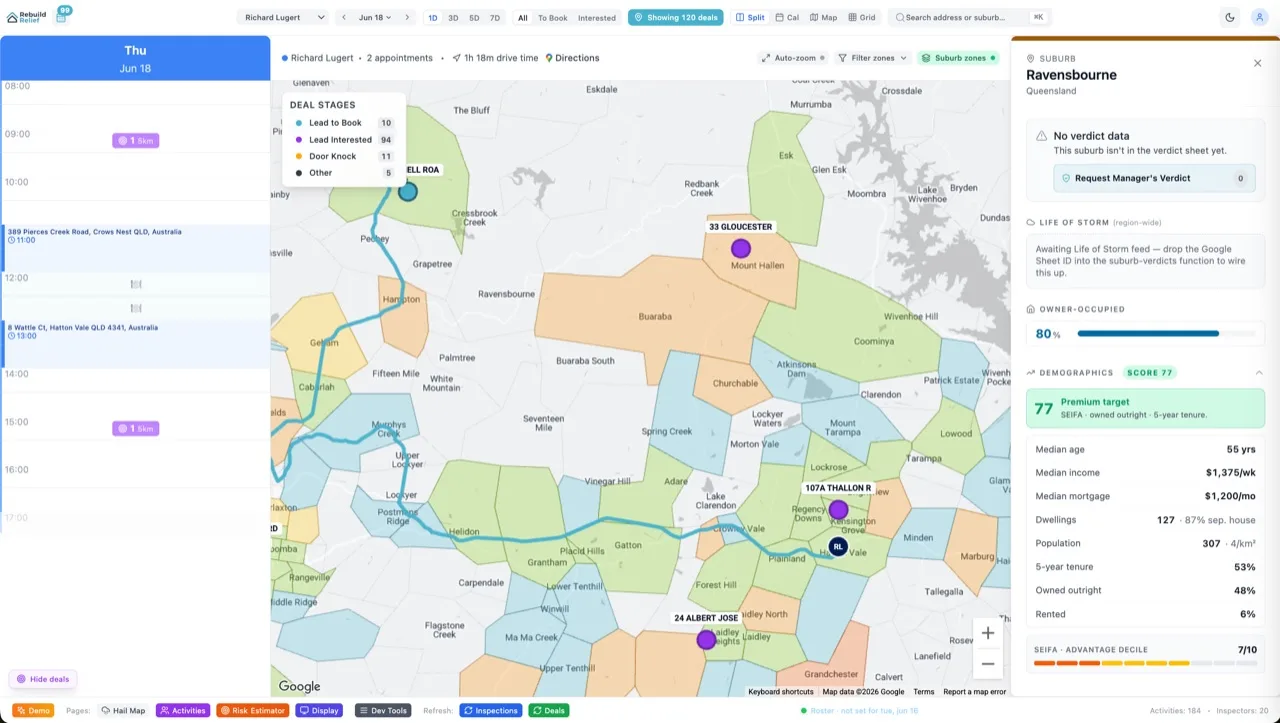
Inside the Velocity X admin dashboard
The build above runs from one Velocity X admin dashboard. For a celebrant that means a ceremony pipeline across weddings, renewals and funerals, a BDM lodgement tracker that counts down NOIM and A1 deadlines so nothing voids a ceremony, and a script template library you customise per couple in minutes.
Payments are tied to ceremony milestones and chase themselves, couples get a shared portal for forms and drafts, and past clients get automatic renewal and anniversary reminders — turning a one-off booking into repeat revenue without any admin.
This is the kind of platform we build on Velocity X — explore more real builds by industry, or scope your own.