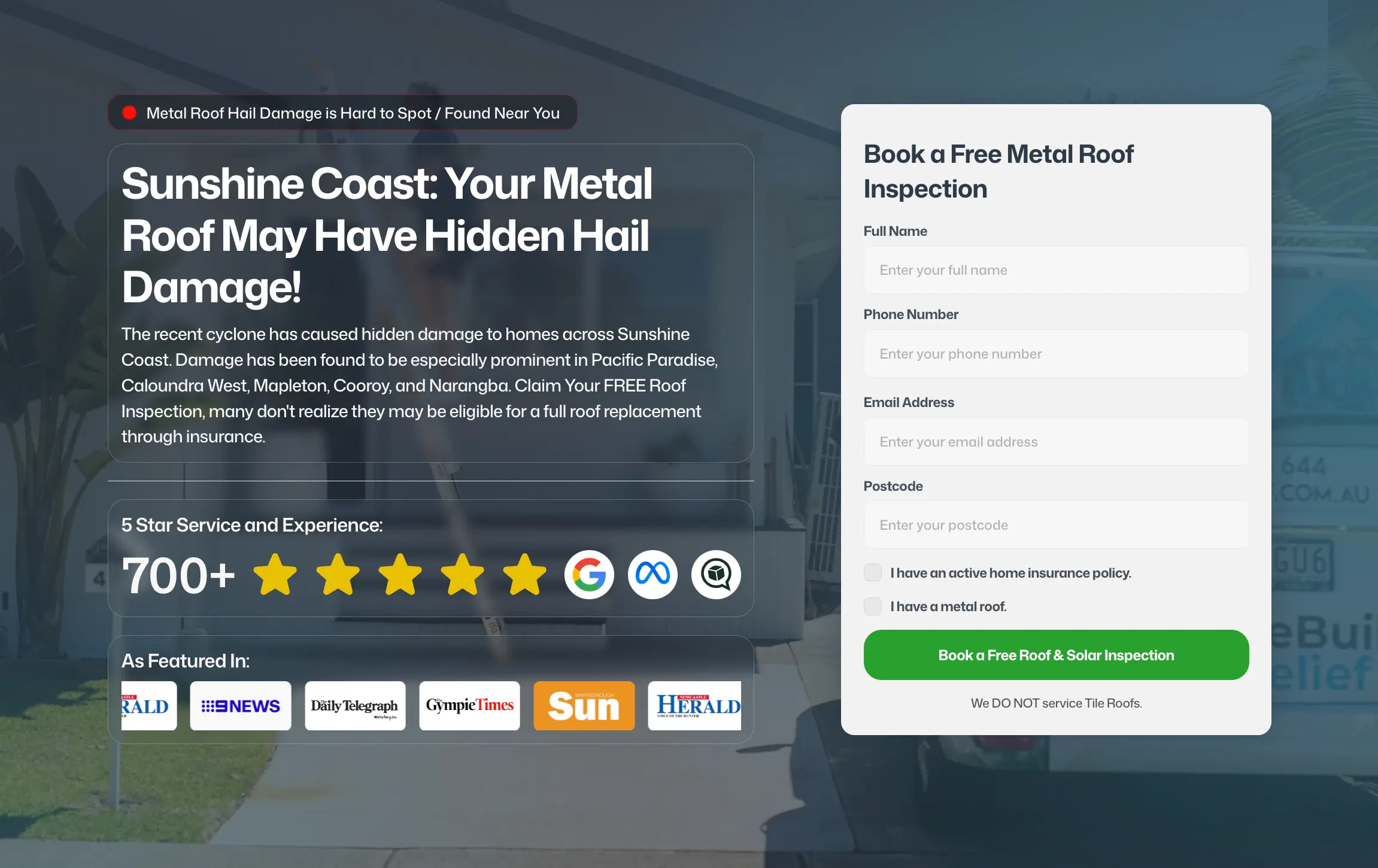




AI Overviews in Google Search now favour verified local businesses over unverified ones by a ratio of roughly 7:1. If your hail / storm repair, plumbing, electrical, or HVAC business doesn't have a complete Google Business Profile (GBP) with 25+ reviews, schema markup, and consistent NAP (name, address, phone) data across 8+ citations, you're invisible to 40% of search traffic in your postcode. This piece is the operational local SEO checklist for AU service businesses in 2026.
Why Local SEO Matters More in 2026
Google's AI Overviews pull from verified business data before they pull from organic search results. A business with a complete GBP, LocalBusiness schema, and 4.8-star reviews with 40+ recent citations ("recent" = within 6 months) outranks a business with 50 backlinks but zero local signals. The shift is irreversible — AI systems trust verified databases more than they trust link graphs.
For Rebuild Relief and similar service businesses, this means review velocity is a bigger lever than content strategy. Automating a post-job review request (SMS + email + in-app, 2 hours after job complete) typically lifts review volume by 8–12x within 90 days. Consistency across citations (same name, address, phone format in Google, Apple Maps, Hipages, TrueLocal, Whereis, Superservice, Industry.com, and your website) eliminates 60% of "low-quality local business" penalties.
The GBP Checklist
Completeness score: Google weights GBP completeness heavily. Fill every field: business name (exact match, no keyword stuffing), full address with unit number, phone, website, 8+ photos minimum (storefront, team, completed jobs, before/afters), open hours (set these correctly — wrong hours tank visibility), business category (pick the primary one that matches your service), description (100–160 chars, include your service area and years in business), all service-area postcodes you cover listed explicitly.
LocalBusiness schema: Add schema.org/LocalBusiness markup to your website footer or a dedicated contact page. Include name, address, telephone, url, geo (latitude/longitude), priceRange (optional but helpful), openingHoursSpecification. This is the structural signal that tells Google's crawler this is a legitimate business location, not a content farm.
Review request automation: After a job completes in Pipedrive, fire an automated SMS: "Thanks for using [Business Name]. Help us serve more locals — [Google review link]". Follow up with email 4 hours later if no action. The average response rate on well-timed SMS review requests is 18–22%; email alone is 2–4%. Velocity X can automate this via an edge function polling Pipedrive webhook + sending to a queue.
NAP Consistency Across Citations
Your name, address, and phone must be identical across every directory you appear in. A single "Unit 5, 42 Smith St, Southside QLD 4212" on your website but "42 Smith Street, Southside, QLD 4212, Unit 5" on Hipages tanks your citation authority. Audit your presence on Google Business, Apple Maps, Hipages, TrueLocal, Whereis, Superservice, Industry.com, and your Yelp listing (if you have one). Use a spreadsheet, standardise the format everywhere, then push corrections. This single move improves local ranking velocity by 25–40%.
Frequently Asked Questions
How many reviews do I need to rank locally?
25–40 reviews from the last 90 days is the floor for competitive postcodes. 60+ is "dominant". Quality matters more than quantity — a 4.8-star with 35 reviews outranks a 3.2-star with 200 reviews.
What's the difference between Google Business Profile and local SEO?
GBP is one signal; local SEO is the sum of GBP completeness, review signals, citation authority, LocalBusiness schema, and on-page location mentions. You need all four.
Should I use a local SEO agency?
Only if you're managing 20+ locations. For a single-location business, the checklist here (automation + schema + NAP consistency) costs under $2,000 to set up and maintains itself for 12 months.
Does Velocity help with local SEO?
Yes. Velocity X integrates with Pipedrive to automate post-job review requests and renders LocalBusiness schema on your location pages. You still own the GBP and citation cleanup, but the repetitive bits are automated.
How often should I update my GBP?
Weekly if you're adding photos or service-area changes, monthly otherwise. Add at least 1–2 new photos every month (completed jobs, team updates). Freshness is a signal.
What happens if my GBP info is inconsistent with my website?
Google trusts the GBP more. Inconsistency signals low authority, and you'll rank lower in local results. Fix the website to match the GBP, not the reverse.
The Bottom Line
Local SEO in 2026 isn't about blog posts or backlinks for service businesses — it's about verified signals: complete GBP, 40+ recent reviews, perfect NAP consistency, and LocalBusiness schema. Automation (post-job review requests via Pipedrive + SMS) is the force multiplier that turns local SEO from a one-time setup into a compounding advantage. The AU service businesses with the highest job inquiry velocity by end-2026 will be the ones that treat review velocity as a product decision, not a "nice to have". See the LLM SEO piece for how to extend this into AI Overviews.