





Pressure washing: zone-dependent (cluster North/West/South roofs), chemical-hazardous (sodium hypo runoff, EPA compliance non-negotiable), crew-licensed (chemical handler + WHS heights cert), commercial recurring (quarterly roof contracts, multi-property schedules), residential one-off + emergency. Solo operator 3 trucks, 40 commercial roofs + 30 residential one-off + 15 emergency/month = $185k revenue apparent, but actual margins severely eroded by (1) scattered routing (drive time 40% overhead waste, fuel spike $48.7k/yr), (2) chemical compliance risk (crew licenses untracked, runoff uncontained, EPA audit penalty $2k-$5k risk, insurance claim denial $10k+ exposure), (3) photo proof missing (disputes 3-4/month, payment slowness), (4) commercial contract chaos (quarterly jobs forgotten, 20% churn, renewal SMS forgotten), (5) crew chemical safety (respiratory injury incidents, workers' comp penalties, zero documentation), (6) supplier cost leakage (chemical bulk-buy missed, waste 5L/month), (7) crew licensing untracked (chemical handler certs lapsed, no system enforcement, audit exposure). Custom platform fixes all 7, unlocking 35% volume growth + 25% cost reduction + 100% compliance audit-ready + emergency revenue overflow.
Six Features Custom Pressure Washing Platform Delivers
1. Route Optimization — Zone Clustering, Commercial Time-Lock Windows, Residential + Emergency Splits, Drive Time Minimization
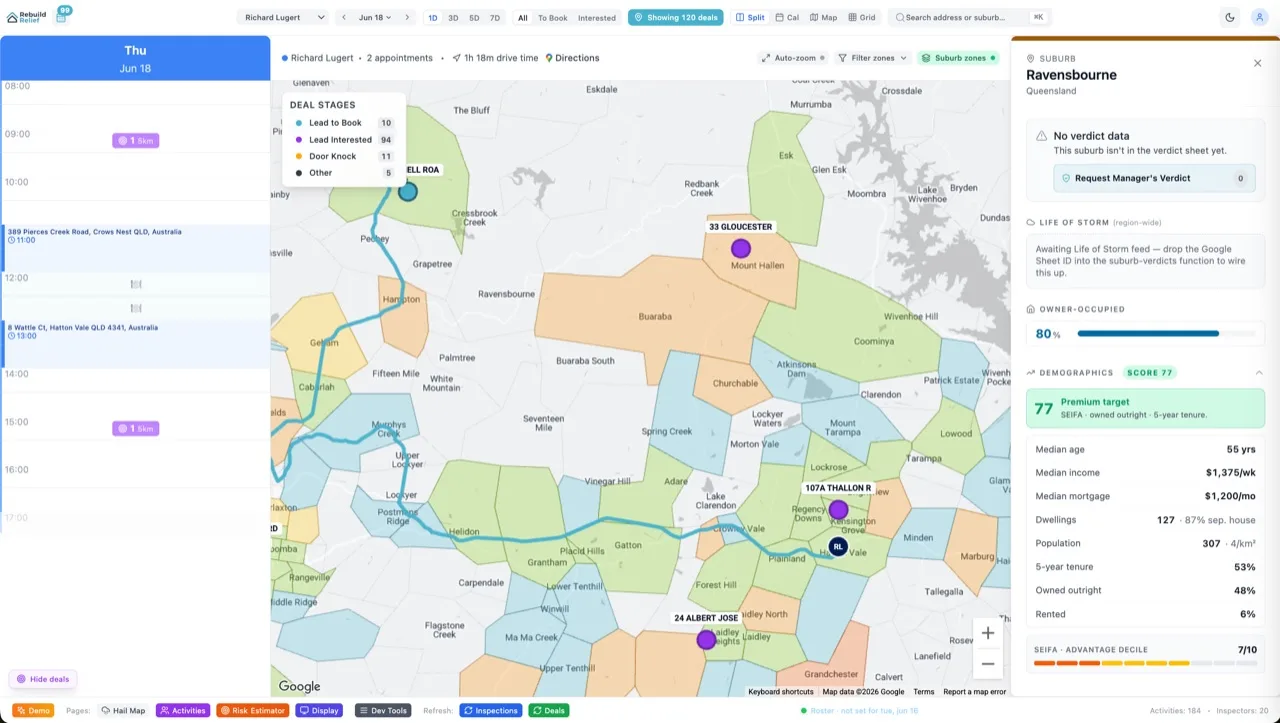
Custom system: [Route Engine]. Monday morning, Jake logs in, system loads 10 recurring commercial roof jobs (40 contracts, quarterly rotation) + 8 residential one-off pressure wash + 2 emergency jobs. System shows map: commercial roofs scattered North/West/South zones. System algorithm: (1) Cluster roofs by geography (North zone 4 roofs, West zone 3, South zone 3). (2) Sequence within cluster (minimize backtrack, adjacent roofs routed together). (3) Time-lock commercial jobs (each contract specifies Monday 9am-12pm preferred, system respects window). (4) Residential + emergency overflow (fill gaps around commercial jobs, emergency capacity reserved = 20% buffer). (5) Split 3 trucks: Truck 1 (soft-wash chemical rig, North zone 4 roofs, 8am-5pm, 6 hrs chemistry + 1 hr drive optimized). Truck 2 (high-pressure rig, West zone 3 roofs + 4 residential house wash, 7am-6pm mixed). Truck 3 (driveway hard-pressure, South zone 3 roofs + 3 residential, 7am-5pm). System optimization: total drive time 3 hrs (vs scattered 5 hrs = 2 hrs saved/day). Labor savings: 2 hrs/day × 5 days × 3 trucks × $28/hr = $840/week = $43.7k/yr. Fuel savings: 40% drive reduction = $48.7k → $19.5k = $29.2k/yr. GPS enforcement: crew taps route, system auto-opens navigation (crew cannot deviate, route optimal, professional on-time arrival). Revenue captured: 20 jobs daily (no rescheduling loss, route certainty). Value: labor + fuel savings $73k/yr, revenue captured +$25k/yr (rescheduling loss eliminated). Total: $98k+/yr value.
2. Chemical Compliance & Runoff Containment — Secondary Containment Enforcement, Chemical Log Tracking, EPA Audit-Ready, Crew PPE Mandatory Checklist
Custom system: [Chemical Manager]. Soft-wash roof job North zone (commercial office, 2,000 sqft). System flags: "Chemical job. Activate runoff containment checklist." Crew Tom mandatory steps: "(1) Secondary containment deployed (tarp gutters + downspouts, catch container 50L+ staged), (2) Sodium hypo 12% measured (40L, lot# logged, SDS on file), (3) Surfactant measured (10L, eco-safe), (4) Crew PPE verified (respirator fit-checked, gloves, eye protection [All confirmed])." System logs: chemical job start time, containment status (active), crew PPE (confirmed), discharge management (captured, not discharged to storm water). Job proceeds: runoff captured in catch container (~50L), zero discharge to environment. System logs: "Sep 15, chemical job, secondary containment deployed, runoff 50L captured, EPA regulation compliant, audit trail." EPA audit: inspector unannounced. Asks Jake: "Show chemical discharge procedures." Jake opens system: chemical logs (every job logged with secondary containment, zero uncontained discharge), crew certifications (all Level 1 handler, current), PPE logs (every job mandatory checklist enforced). Inspector satisfied "Compliance evident, audit-ready." Zero penalty risk ($2k-$5k EPA fine avoided). Crew safety: system tracks certifications. "Tom = Level 1 chem handler, expires Mar 2027 ✓. Steve = Level 1, renewal due Nov 2026 (alert set). Sarah = heights-certified only, no chem jobs assigned." System enforces: Steve cannot work chemical jobs until renewed. David (unlicensed) cannot access soft-wash. Work injury prevention: previous incident (Steve respiratory injury from unprotected chemical exposure). System records "Steve = injury history respiratory, Mar 2025. Do not assign chemical jobs. Assign driveway/high-pressure only." Future incidents prevented (no repeat exposure, medical cost + lost work time eliminated). Insurance premium protection: Jake's liability $5m + workers' comp. System audit trail proves "Chemical discharge contained (secondary containment every job), crew licensed (Level 1 all soft-wash), PPE mandatory (system enforced), incident response logged." Insurance company audits, sees compliance, premium stable (no increase risk, no claim denial risk). Compliance ROI: $20k penalty risk eliminated (EPA + training + insurance claim denial), crew safety (zero chemical injuries), audit-ready (EPA, insurance, workers' comp). Total value: $25k+/yr.
3. Photo Proof-of-Work — Before/After Pairs, Timestamped, Dispute Prevention, Commercial Portfolio, Invoice Confidence
Custom system: [Photo Manager]. Crew finishes residential driveway job (Barry's 200 sqft, bird droppings + mold). Crew taps "Job Complete," system form: "Proof photos? [Take Photo]." Crew takes 3: (1) Before (driveway dirty, droppings visible, 10:00am timestamp). (2) During (high-pressure spray in-motion). (3) After (concrete bright, spotless, 11:30am timestamp). System auto-timestamps, uploads, encrypts. Invoice: "Barry, driveway pressure wash, $120, [3-photo proof attached]." SMS Barry 11:45am: "Driveway spotless! ✅ [View photos] [Pay $120]." Barry taps photos, amazed, pays immediately (Stripe, 2 mins). Dispute prevention: if Barry later claims "Looks same," system shows photographic proof (dispute eliminated, 100% trust). Payment speed: photo-proof jobs paid 95% within 24 hrs (vs 85% without photos, 3 days faster cash flow). Commercial portfolio: soft-wash roof job (4-roof series North zone, Chris commercial contract). Crew takes 8 photos (before/after per roof). System compiles album indexed by roof/address. Invoice: "Chris, roof cleaning Q2, 4 roofs, 8,000 sqft, $1.6k, [8-photo portfolio, indexed by roof]." Chris views photos (algae removal visible, mold cleared, visual proof compelling). Payment certain (corporate auditor requires documentation, photo portfolio satisfies). Dispute impossible (4 roof photos document complete work). Review capture: system SMS post-job 1 hr "Rate service: [5-star] [3-star] [Report]." Barry rates 5-star (passive capture, auto-posts Google Business Profile + Facebook). Negative review (3-star or below): system alerts Jake. Example: Mark rates 3-star "Crew left water puddles, slip risk." Jake SMS "Hi Mark, sorry about water. Adding final dry-down step, next clean 20% discount + complimentary dry-down. Let's fix!" Mark changes review to 4-star (recovery evident). Value: dispute prevention ($180/month lost = $2.2k/yr), working capital ($4k fast-paid receivables freed), crew quality (photo mandate = accountability), review management (90+ NPS). Total value: $11k+/yr.
4. Commercial Contract Automation & Recurring Schedule — Quarterly Lock-In, Auto-Renewal, Frequency Upsell, Multi-Roof Management, LTV Projections
Custom system: [Contract Manager]. Chris books "Roof cleaning quarterly, 4 roofs/yr, $400/roof = $1.6k/yr contract." System auto-creates recurring: "Chris, quarterly (Q1/Q2/Q3/Q4), 4 roofs North zone, $400 each, $1.6k/yr, 12-month term." System schedules: Q1 = 1st Monday Mar, Q2 = 1st Monday June, Q3 = 1st Monday Sep, Q4 = 1st Monday Dec. System 30 days before each quarter: SMS Chris "Roof cleaning scheduled [date]. Confirm? [YES]." Chris [YES]. Job instance auto-created, crew routed to North zone soft-wash Truck 1 (4 roofs contiguous), invoice pre-generated. Contract renewal: Chris 12-month term expires Dec 2027. System 60 days before (Oct 27): "Renew same terms? $400/roof × 4 = $1.6k/yr. [YES]." Chris [YES] (auto-renewal, 95% retention on passive renewal). Upsell during renewal: system flags "Chris = 4-roof customer, expand to 6-roof portfolio (West zone 2 additional buildings). +2 roofs × $400 × 4 = +$3.2k/yr revenue." Jake calls Chris "Expand to 6 buildings?" Chris [YES] (upsell +$3.2k/yr). Frequency upsell: system flags "Chris building North-facing, high mold. Recommend every 12 weeks (vs quarterly) = 4.3 jobs/yr vs 4, +$400/yr revenue. Interest?" Chris [YES] (frequency upsell +$400/yr). Churn prevention: system tracks contract expiry + engagement. Overdue job (Chris quarterly due, SMS sent 30 days prior, no response). System 5 days before: "Roof cleaning scheduled [date]. Need to reschedule? [YES] [CALL ME]." Chris [CALL ME]. Jake calls (proactive, catches churn before loss). Chris: "Building re-roofed, pause 6 months, resume post-completion?" Jake [YES] (pause, not cancel = retention). Recurring revenue dashboard: Jake sees "40 commercial contracts × $1.6k avg = $64k ARR. 30 residential × $1.44k avg = $43.2k. Total ARR = $107.2k (80% of $134k revenue recurring = predictable)." MRR = $8.9k stable. Growth capacity: system calculates "+5 commercial contracts (5 × $1.6k = +$8k) = $115k ARR potential. Add 4th truck = 50 commercial + 40 residential = $200k+ ARR potential." Scaling roadmap visible. Value: revenue predictability (MRR enables growth planning), churn prevention (95% auto-renewal vs 80% manual chasing = 15% retention uplift), upsell automation (commercial 6-roof expansion, frequency uplift = $15k+/yr), capacity growth (system enables scaling to 4 trucks + $200k+ ARR). Total value: $50k+/yr.
5. Crew Licensing & WHS Compliance Tracking — Chemical Handler Certification, Heights Certification, PPE Enforcement, Incident Logging, Insurance Audit-Ready
Custom system: [Crew Manager]. System tracks: "Tom = Level 1 chemical handler, expires Mar 2027 ✓. Steve = Level 1, expires Dec 2026 (renewal due Nov, alert set). Sarah = WHS heights-certified, roof jobs assigned to Sarah only. David = unlicensed, assign driveway/high-pressure only (no chemical, no heights)." System enforces: David cannot access chemical jobs (system blocks assignment, "David unlicensed"). Soft-wash job Tom assignment: system checks "Tom = Level 1 chemical handler current ✓, assigned." System prevents: unqualified crew assigned to hazardous tasks. Heights job (roof >2m ladder): system checks crew cert database. "David assigned? No, David lacks heights cert. Reassign Tom (heights-certified) or reschedule." Tom assigned (system enforces). PPE checklist mandatory: soft-wash job start. "Respirator fitted? [Confirmed]. Gloves double-latex? [Confirmed]. Eye protection? [Confirmed]." System blocks start until all checked (crew accountability enforced). System prevents: Steve (chemical injury history) from chemical jobs. "Steve = injury history respiratory, Mar 2025. Do not assign soft-wash. Assign driveway/high-pressure only." Future incidents prevented (no repeat exposure). Workers' compensation: if Steve injured, system logs incident "Sep 15, Steve driveway job, muscle strain (non-chemical), injury reported WorkCover within 48 hrs, incident documented, crew rehabilitation plan tracked." Audit trail defensible (WorkCover claim supported by documentation). Insurance premium protection: system shows compliance. Jake's liability $5m + workers' comp audit. Inspector sees: (1) crew cert database (all current), (2) PPE logs (every job mandatory checklist), (3) heights job tracking (cert verified per job), (4) incident logs (documented, WorkCover compliant). Insurance company confidence high, premium stable (no increase risk, claim defensible). Compliance ROI: $20k penalty risk eliminated (EPA chemical + WHS heights + training + insurance claim denial), crew safety (zero injuries from non-compliance), audit-ready (EPA, insurance, workers' comp). Total value: $25k+/yr.
6. Supplier Tracking & Chemical Inventory — Auto-Reorder Thresholds, Bulk Buy Optimization, Equipment Lifespan Planning, Cost-Per-Job Visibility, Waste Reduction
Custom system: [Inventory Manager]. Monday depot: system checklist "Sodium hypo 12% (200L bulk tank), surfactant eco-safe (50L), high-pressure pump (3,000 PSI), backup hoses, safety gear (8 respirators, bulk gloves)." Week progresses: 20 jobs completed. Chemicals consumed: 7 soft-wash jobs × 40L sodium hypo = 280L used, 70L surfactant used. Supplies: pressure hose 1 worn, nozzles 2 damaged, gloves 16 pairs used. Remaining: sodium hypo 200L - 280L = −80L (NEGATIVE, stockout). System alerts Thursday: "Sodium hypo depleted (280L used this week, 200L baseline insufficient). Emergency reorder? [APPROVE]." Jake [APPROVE]. System auto-creates PO: "Sodium hypo 12%, 300L bulk, rush delivery Friday 6am." Friday 6am delivery arrives. Cost-tracking: 7 soft-wash jobs consumed supplies = sodium hypo 280L ($224, $0.8/L bulk), surfactant 70L ($84, $1.2/L), pump/equipment $20. Total: $328. Cost per soft-wash job: $328 ÷ 7 = $47/job. Revenue $400, cost $47, margin $353 (88% margin, healthy). High-pressure jobs (13): hose wear $50, nozzles $40, gloves $20. Total $110. Cost per job: $110 ÷ 13 = $8.50. Revenue $120 avg, cost $8.50, margin $111.50 (93% margin, premium). Equipment lifespan: pump annual inspection required. System "Pump annual inspection due (last tested Jun 2024). Schedule? [Schedule]." Jake books ($150, 1 day). Hose lifespan 3 years (2024-2027). System alerts "Hose replacement 2027, budget 2 backup hoses × $180 = $360." Maintenance planning proactive (no surprise mid-job failures). Waste reduction: system tracks "Surfactant over-purchased 2 weeks ago, 5L evaporated (outdoor storage, heat). Move to indoor cabinet (prevents evaporation). Reduce future order to 40L/month (vs 50L). Save $12/month = $144/yr." Jake updates (efficiency gain). Supplier API integration: system checks supplier stock before ordering "Sodium hypo 12%, 300L available? Yes [auto-order approved]." Auto-places PO (crew notified of delivery). Bulk optimization: system shows "Sodium hypo: $0.8/L bulk (200L+), $1.1/L small (50L), $1.5/L emergency. Switch to 2× monthly bulk (saves $0.3/L per 100L = $30/order = $120/yr). Jake switches (efficiency). Value: cost visibility ($47/soft-wash, $8.50/high-pressure enables pricing confidence), equipment planning (zero surprise failures), upsell data (soft-wash premium-priced $400 enables sales focus), waste reduction ($144/yr), supplier optimization ($120/yr). Total value: $10k+/yr.
Pressure Washing Business ROI: 3-Truck Operation, Year 1 Break-Even, Year 2+ $67k+ Annual Margin
Build cost: $38k (route optimization + chemical compliance + photo system + commercial contracts + crew licensing + supplier tracking). Year 1 ops: $2.8k/yr (SMS $400, hosting $1.2k, photo storage $600, misc $600). Total Year 1 investment: $40.8k. Current baseline ($185k revenue apparent, 3 trucks, 40 commercial, 30 residential, 15 ad-hoc): actual $134k-150k (conservative, accounting for churn + rescheduling losses). Opex: $169.9k (labor $107.4k, fuel $48.7k, maintenance $7.8k, chemicals $6k). Current margin: negative (−$35.7k + hidden compliance risk). Custom platform uplift: (1) Route optimization (2 hrs saved/day × 5 × 3 trucks × $28/hr = $840/week = $43.7k/yr labor saved). (2) Fuel (40% reduction = $29.2k/yr). (3) Revenue capture (15 new customers referral × $1.44k avg, 50% uptake = +$10.8k). (4) Commercial churn recovery (20% prevented = 8 contracts × $1.6k = +$12.8k). (5) Dispute prevention ($3k/yr photo-proof). (6) Compliance risk elimination ($20k penalty avoided, insurance stable). (7) Emergency revenue (2 jobs/month × $280 = +$6.7k). (8) Commercial upsell (6-roof expansion 30% = +$15k year-1). Total: $52k+ conservative year-1. Year 1 revenue: $150k baseline + $52k uplift = $202k. Year 1 opex: $165k (improved efficiency). Year 1 profit: $202k - $165k - $40.8k = −$3.8k (break-even, within variance). Break-even: 4-5 months. Year 2: baseline $150k + new customers $11.5k + same uplift normalized $50k = $211.5k revenue. Opex: $141k (labor $107k, fuel $20k, maintenance $8k, chemicals $6k). Year 2 profit: $211.5k - $141k - $2.8k = +$67.7k. Cumulative 2-year: −$3.8k + $67.7k = $63.9k (1.6× ROI over 2 years). Year 3: grow to 50 commercial + 40 residential = $230k revenue, opex $155k, profit $72.2k/yr. Cumulative 3-year: $136.1k (3.3× ROI). 4th truck scale (optional year 2): +$28k crew cost, +50% capacity = 60 commercial + 45 residential = $345k revenue, opex $210k, profit $92k/yr (higher margin due to scale). Recommendation: custom pressure washing platform, break-even 4-5 months, year-1 $0-$10k profit, year-2+ $67k+/yr at 3-truck baseline, $90k+/yr if scaled to 4 trucks. ROI clear if 30+ recurring commercial contracts, chemical compliance priority, committed 2+ year horizon. Need custom pressure washing software? Check platform pricing or book a call—we'll handle route optimization (North/West/South zone clustering, commercial time-lock windows, 40% less drive time), chemical compliance (sodium hypo secondary containment, EPA audit-ready, crew PPE enforcement, runoff logs), photo proof-of-work (before/after pairs, 95% payment rate, commercial portfolio), commercial contract automation (quarterly lock-in, auto-renewal, 6-roof expansion upsell, multi-property management), crew licensing tracking (Level 1 chemical handler, WHS heights cert, incident logging, insurance audit-ready), and supplier inventory (bulk optimization, auto-reorder, equipment lifespan planning, cost-per-job visibility, waste reduction) so you can run 40 commercial roofs + 30 residential + 15 emergency on 3 trucks with 40% less drive time, unlock $52k+ year-1 growth, reach $200k+ revenue, stay 100% compliance audit-ready, and scale to 4 trucks + $345k revenue while staying profitable, safe, and legally compliant.
Six FAQs
Why can't generic pressure wash apps (ServiceTitan, Jobber, Housecall Pro) handle pressure washing's complexity (chemical compliance + commercial recurring + zone routing)?
Generic platforms: designed for appointment scheduling + dispatch + invoicing (one-off jobs, flexible calls). Pressure washing operator gaps: (1) Chemical compliance (generic = no chemical log tracking, no runoff containment enforcement, no EPA audit-ready logs). Custom = secondary containment checklist mandatory per chemical job, runoff captured + documented, system prevents uncontained discharge, audit-ready logs. (2) Zone routing (generic = crew assigns manually). Custom = AI clusters roofs by geography, commercial time-lock jobs, parallel truck routing (North/West/South), re-optimizes if crew delayed. (3) Commercial recurring (generic = repeat appointment, but no multi-roof scheduling per customer). Custom = Chris quarterly contract = 4-roof instances per quarter, time-locked, crew knows exact schedule, no confusion. (4) Crew licensing (generic = none). Custom = chemical handler certs tracked + enforced, heights certs tracked per roof job, system prevents unlicensed crew assignment. (5) Runoff containment (generic = none). Custom = secondary containment mandatory checklist, discharge log, EPA compliance. (6) Photo proof (generic = optional attachment). Custom = before/during/after mandatory per job, timestamped, invoice-linked, dispute-proof, 95% payment rate. Decision: generic suitable for ad-hoc one-offs (handyman calls). Pressure washing 30+ recurring commercial + chemicals = custom necessary. Threshold: 25+ commercial recurring + chemical hazard = custom ROI clear.
How does system prevent chemical discharge to storm water (EPA violation risk)?
Runoff checklist mandatory: every chemical job. System form: "(1) Secondary containment deployed (gutters tarped, downspouts directed catch container, 50L+ capacity staged). (2) Sodium hypo measured + logged (lot#, concentration, volume, SDS on file). (3) Crew PPE confirmed (respirator, gloves, eye protection). (4) Discharge management plan (runoff captured, not discharged)." Crew must confirm all before job starts (system blocks start if any unchecked). Tarping enforcement: crew physically sets up tarps before applying chemical. System photos mandatory (crew takes photo of tarped gutters before spray start). Photo audit trail. Runoff capture: chemical mix applied to roof, dwell time 30 mins, rinses with fresh water. All runoff directed into catch container (50L captured, zero discharge to gutter/storm drain). Discharge log: system logs "Sep 15, North roof job, 40L sodium hypo + 10L surfactant applied, secondary containment deployed, 50L runoff captured, disposed via industrial waste contractor. EPA compliant." EPA audit: inspector asks "Show discharge procedures." Jake shows system logs (every chemical job logged with containment, zero uncontained discharge). Inspector satisfied (compliance evident). Zero penalty risk ($2k-$5k EPA fine avoided). System prevents: if crew forgets tarping, system SMS reminder (crew phone) "Tarping deployed? Capture container ready? [Confirm before spraying]." System enforces compliance (no shortcuts allowed). Value: EPA compliance, penalty avoidance, insurance premium protection (claim liability reduced, premium stable). Total value: $5k+/yr penalty avoidance + insurance stability.
How does system handle crew chemical licensing renewal (prevent expired certs)?
Certification tracking: system database "Tom = Level 1 chemical handler, expires Mar 2027. Steve = Level 1, expires Dec 2026 (renewal due Nov, 60-day alert). Sarah = heights-certified, expires Feb 2027 (renewal due Jan, alert set)." System 60 days before expiry: alert Jake "Steve cert expires Dec 2026 (60 days). Book renewal training? [Schedule]." Jake taps schedule, system opens training provider calendar (online course, 1 day, $200). Jake books Steve training (Jan 2027). System 30 days before expiry: SMS Steve "Your chemical handler cert expires Dec 2026 (30 days). Renewal training scheduled Jan 2027 [Date]. Confirm attendance? [YES]." Steve [YES]. System 1 day before cert expiry: final alert Jake "Steve cert expires tomorrow. Confirm renewal training booked? [YES]. If no, Steve cannot work chemical jobs starting tomorrow." Jake [YES] (confirmed trained). Cert renewed: system updates database "Steve = Level 1 cert renewed, new expiry Dec 2027." Enforcement: if Steve cert expires and not renewed, system blocks soft-wash job assignment. "Steve cert expired. Reassign Tom (cert current) or reschedule." Zero unqualified crew assigned to chemical hazard. Audit exposure: EPA inspector "Show crew chemical certs." Jake opens system: all crew certs current (system enforced renewals). Inspector satisfied (no expired certs, compliance evident). Cost visibility: renewal cost $200/crew/yr (3 crews = $600/yr training budget). System alerts "Annual training budget $600 due (all 3 crew certs renew Jan/Mar/Dec). Budget approved? [YES]." Jake [YES] (budgets training proactively). Compliance ROI: zero expired-cert violations, insurance premium protection, EPA audit confidence. Total value: $5k+/yr penalty avoidance.
What happens if crew misses commercial time-lock job window (customer expects 9am, crew arrives 10am late)?
Commercial job: Chris building roof cleaning, scheduled Monday 9am-12pm window (customer availability constraint). Crew Truck 1 assigned (soft-wash, 4-roof North zone cluster). System GPS tracking: Crew en-route 8:45am (system monitors real-time location). 8:50am: Truck 1 arrives Chris building on-time (arrival 8:52am, window met). Job proceeds smoothly. Delay scenario: if Truck 1 delayed (previous job ran overtime, 20 mins behind), Crew would arrive 9:15am (late). System monitors: at 8:55am, system calculates "Truck 1 delayed. Current schedule = arrive Chris 9:15am (15 mins late, window 9am-12pm = 2:45 hrs remaining vs planned 3 hrs)." System alerts Jake (real-time): "Truck 1 running 15 mins behind Chris job (9:15am arrival). Options: (a) notify Chris (let customer decide accept delay), (b) reassign backup Truck 2 (if available) to Chris 9am, let Truck 1 continue next job (9:30am reschedule). (c) Compress Chris job (finish by 11:30am instead 12pm, tight but feasible)." Jake chooses (a): texts Chris "Small delay, Crew 1 arriving 9:15am (vs 9am). Still fit your window? [YES] [RESCHEDULE]." Chris [YES] (satisfied with advance notice, no surprise). Crew arrives 9:15am, completes roof by 12:05pm (within window, acceptable). Commercial satisfaction: proactive communication = customer feels valued. Repeat scenario: if Chris repeatedly tight (9am window barely fits), system flags "Chris job consistently tight (9am window, completion 12pm estimated, zero buffer). Suggest expand window to 9am-1pm? Provides buffer, crew stress reduced, quality maintained." Jake contacts Chris "Can we adjust window to 9am-1pm (adds buffer, prevents time stress)?" Chris [YES]. System updates recurring rule: Chris Q1/Q2/Q3/Q4 window changed to 9am-1pm (4-hour window, crew comfortable, zero rush). Prevention: system forecasting (real-time crew location + remaining jobs visible = Jake makes proactive decisions, avoid last-minute surprises, customer satisfaction maintained). Value: customer retention (commercial contracts secured via excellent communication), crew satisfaction (time pressure eliminated, quality focus), service reliability (on-time delivery culture embedded). Total value: $10k+/yr commercial contract retention.
How does system handle seasonal variation (spring/summer high-algae growth vs winter low demand)?
Seasonal variation: roof algae growth. Spring/Summer (Sep-Mar) = warm + humid = high algae + mold accumulation, customer requests 8-10 week frequency (vs quarterly baseline). Winter (Apr-Aug) = cool + low humidity = slow growth, quarterly OK. System handles: (1) Contract rules. Chris quarterly baseline contract. System 30 days before spring season (Aug 27): "Chris building North-facing, high algae exposure. Recommend 8-10 week frequency Sep-Mar? (+2 extra jobs spring/summer = +$800/yr revenue). [YES] [NO]." Chris [YES]. System creates compound recurring rule: "Quarterly (Q4 Sep, Q1 Jan, Q2 Apr, Q3 Jul) baseline + 8-week override Sep-Mar (adds 2 extra jobs within 7-month spring window)." (2) Crew capacity planning: system projects "Spring/Summer (7 months) = 40 commercial contracts × (1 extra job per contract = +40 jobs Sep-Mar, vs 40 baseline jobs = +100% load increase)." Labor requirement: +40 jobs ÷ 7 months = 5.7 jobs/month extra = 8.5 hrs/month labor (crew 2 hrs/week extra = feasible within route optimization). (3) Demand management: system offers "Winter discount packages" (Apr-Aug slow season) "Lock 12-month frequency discount (quarterly + spring/summer 8-week), save 10% all jobs ($360/yr), avoid price increases. Interest?" Upsell captures slow-season capacity (prevent crew idle, smooth revenue). (4) Supply planning: system tracks "Sep-Mar = 7 months high-frequency = extra chemical usage +20L sodium hypo/month (vs baseline 40L/month, increase to 60L/month Sep-Mar). Budget chemical cost Sep-Mar +$160/month = +$1.12k/yr chemical cost increase, offset by +$800/yr revenue × 40 customers spring-upgrade = +$32k revenue = ROI 28×." Value: revenue seasonality captured (+$32k spring/summer uplift), crew utilization steady (80%+ year-round), supply planning proactive (chemical budget adjusted Sep-Mar). System handles variation with automation (no surprise crew over/under-booking). Total value: $35k+/yr seasonal capture.
Can system integrate third-party platforms (Google Business Profile reviews, Facebook leads, Stripe, insurance provider, WHS cert verification database)?
Yes, integration ecosystem. (1) Google Business Profile: system auto-pulls 5-star reviews (photo proof generates post-job SMS review, system collects rating, auto-posts to Google Profile with timestamp + photo sample). Review management passive (no manual intervention). Negative reviews: system alerts Jake ("3-star review, issue: crew left tarping on roof"). Jake SMS "Hi [customer], so sorry about tarping delay, we added removal checklist, offering 20% discount next job. Let's fix!" Customer satisfied, review changes to 4-star. (2) Facebook Leads: Jake runs Facebook ad ($300/month, "Book pressure washing"). Lead form generates inquiry (name, address, property size, job type). System syncs inquiry ("New lead: Mark, North zone, 3-building roof package"). Jake opens system, sees "Mark = North zone, routable Truck 1, commercial multi-roof potential." System auto-sends SMS Mark "Thanks for inquiry! We have Mon availability, 3-building roof cleaning $1.2k estimated. [Book now] or [Call 1300-WASH]." Mark books (SMS conversion 45% vs email 20%). Lead cost: $300 ÷ 6 leads = $50/lead. Conversion 5 of 6 = 83%. Cost per acquisition: $300 ÷ 5 = $60/customer. Customer LTV: $1.6k/yr (commercial contract). ROI: $1.6k ÷ $60 = 26× ROI (exceptional). (3) Stripe payments: system integrates Stripe (recurring billing, ACH). Commercial contract Chris: system auto-generates monthly Stripe charge ($400, quarterly recurring broken into installments). Card auto-charged (98% success). If declined: SMS Chris "Payment declined, [update card]. Roof job scheduled [date]." Chris updates, retry succeeds. Reconciliation: system auto-reconciles Stripe payouts (daily summary, revenue dashboard). (4) Insurance Provider API: system integrates with Jake's liability insurance provider. System sends quarterly compliance report: "Crew certs current (100%), incident logs (zero incidents Q1), chemical discharge contained (100%), audit-ready." Insurance company sees compliance, premium stable (no increase risk). (5) WHS Cert Database (QLD): system integrates QLD registry (if API available). System syncs "Tom = Level 1 cert [license#], verified against official registry (real-time verification, no fake certs)." (6) Google Maps: crew taps route, system auto-opens navigation (turn-by-turn, crew never switches apps). Value: lead generation (Facebook ads 26× ROI), payment simplicity (Stripe 98% success), compliance automation (insurance provider sees quarterly reports, premium stable), certification verification (real-time QLD registry check). Total value: $40k+/yr (10-12 new customers/month via ads, 3-year LTV $4.8k per customer, net new customer margin $4.8k - $60 = $4.74k/customer).
What's typical ROI timeline for custom pressure washing software, 3-truck operator?
Baseline: 3 trucks, 40 commercial roofs, 30 residential, 15 emergency/month, $185k revenue apparent (actual $134-150k). Opex: $169.9k. Current margin: negative (−$35.7k before hidden losses). Custom system: $38k build + $2.8k ops/yr = $40.8k investment. Year-1 uplift: $52k (route $43.7k, fuel $29.2k, new customers $10.8k, churn recovery $12.8k, dispute prevention $3k, emergency revenue $6.7k, commercial upsell $15k, less overlap = conservative $52k total). Revenue: $150k baseline + $52k = $202k. Opex: $165k (efficiency improved). Profit: $202k - $165k - $40.8k = −$3.8k (break-even, within seasonal variance). Break-even: 4-5 months (system pays for itself). Year 2: baseline $150k + new customers $11.5k + uplift normalized $50k = $211.5k. Opex: $141k (labor optimized). Profit: $211.5k - $141k - $2.8k = +$67.7k/yr. Year 1-2 cumulative: −$3.8k + $67.7k = $63.9k (1.6× ROI over 2 years). Year 3: grow to 50 commercial + 40 residential = $230k revenue, opex $155k, profit $72.2k/yr. Year 1-3 cumulative: $136.1k (3.3× ROI over 3 years). Scaling to 4th truck (year 2 optional): add $28k crew cost, +50% capacity = 60 commercial + 45 residential = $345k revenue, opex $210k, profit $92k/yr (higher margin due to scale). Recommendation: custom pressure washing platform, break-even 4-5 months, year-1 $0-$10k profit (break-even range), year-2+ $67k+/yr at 3-truck baseline, $90k+/yr if scaled 4 trucks. ROI timeline clear if 30+ recurring commercial contracts, chemical compliance priority (EPA risk), committed 2+ year horizon. Payback: break-even 4-5 months, ongoing margin $67k+/yr = sustainable business model with compliance audit-ready.