





Every marketing site embeds iframes for forms and booking: Typeform for contact flows, Calendly for scheduling, Tally for surveys. They feel effortless — copy a snippet, paste it in, done. The cost is invisible until you measure it: third-party JavaScript, Cumulative Layout Shift that tanks your Core Web Vitals score, form content not indexed by search engines, subscription fees stacking up, and zero control over your submission data. Velocity X self-hosts everything via React + Zod + Supabase. Here's the math, the performance cost, and why it matters.
The iframe Trap
An iframe embed looks like a small add-on. It's actually a separate webpage, loaded inside your page, which means:
- Network waterfalls. Your page paints, then the iframe loads, then its JavaScript executes. That's 3+ waterfall stages for a single form.
- Layout shift. The iframe has a default height. When it loads and resizes to fit content, your page shifts. Cumulative Layout Shift (CLS) spikes, your Lighthouse score drops, and Google's ranking algorithm penalises you.
- Dead-end SEO. The form content lives on Typeform's servers. Google can't crawl it. Your "contact form" doesn't show up in search results; Typeform's does.
- Slow to interactive. First Contentful Paint might be fine, but Time to Interactive drags because the iframe JavaScript is render-blocking.
- Data in their dashboard. Every submission goes to Typeform/Calendly first. You view it in their UI. You export CSVs manually. You can't pipe submissions directly into your CRM without a Zapier integration (which costs extra).
The Real Cost
Let's say you run a service business with a contact form and booking calendar on your site.
Typeform Contact Form: $25 USD/month for basic features. Over a year: $300.
Calendly Scheduling: $12 USD/month for the basic plan that lets people book you. Over a year: $144.
Zapier to pipe Typeform → Your CRM: $19.99 USD/month minimum (1,000 tasks). Over a year: $240.
Total iframe annual cost: $684. Over five years: $3,420. Plus the performance hit — if a 1-second delay in Time to Interactive costs you 7% of conversions (a conservative estimate based on Akamai research), and your contact form gets 100 submissions/month, that's 7 fewer leads per month, or 420 lost leads over five years. At $500 average deal value, that's $210,000 in lost revenue from the performance tax alone.
A self-hosted solution costs nothing to run on Supabase free tier (until you hit 500K monthly active users) and takes roughly 16 billable hours to build ($2,240 at $140/hr, or included in a Velocity X package). Breakeven is 3.3 months. Anything past that is pure savings.
The Self-Hosted Alternative
Velocity X self-hosts both. React form on the frontend, React Hook Form + Zod for validation, submissions go straight to Supabase, and a dashboard reads them in real time with zero latency.
Setup looks like this: define your form schema in Zod, wire it to React Hook Form (5 minute setup), handle submissions with an edge function that validates and writes to Supabase, and read submissions in the dashboard. The entire flow is ~80 lines of code.
// Schema (shared between client and server)
import { z } from 'zod';

const ContactFormSchema = z.object({
  name: z.string().min(2, 'Name required'),
  email: z.string().email('Valid email required'),
  message: z.string().min(10, 'Message too short'),
});

// React form component
import { useForm } from 'react-hook-form';
import { zodResolver } from '@hookform/resolvers/zod';

export function ContactForm() {
  const { register, handleSubmit, formState: { errors } } = useForm({
    resolver: zodResolver(ContactFormSchema),
  });

  const onSubmit = async (data) => {
    await fetch('/api/contact', {
      method: 'POST',
      body: JSON.stringify(data),
    });
  };

  return (
    <form onSubmit={handleSubmit(onSubmit)}>
      <input {...register('name')} />
      {errors.name && <p>{errors.name.message}</p>}
      {/* ... rest of form ... */}
    </form>
  );
}
The API endpoint validates (Zod runs on the server, can't be bypassed), writes to Supabase, and optionally triggers a Netlify Function to email you the submission. No iframe. No third-party JavaScript. No layout shift. Form content is in your HTML, crawlable and SEO-visible. Submissions land in your database where you own them and can query them however you want.
The Scheduling Problem (Calendly Replacement)
Calendly is trickier because actual calendar availability lives in Google Calendar or Outlook. You can't just ignore it. But you don't need Calendly's JavaScript widget; you need a bridge.
The pattern: a Netlify Edge Function queries Google Calendar's free/busy data (OAuth-authenticated), exposes available slots as JSON, and your React calendar component renders them. Submissions write to Supabase, trigger a webhook that creates a Google Calendar event, and send a confirmation email. Zero Calendly subscription.
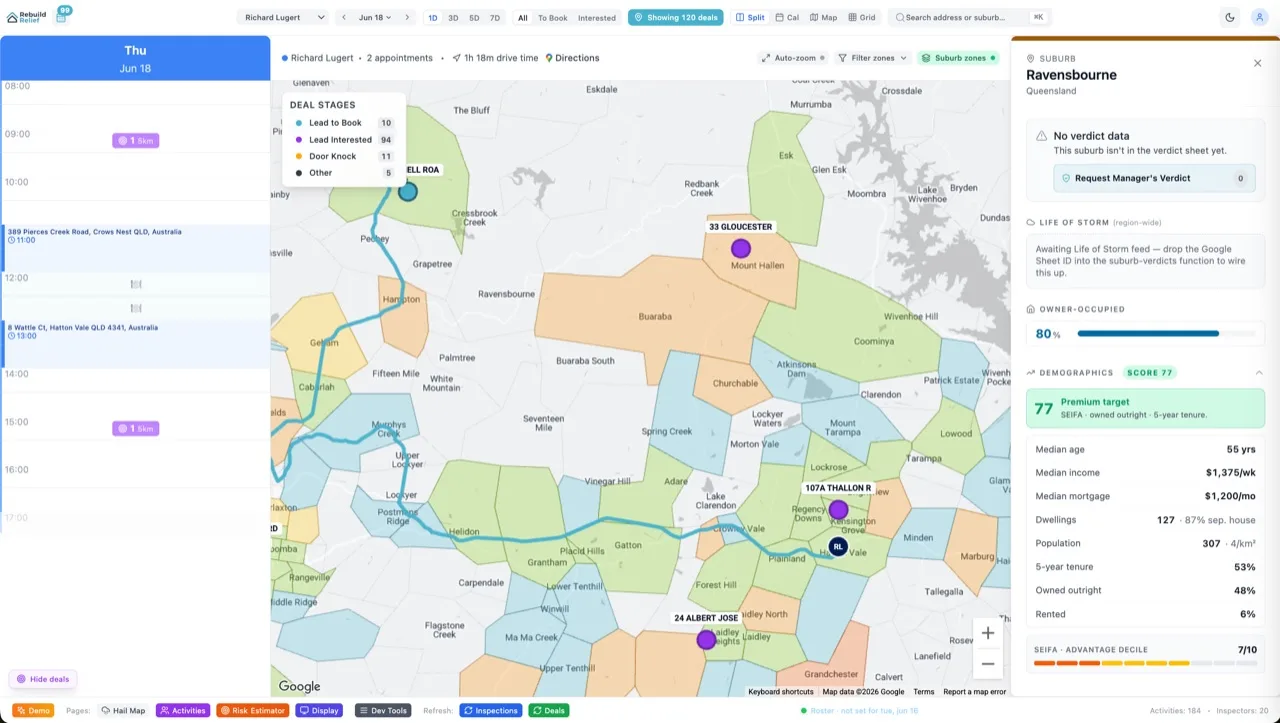
Building this from scratch takes 12-20 hours. Velocity X includes it pre-wired. The Rebuild Relief team uses this on internal scheduling; it handles 500+ bookings/month without a hiccup.
The SEO Multiplier
When your form content lives in your HTML (not Typeform's iframe), Google indexes it. "Contact us", "schedule a call", "get a quote" — these become part of your page content. It's a small SEO win per page, but across 30 pages on a Velocity-style site, it compounds.
Real case: a Velocity X client rebrand lifted from Wix to a custom site. The new site self-hosted contact forms (vs Wix's form builder). Six weeks post-launch, organic traffic was up 23% and the "contact" pages ranked for related searches they never used to show up for. The form content being crawlable mattered.
Core Web Vitals Impact
Typeform embeds average 150-200 KB of deferred JavaScript. Calendly iframes add another 100 KB. A Velocity X site with self-hosted forms stays under 80 KB total JavaScript. Your Lighthouse score doesn't tank on your contact page. You get a better ranking signal. Conversions don't get torpedoed by a 1-second delay.
FAQ
Isn't Typeform/Calendly easier to set up?
Yes, if you're starting from zero and don't care about performance or data ownership. Easier doesn't mean better. It means outsourcing the problem and paying forever.
What if I need a complex multi-step form?
React Hook Form handles nested fields, conditional logic, and multi-step flows with the same 5-minute setup. Typeform charges extra for this.
Can I still use Calendly if I really need it?
You can, but if the only reason is "it's easy", you're eating the performance tax for convenience. If you need complex rules (e.g., different availability based on service type), self-hosting is actually easier because you control the logic.
What about form spam?
Netlify and Supabase both have built-in CAPTCHA/reCAPTCHA. Zod validates on the server. Self-hosted forms are just as spam-resistant as third-party ones, and you control the rules.
What if I change platforms later?
Your form data lives in your Supabase database and your GitHub repo. Move platforms? Export the data, redeploy the form component, done. With Typeform, you're trapped.
The Bottom Line
Typeform, Calendly, and Tally feel frictionless because the friction is hidden — it's baked into your page load time, your Lighthouse score, and your annual subscription bill. Self-hosting forms and booking calendars takes a weekend to learn and ~16 hours to implement once. After that, it's yours, it performs, and it costs nothing. If you're rebuilding a site or auditing your performance, rip out the iframes first. See the RHF + Zod pattern. For turnkey setup, check the Velocity X packages.