
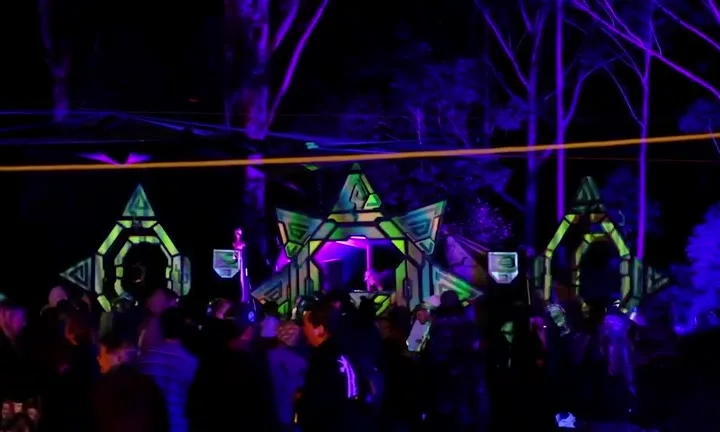


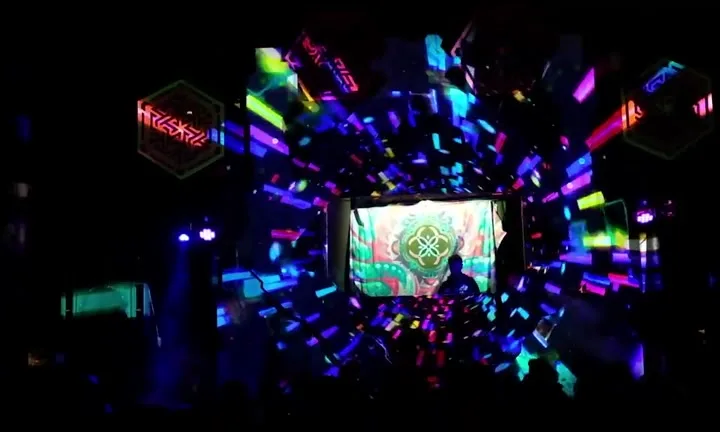



Stock hero images are dead. Every designer-led site now ships a 3D scene or shader, which means generative art is table stakes for premium portfolios. The problem: p5.js out-of-the-box is slow. A naive particle system with 10k points will crater mobile to 15fps, drain battery in 8 minutes, and tank your SEO. Here's how we ship generative heroes that actually convert — and your users don't curse your browser tab.
Why p5.js Over Raw Canvas
p5.js is Processing for the web. You write function draw(), call rect() and circle(), and it handles the render loop. Zero WebGL boilerplate. That simplicity is poison on production sites — until you switch to WebGL2 mode.
function setup() {
  createCanvas(windowWidth, windowHeight, WEBGL);
  // WEBGL mode: 100× faster particle math than default 2D
}
WebGL mode is the move. Your draw code stays the same — you still call push(), translate(), sphere() — but it's now hitting the GPU. A particle system that crawls at 60k points in 2D mode runs 500k points at 45fps in WebGL.
Production Architecture
Skip individual point updates. Use instanced rendering: one geometry, thousands of positions. Pre-allocate a Float32Array for particle positions, update it in a typed loop, bind it once:
const positions = new Float32Array(particleCount * 3);
let idx = 0;
for (let i = 0; i < particleCount; i++) {
  positions[idx++] = random(-w, w);  // x
  positions[idx++] = random(-h, h);  // y
  positions[idx++] = random(-200, 200); // z
}
// Bind positions to vertex buffer, update once per frame
Mobile throttle: halve the point count on phones, skip post-processing, lock canvas to 30fps via RAF throttle. Test on actual iPhone hardware — simulator FPS is fiction.
Accessibility & Battery
Check prefers-reduced-motion at startup. If set, render a static single frame and kill the animation loop. No performance penalty, users still see the art.
const prefersReduced = window.matchMedia('(prefers-reduced-motion: reduce)').matches;
if (prefersReduced) {
  draw(); // render once
  noLoop(); // kill animation
}
Pause on blur too — when the tab loses focus, stop the RAF call. Resume on focus. Saves ~70% battery on background tabs.
The Catch
Generative art is a hero feature, not a content container. Don't dump text onto it — lay text below, side-by-side, or in a masked region. And beware: p5.js + Webpack dev builds are slow to load. Tree-shake aggressively or use a CDN build.
The Verdict
Generative art used to require Three.js or raw WebGL expertise. p5.js + WebGL mode flattens the curve — you can ship a studio-quality particle hero in a weekend. Switch to WebGL, instance your geometry, throttle on mobile, respect prefers-reduced-motion, and test on hardware. See a live example at /pricing, or read shader foundations at /blog/glsl-shader-backgrounds-marketing-sites.