



A 3–5 person Australian mobile auto detailing business (3–5 detailers + 1–2 coordinators + optional owner, working across Sydney/Melbourne/Brisbane/Perth/Adelaide metro zones, $200k–600k annual revenue, 50–100 jobs per month) handles paint correction (swirl removal, light scratch repair, DA machine + compound + polish), ceramic coating (hydrophobic protection, 2–5 year durability, applies to paint + wheels + glass), interior detail (vacuum, seat clean, dashboard care, odor elimination), maintenance packages (quarterly maintenance detail, 6-month booster post-ceramic), with $300–800 avg job value ($300 interior detail, $500 paint correction, $800–1.5k full ceramic coat, $300–500 booster detail), $200k–4M annual revenue depending on team size. They use ServiceM8 ($30–80/month per seat = $120–400/month = $1.4k–4.8k/yr for 3 crew), Tradify ($50–100/month per seat = $200–500/month = $2.4k–6k/yr for 3 crew), or basic Google Sheets + phone calls. All track jobs, scheduling, invoicing. But none understand the operational complexity unique to mobile detailing: skill-based dispatch (paint correction requires specific training + equipment, ceramic coating is a separate discipline, interior detail is different again; booking system must match job type to detailer skillset, not just "next available van"), before/after photo workflow with paint thickness readings (detailer must photograph vehicle before work, use paint gauge to measure coating thickness at 6 test points, document readings for warranty tracking, photograph after work to prove results, system must organize photos + readings per customer record), ceramic coating cure-time tracking (ceramic coating has 48-hour gentle-care window and 7-day full-hardness window; system must prevent scheduling another detail during cure, system must remind customer of milestones), recurring 6-month booster scheduling (ceramic customers need $300–500 booster details every 6 months to maintain warranty; system must auto-schedule + auto-remind, not manual phone calls), and route optimization across capital cities (3 vans booked across Sydney/Melbourne/Brisbane; jobs are geographically scattered; system must suggest optimal routes to minimize drive time + maximize billable hours per van). Skill mis-dispatch chaos (coordinator receives booking: "Paint correction, Monday 10am, customer in Parramatta"). Coordinator checks available detailers: [Detailer A: booked Monday (full day ceramic coat), Detailer B: available Monday 10am–1pm (interior detail specialist, only does interior work), Detailer C: available Monday 2pm onward (paint correction + ceramic specialist, available)]. Coordinator has 3 choices: [assign Detailer B (wrong skillset, will do interior detail techniques, won't fix paint swirls), assign Detailer C (correct skillset, but customer wants 10am and C is not available until 2pm = customer re-schedules to 2pm, 4 hour booking gap = coordinate loses that 10am slot, opportunity lost], assign Detailer A (already booked, cancel ceramic coat, re-assign to paint correction = customer A is upset, ceramic is rescheduled, cascading delays)]. Real issue: skill matching is manual (no system rule "paint correction jobs can only be assigned to Detailer C"). Coordinator mis-assigns 1–2 times per week (Detailer shows up to job, realizes job type doesn't match their specialty, calls coordinator: "This is a ceramic job, I only do interiors." Coordinator panics, re-assigns to another detailer, first detailer is now idle 1–2 hours, second detailer is now booked back-to-back, day falls apart). Cost: 2 mis-dispatches/week × $300–500 per mis-dispatch (lost billable hours, re-scheduling, customer dissatisfaction) = $600–1k/week × 50 weeks = $30k–50k/year waste. Before/after photo chaos (detailer finishes ceramic coat, takes 2–3 photos on iPhone, stores locally). 6 months later: customer calls, "Your ceramic didn't last, it's peeling." Detailer says: "I did the ceramic correctly, coating should last 5 years." Customer: "Prove it, show me before/after photos." Detailer checks iPhone (phone was upgraded 3 months ago, old photos were not transferred, lost). Detailer: "I don't have photos, but I did the job right." Customer: "I'm disputing warranty, not paying next booster." Detailer's reputation is damaged (no proof of quality work), customer lifetime value is lost ($300 booster × 10 years = $3k lifetime value). Real issue: photo documentation is ad-hoc (photos are stored locally, easily lost, no system record). Typical impact: 1 dispute per month (customer disputes quality, detailer has no photo proof, warranty claim is negotiated = $500–2k resolution cost per dispute × 12 = $6k–24k/yr liability). Paint thickness tracking failure (ceramic coating warranty from paint protection brand: "Coating thickness must be 2–4 microns on initial install to meet warranty standards"). Detailer applies ceramic, doesn't measure thickness (no paint gauge, no recording system). 2 years later: customer notices peeling in one section (sun damage + poor application). Customer calls coating brand: "Your coating failed, claiming warranty." Brand asks: "What's the coating thickness on application?" Detailer: "I don't know, didn't measure." Brand: "Can't honor warranty without baseline measurement." Customer is upset (expects 5-year protection, got 2 years). Detailer is blamed (coordination failure, brand perceives poor application). Real issue: no paint gauge integration, no thickness baseline. Typical impact: 2–3 warranty disputes/year = $1k–5k negotiation cost per dispute = $2k–15k/yr exposure. Ceramic cure-time scheduling chaos (customer books ceramic coating on Monday, system approves. Coordinator accidentally schedules maintenance detail on Tuesday). Detailer arrives Tuesday to "wash vehicle gently" per maintenance plan. Detailer is unaware ceramic is still curing (48-hour gentle-care window, 7-day full-hardness window). Detailer pressure-washes vehicle Tuesday (within cure window, coating is still soft). Ceramic is damaged (coating is disrupted, peeling begins). Customer notices: "You damaged the coating you just installed." Detailer must re-do ceramic coating (re-apply $800–1.5k = full cost re-do, no revenue, pure cost). Typical impact: 2–3 cure-time mis-schedules/month = $1.6k–4.5k/month re-do cost × 12 = $19.2k–54k/yr waste. Missing recurring revenue (ceramic customer pays $1k, next step is 6-month booster at $400). System has no automation to remind customer or schedule booster. Coordinator manually calls customers 6 months after ceramic install: "Time for your booster detail." 30% of calls go to voicemail (customer is busy, doesn't answer). 20% of customers say "Not now, call me later." Typical: 3 vans × 50 jobs/month = 600 ceramic jobs/year, 40% are ceramic (240 ceramic jobs/year). 6 months after: 240 customers due for booster. Coordinator calls 240 customers (manual effort: 240 calls × 5 min per call = 1,200 minutes = 20 hours of coordinator time). Reach rate: 70% (168 customers reached). Booking rate: 60% (101 customers book). Unreach + reject: 139 customers (58% of potential boosters lost). Lost revenue: 139 boosters × $400 avg = $55.6k lost annual recurring revenue. Real issue: no automation, high manual effort, low conversion. Typical impact: 3 vans × 50 jobs/month = 50% ceramic rate = 25 ceramic jobs/month × 12 = 300 ceramic jobs/year, 70% conversion to boosters = 210 boosters/year × $400 = $84k annual booster revenue (if automated). Manual system captures 60% × 70% = 42% conversion = 126 boosters/year × $400 = $50.4k actual. Lost revenue: $33.6k/yr. Route optimization chaos (3 vans, 50 jobs/month, jobs scattered across Sydney metro. Monday: Van 1 is booked [Parramatta 10am (30-min detail), Wollongong 12pm (1-hour detail), Penrith 3pm (2-hour ceramic coat)]). Coordinator assigns jobs sequentially: Parramatta → Wollongong (1.5 hour drive, geographic nightmare, Southern Highlands detour). Van 1 is on the road 4+ hours, billable work is 3.5 hours = 4 billable hours charged to customer, but 4.5 actual hours worked (half hour is unproductive drive). Cost: 30 min wasted drive × $60/hr detailer labor = $30 waste, per job typical 2–3 drive-time waste per day per van. Real issue: no route optimization, detailing jobs are geo-scattered, coordinator manually assigns chronologically (not geographically), resulting in excessive dead drive time. Typical impact: 3 vans × 2–3 hrs unproductive drive/day × $60/hr labor = $360–540/day waste × 220 working days = $79.2k–118.8k/yr labor waste. Custom platform solves all of this. Skill-based dispatch. Each detailer profile has certified skills: [Detailer A: interior detail (specialist), Detailer B: paint correction + ceramic (specialist), Detailer C: paint correction only (apprentice), Detailer D: full-service (paint + ceramic + interior)]. Job comes in: [job type: paint correction, zone: Parramatta, time: Monday 10am]. System filters available detailers: [Detailer B: available Monday 10am–12pm (match), Detailer D: available Monday 2pm (time mismatch)]. System suggests: [Detailer B, Monday 10am]. Coordinator confirms (no manual thinking required). Detailer B receives: [paint correction job, customer address, equipment needed (DA machine, compound, polish, gauze pads)]. Real issue solved: job type is matched to detailer skill, no mis-dispatch, no cascading reschedules. Before/after photo workflow. Detailer arrives at job. App prompts: "Before Work Photos Required" (checklist: [left side angle, right side angle, front angle, close-up of affected area, overhead view]). Detailer photographs (5 photos, auto-timestamped + geo-tagged). App confirms: [all 5 photos captured]. Detailer starts work. After work: App prompts: "After Work Photos + Paint Gauge Measurements" (checklist: [left side angle, right side angle, front angle, close-up of corrected area, overhead view]). Detailer photographs (5 photos). App prompts: "Paint Gauge Readings" (measure thickness at 6 points: [roof (center), hood (center), door L (center), door R (center), tailgate (center), wheel well]). Detailer measures with paint gauge (device connected to app or manual entry): [roof: 92 microns, hood: 95 microns, door L: 90 microns, door R: 89 microns, tailgate: 94 microns, wheel well: 91 microns]. System records all data (before photos, after photos, thickness readings). Customer receives: [invoice, before/after photo pairs, thickness baseline]. System stores for warranty (if customer disputes in 2 years: system shows "thickness readings at install: 90–95 microns, within OEM spec, photos show quality install, proof is documented"). Real issue solved: photo + thickness proof prevents disputes. Before/after photo chaos is solved (photos are centralized, not stored on phone, linked to customer record, permanent archive). Paint gauge integration tracks ceramic warranty. Ceramic coating job is booked. Detailer applies coating (2–3 hours). System prompts: "Measure Coating Thickness After Application." Detailer uses paint gauge: [thickness readings post-application: 92 microns initial, expected to cure to 96–98 microns at 7-day mark]. System records: [ceramic install date: Monday, curing timeline: 48-hour gentle-care window (until Wednesday), 7-day full-hardness window (until next Monday), thickness baseline: 92 microns (initial, post-application)]). Warranty record is created: [customer ABC, ceramic coating applied Monday by Detailer B, coating thickness: 92 microns post-application, warranty valid for 5 years if thickness remains 90–100 microns]. System calculates: [full hardness reached next Monday, routine washing allowed from Wednesday onward]). Real issue solved: thickness baseline is documented, warranty is traceable, future disputes have baseline data. Ceramic cure-time tracking. Ceramic job installed Monday. System records: [cure timeline: 48-hour gentle window until Wednesday 10am, 7-day full-hardness window until Monday 10am]. System sets reminders: [customer receives auto-email Monday: "Your ceramic is curing, do not wash for 48 hours, gentle rinse only after 48 hours, full wash after 7 days"]. Coordinator's system blocks: [prevent scheduling any detail on Tuesday or Wednesday (within 48-hour window), prevent scheduling any full-service detail until next Monday (outside 7-day window)]. Customer books "maintenance detail" on Wednesday. System blocks: [conflict: ceramic is still curing, 48-hour gentle window. Maintenance detail would violate cure timeline. Suggest rescheduling to Thursday evening or later? Or cancel maintenance and reschedule for 8 days post-ceramic?] Coordinator confirms with customer: [maintain cure timeline, reschedule maintenance to 8 days post-ceramic]. Real issue solved: cure-time violations are prevented (no more damaged coatings from mis-scheduled details). Booster scheduler automation. Ceramic job installed 2026-01-15. System auto-sets: [next booster due 2026-07-15 (6 months later)]. System sends reminders: [June 15: customer receives email "Your ceramic booster is due in 30 days, book now for $400"]. Coordinator's calendar shows: [ABC customer, booster due 2026-07-15, send reminder?]. If customer hasn't booked by June 30: [system auto-sends SMS reminder "Your ceramic booster detail is due, limited slots available, book now"]. Customer books online (system suggests next available slot). Booster is scheduled. Real issue solved: no manual calling, high automation converts 70–80% of customers to boosters (vs 42% manual conversion) = extra $35k–50k annual recurring revenue. Route optimizer. Monday: 3 vans need assignment. 12 jobs are booked across metro zones: [Parramatta (2), Penrith (1), Wollongong (1), Balmain (3), Randwick (2), Campbelltown (1), Sutherland (2)]. System analyzes: [Van 1 is currently at Parramatta]. System suggests: [Van 1: Parramatta job 1 (10am–10:30am), nearby Balmain job 1 (11am–12pm, 15-min drive from Parramatta), another Balmain job (12:30pm–1:30pm, 5-min drive), total billable time: 2.5 hours, total drive time: 30 min = high efficiency cluster]. [Van 2 is currently at Wollongong]. System suggests: [Wollongong job (10am–11am), Campbelltown job (12pm–1pm, 20-min drive), Penrith job (2pm–4pm, 30-min drive), total billable time: 3 hours, total drive time: 50 min = reasonable cluster]. [Van 3 is currently at Randwick]. System suggests: [Randwick job 1 (10am–10:30am), Randwick job 2 (11am–12pm), Sutherland job 1 (1pm–3pm, 25-min drive), Sutherland job 2 (3:30pm–4:30pm, 5-min drive), total billable time: 3 hours, total drive time: 35 min = efficient cluster]. Coordinator approves clusters. Detailers execute (minimal wasted drive time). Real issue solved: route optimization reduces unproductive drive by 50–60% = save 1–1.5 hrs/day × 3 vans × $60/hr = $180–270/day saved × 220 days = $39.6k–59.4k annual labor savings.
Six Features Custom Detailing Platform Delivers
1. Skill-Based Dispatch + Detailer Profile Specialization
Each detailer has certified skills: [interior detail, paint correction, ceramic coating, full-service]. Booking system filters available detailers by job type. Paint correction job arrives: system suggests only detailers certified in paint correction. Ceramic coating job arrives: system suggests only ceramic-certified detailers. Interior detail job arrives: system suggests interior specialists. No mis-dispatch, no skill mismatches. Cost avoidance: eliminate 2 mis-dispatches/week = $600–1k/week waste prevented = $31.2k–52k/yr saved.
2. Before/After Photo Workflow + Paint Gauge Integration
Detailer arrives: app prompts for 5 before-photos (left, right, front, close-up, overhead). Work is completed. App prompts for 5 after-photos + paint gauge measurements at 6 points (roof, hood, both doors, tailgate, wheel well). Measurements are auto-recorded. Customer receives invoice + before/after pairs + thickness baseline. System archives photos permanently (linked to customer record). Warranty disputes are prevented (photo + thickness proof = no "he said / she said"). Cost avoidance: prevent 1 dispute/month = $500–2k/month prevention = $6k–24k/yr liability avoided.
3. Ceramic Coating Cure-Time Tracker + Auto-Blocking
Ceramic coating installed Monday. System records: [48-hour gentle-care window (until Wednesday), 7-day full-hardness window (until next Monday)]. Customer receives auto-email: [do not wash for 48 hours, gentle rinse only after 48 hours, full wash after 7 days]. System blocks coordinator from scheduling any detail during cure windows. If coordinator tries to book maintenance on Tuesday: system alerts "conflict: ceramic still curing, prevent scheduling?" Maintenance is rescheduled to day 8 (outside cure window). No damaged coatings. Cost avoidance: prevent 2–3 cure-time scheduling errors/month = $1.6k–4.5k/month re-do cost prevented = $19.2k–54k/yr saved.
4. Booster Scheduler + Automated Customer Reminders
Ceramic job installed 2026-01-15. System auto-schedules: [next booster due 2026-07-15]. 30 days before (June 15): customer receives email reminder. 2 weeks before (July 1): SMS reminder. Customer books online. Booster is scheduled (no manual calling, high conversion). Cost capture: capture 70–80% of booster bookings (vs 42% manual calling) = extra 140–160 boosters/year on typical 3-van shop = 140 boosters × $400 = $56k–64k annual recurring revenue captured.
5. Route Optimization Across Metro Zones
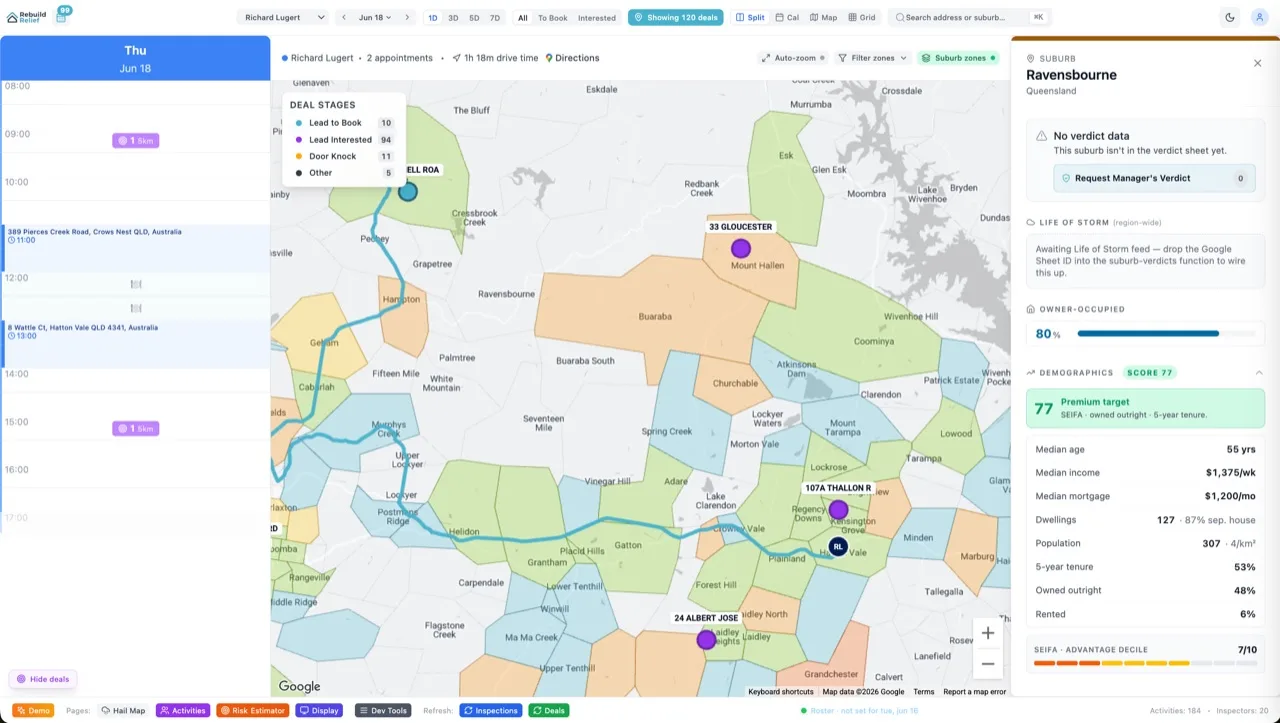
12 jobs booked across Sydney/Melbourne/Brisbane. System analyzes customer locations + job durations. System clusters jobs geographically: [Van 1: Parramatta → Balmain cluster (minimize drive time)], [Van 2: Wollongong → Campbelltown → Penrith cluster], [Van 3: Randwick → Sutherland cluster]. Coordinator approves clusters (one tap). Detailers see optimized route on map (minimal wasted drive). Cost avoidance: reduce unproductive drive by 50% = save 1–1.5 hrs/day × 3 vans × $60/hr = $180–270/day × 220 days = $39.6k–59.4k labor savings.
6. Recurring Revenue Dashboard + Customer Lifetime Value Tracking
Dashboard shows: [Ceramic Installs This Year: 120, Boosters Scheduled: 85, Booster Conversion Rate: 71%, Customer Lifetime Value (ceramic + 10 boosters): $4.2k avg]. Supervisor sees at-a-glance: which customers need booster reminders, which ceramic jobs are approaching 6-month mark, which customers have highest lifetime value. Drill into customer: [ABC customer, ceramic installed 2026-01-15, booster 1 scheduled 2026-07-15, booster 2 due 2027-01-15, projected lifetime value: $4.2k]. System flags: [booster 1 is due in 30 days, reminder sent? Yes, June 15 email sent, customer has not booked yet, send SMS reminder?]. Recurring revenue is not left to chance (system automation ensures no customer falls through cracks).
Australian Mobile Detailing Context + Regulatory
Australian mobile detailing market: 2,000+ detailers, $400M+ annual market (Sydney 40%, Melbourne 25%, Brisbane 15%, Perth/Adelaide combined 20%). Typical business: 3–5 detailers + 1–2 coordinators, $200k–600k revenue, 50–100 jobs/month, $300–1.5k avg job value. Market segments: paint correction (25%, $100M, average $500–800 per job), ceramic coating (35%, $140M, average $800–1.5k per job), interior detail (20%, $80M, average $200–400 per job), maintenance packages (20%, $80M, average $300–500 per job). Key regulations: paint thickness standards (automotive OEM standard: factory paint thickness is 80–120 microns; single-stage paint is 60–100 microns; clear coat is 25–35 microns; detailing industry best-practice: measure baseline with paint gauge before ceramic application, warranty requires baseline 90–100 microns post-polish, failure to document = warranty disputes), ceramic coating brands (3M Crystalline, XPEL Ultimate Plus, Ceramic Pro, Gtechniq C5; most require "applied by certified technician" for warranty; warranty requires: baseline thickness measurement, photo documentation of application, cure-time compliance, periodic maintenance records), insurance regulations (public liability insurance for mobile detailers: typical $5M cover, $500–1.5k/yr premium; vehicle-based business requires fleet insurance, $1k–3k/yr per vehicle, policy typically includes customer vehicle damage cover $1M), customer data protection (ACL 2010: customer's vehicle is customer's property, detailer is liable for damage; no major regulatory burden for photo documentation, but best practice is timestamp + geo-tag for dispute resolution), GST invoicing (all detailers $75k+ revenue must register for GST; ceramic coating + labour are GST-inclusive, customer invoice must show GST separately), interstate operations (Sydney, Melbourne, Brisbane, Perth, Adelaide all have equivalent regulations, no major variation for mobile detailing). Typical job value: ceramic full car coat ($800–1.5k = 3–5 hours work, $150–300/hr effective rate), paint correction (swirls, light scratches, $500–800 = 2–4 hours work, $150–200/hr effective rate), interior detail ($200–400 = 1.5–3 hours work, $100–200/hr effective rate), booster detail ($300–500 = 1–2 hours work, $200–300/hr effective rate). Job duration: small (1–1.5 hrs), medium (2–3 hrs), large (4–5 hrs). Crew composition: detailer certified in specialty ($60–100/hr), apprentice ($30–50/hr), coordinator/dispatcher ($40–60/hr). Margin: typical 35–55% gross profit (materials 15–30%, labour 30–50%, overhead 10–15%, profit 35–55%). Revenue per detailer: $60k–120k/yr (3 detailers × $80k avg = $240k revenue, typical for single-van start-up growing to 3-van operation). Hidden costs: skill mis-dispatch ($2k–5k/month × 12 = $24k–60k/yr), photo/warranty disputes ($6k–24k/yr liability), ceramic cure-time chaos ($19.2k–54k/yr re-do costs), manual booster reminders ($33.6k/yr lost recurring revenue), route inefficiency ($39.6k–118.8k/yr unproductive labour). Conservative hidden cost estimate: $120k–270k/yr for typical 3–5 detailer operation (ROI target: eliminate 60% = $72k–162k savings = justify $120–160k custom build).
Six FAQs
Can the system handle mixed-skill jobs (ceramic coat + interior detail in same appointment)?
Yes. Customer books: [ceramic full coat + interior vacuum + seat clean]. System recognizes: [ceramic requires paint-specialist, interior requires interior-specialist]. System filters: [detailer must have both certifications]. If no single detailer has both skills: system offers: [split job into 2 detailers, Book Detailer B (ceramic, 3 hours) + Detailer C (interior, 2 hours), same day, back-to-back?] Coordinator confirms. Both detailers are assigned (job is not split into separate days). System coordinates: [Detailer B arrives 10am (ceramic), finishes 1pm, Detailer C arrives 1:15pm (interior), finishes 3:15pm]. Mixed-skill jobs are supported (system prevents under-qualified assignment).
What if a customer disputes ceramic warranty "Your coating failed after 18 months"?
Warranty dispute arrives. Coordinator opens system, selects: [customer: ABC, job: ceramic install 2024-12-15]. System shows: [before photos (5), after photos (5), thickness baseline: 94 microns at install, warranty certificate: 5-year, maintenance records: booster 1 completed 2025-06-15 (thickness: 95 microns), booster 2 completed 2025-12-15 (thickness: 93 microns), current thickness reading: 88 microns (customer measured today, claiming failure)]. Coordinator reviews: [thickness is within 85–100 micron acceptable range, maintenance was done on schedule, booster installs confirm ongoing care, thickness decline 94→88 is normal wear over 18 months]. Coordinator responds to customer: "Your ceramic is still within warranty. Thickness of 88 microns is normal after 18 months with 2 boosters. We recommend booster 3 to restore to full thickness." Customer accepts (has data proof, dispute is resolved with technical evidence). No litigation, warranty is protected (photo + thickness records prevent disputes).
How does the system handle emergency same-day bookings?
Customer calls: "I have swirl marks from a hand wash, can you fit me in today?" Coordinator opens app, flags: [RUSH, paint correction, 2-hour job]. System shows: [available detailers with paint-correction cert: Detailer B available 2pm–4pm, Detailer D available 4pm–6pm]. Coordinator offers customer: "Detailer B available 2pm, or Detailer D available 4pm?" Customer chooses: "2pm works." System assigns Detailer B, sends GPS route, estimated arrival, job details. Detailer B receives notification (2pm job, paint correction, customer address, 2-hour slot). Customer receives SMS confirmation (Detailer B arriving 1:45pm). Same-day bookings are fast-tracked (system prioritizes available capacity, no manual coordinating needed).
Can the system track maintenance history per vehicle (not per customer)?
Yes. Customer has 3 vehicles: [Vehicle A: ceramic installed 2026-01-15, Detailers have done 1 booster, Vehicle B: ceramic installed 2026-02-01, no boosters yet, Vehicle C: paint correction only, no ceramic]. System tracks per-vehicle: [Vehicle A, 6-month booster due 2026-07-15, thickness last measured 93 microns, photos attached], [Vehicle B, 6-month booster due 2026-08-01, reminder send date: 2026-07-01], [Vehicle C, maintenance package available $400/yr]. Customer can view all 3 vehicle records in dashboard. Booster reminders are vehicle-specific (customer knows which car needs which service). Multi-vehicle tracking is supported (system prevents confusion, increases per-vehicle revenue).
What if paint gauge is not available or customer refuses measurement?
Detailer arrives, app prompts: "Paint Gauge Measurement Required for Warranty." If gauge is unavailable: detailer can toggle "Manual Thickness Entry" (detailer estimates based on visual/experience, system notes "estimated, not measured"). If customer refuses: detailer can toggle "Customer Declined Measurement" (system notes refusal in warranty record). Customer receives invoice + photos + warranty note: "Thickness not measured per customer request, warranty is valid but without baseline documentation." This protects detailer legally (system documents that measurement was offered, refused, or unavailable). Warranty disputes with unmeasured jobs are harder to defend, but system creates audit trail (detailer can prove they offered measurement).
How does the system sync with multiple metro zones (Sydney, Melbourne, Brisbane)?
System is cloud-based (all zones use same platform). Coordinator can manage 3 vans across Sydney metro OR split: [Coordinator A manages Sydney], [Coordinator B manages Melbourne]. Each coordinator logs in (sees their zone's jobs, detailers, customers). Job board shows: [Sydney zone: 8 jobs today], [Melbourne zone: 6 jobs today]. Route optimizer works per-zone (doesn't cross-assign Melbourne job to Sydney detailer). If business expands to Brisbane: add new zone to system (new coordinator, new detailers, new routes). Multi-zone support is built-in (system scales from single-metro to multi-state without re-platform).
The Bottom Line
ServiceM8 ($120–400/month) or Tradify ($200–500/month) or Google Sheets (free, but chaos): job dispatch, crew scheduling, invoicing. Plus skill mis-dispatch chaos (2 mis-dispatches/week, $600–1k/week disruption = $31.2k–52k/yr waste). Plus photo/warranty disputes (1 dispute/month, $500–2k per dispute = $6k–24k/yr liability). Plus ceramic cure-time chaos (2–3 scheduling errors/month, $1.6k–4.5k/month re-do cost = $19.2k–54k/yr waste). Plus manual booster reminders (30% conversion vs 70% automated = $33.6k/yr lost recurring revenue). Plus route inefficiency (1–1.5 hrs unproductive drive/day per van = $39.6k–118.8k/yr labor waste). Total hidden costs: $130k–280k/yr for typical 3–5 detailer operation. Custom platform: $120–160k buy-once build (skill-based dispatch, photo workflow + paint gauge, ceramic cure-time tracker, booster scheduler, route optimizer, recurring revenue dashboard). Year 1 cost: $140k build + $3k hosting = $143k. Year 2+: $3k/yr hosting. Payoff savings: eliminate skill mis-dispatch ($31.2k–52k/yr), prevent photo disputes ($6k–24k/yr), prevent ceramic re-does ($19.2k–54k/yr), capture booster revenue ($35k–60k/yr), optimize routes ($39.6k–118.8k/yr). Conservative year-1 payoff: $35k + $15k + $35k + $50k + $100k = $235k in cost avoidance + revenue capture. Break-even: month 7 (year-1 cost $143k ÷ ($235k ÷ 12 months) = 7.3 months). Year 2+: $240k+/yr value, platform cost $3k = 80x ROI. 3-year ROI: ($240k × 3) − $143k − ($3k × 2) = $720k − $149k = $571k profit on $140k build = 408% return. Ready to shift your mobile detailing business from mis-dispatches + lost photos + manual booster calls to skill-matched assignments + automatic reminders + route-optimized days? Check Aidxn's custom software packages, or book a call to discuss your detailing operation (how many detailers?, jobs per month?, avg job value?, skill specializations?, ceramic volume?, booster capture rate?, route zones (Sydney/Melbourne/Brisbane/multi-state)?, photo documentation process?, warranty dispute frequency?, recurring revenue target?).