


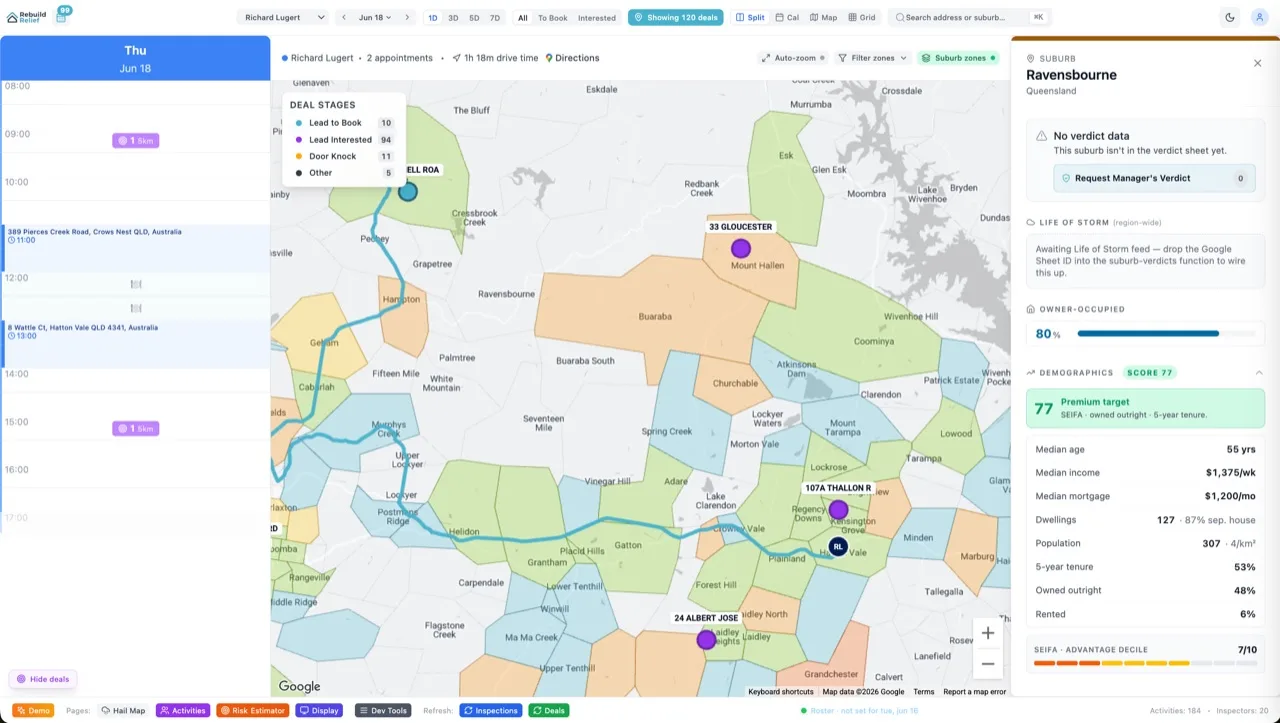

ServiceM8 ($40–60/month), TradieHub ($30–50/month), HirePool integration — these solve the baseline: job scheduling, invoice generation, parts inventory, technician dispatch. They do client lookup, before-and-after photos, quote approval, and payment tracking. But caravan and RV repair workshops in Australia operate a fundamentally different business than ServiceM8 assumes. A 6-bay shop handling storm-damage claims (hail, wind, lightning), warranty work (Jayco, Avida, JB warranties), LPG gas certification (legal requirement), tow ball + brake controller fitment, recurring service intervals (annual water tank clean, 40-hour wheel bearing check), and owner pickup scheduling isn't asking "how do I send an invoice?" They're asking "how do I capture insurance claim details (claim number, policy holder, assessor notes, damage photos, parts list for insurer approval), track warranty work (which component is covered, warranty term, manufacturer approval timelines), manage LPG certification renewals (legal log, gas bottle testing, decal updates), schedule fitment work (tow ball, brake controller, solar panels, awning — each needs different bay time, different tooling, different licensing), remind owners of 12-month service intervals (water tank, bearings, brake fluid), and coordinate owner pickups (notify owner when job ready, confirm pickup time 48 hours ahead, final walk-through checklist)?"
ServiceM8 does job scheduling. It doesn't manage insurance claim workflows (capture assessor notes, sync with insurer portal, flag parts awaiting approval, prevent billing before claim approval). It doesn't track warranty coverage (which part is under warranty, which parts customer pays for, manufacturer approval gates, Jayco vs Avida vs JB different terms). It doesn't log LPG certification (legal audit trail, gas bottle test dates, compliance expiry, renewal reminders). It doesn't organize fitment work by required bay-time and tooling (tow ball 2 hours + ball mount + brake controller 3 hours = 5 hours total, need electrical specialist, need specific tow-ball torque wrench 120–150Nm, need BrakeBoost controller kit). It doesn't remind owners of recurring service (water tank 12 months, bearings every 40 hours towing, brake fluid every 2 years, gas bottle test every 5 years). It doesn't orchestrate pickup (owner notification 1 week before ready, pickup confirmation 48 hours ahead, final checklist before release). Velocity X custom owns all six.
Six Features Custom Caravan/RV Repair Platform Delivers
1. Insurance Claim Intake + Approval Workflow
Storm damage: customer phones Wednesday morning, hail hit roof. Technician opens system: [new claim form]. Fills: [customer name, policy number, claim ID from insurer, claim type: "hail damage roof", assessor name/phone, damage description: "fist-sized dents, multiple cracks in corner slider cabinet"], [photos: 6 roof photos, 3 interior water damage photos, 2 documentation photos (policy, claim letter)]. System auto-flags: [insurer = NRMA, claim status = pending assessor approval]. Parts captured: [roof panel replacement $1200, slider cabinet $600, sealant/labour $300 = $2100 total]. System shows: [which parts need insurer pre-approval before ordering, which parts customer is liable for (excess $500)]. Technician schedules repair: [3-day turnaround pending approval]. Insurer approval arrives Friday, system updates: [claim approved, roof panel + cabinet approved, customer excess $500 due before release]. Technician books bay 3 for 2 days Monday–Tuesday. Owner gets SMS: [repair approved, starts Monday 8am, 2-day job, cost $2100 less excess $500, total customer $500]. System tracks: [which jobs are insurance-dependent, prevents starting work before approval, flags approval delays]. No spreadsheet audit trail; insurance = legal proof.
2. Warranty Coverage Tracking + Manufacturer Approval
Jayco Expanda owner: water pump failure at 18 months. Customer calls, system pulls: [serial number 42VD1842, warranty term: 5 years (pump + labour), registered owner, service history]. Technician logs: [fault: pump no pressure, customer reports], [diagnosis: pump seal failure, replaceable under warranty]. System checks: [Jayco coverage list: pump = covered, labour = covered, parts cost = $420]. System auto-generates: [warranty claim form, pump part number JYC-PMP-420Z, labour 2 hours @ $120/hr covered = $240]. Technician doesn't need to phone Jayco; system manages claim submission. Jayco approves (typically 24 hrs): [part shipped to workshop]. System notifies owner: [covered under warranty, no cost to you, pump arriving Tuesday, repair same day]. Avida warranty (different terms): same process, different coverage rules (some items 2-year labour, 5-year parts). JB warranty (3-year full coverage): same system, auto-routing to each manufacturer's approval gate. Technician never over-promises ("might be warranty") because system shows exact coverage. No warranty disputes ("I thought pump was covered").
3. LPG Gas Certification + Legal Compliance Log
Australia requires: LPG caravans/motorhomes certified every 10 years (or at sale/transfer). System tracks: [Jayco Expanda serial 42VD1842, last certified: June 2023, next cert due: June 2033]. Owner books service: system flags: [next LPG cert due in 8 months, recommend scheduling during next service to batch work]. Workshop schedules: [July 2026 annual service + LPG cert, 4 hours, specialist tech required]. Certification includes: [pressure test, hose inspection, regulator function, leak detection, decal replacement, compliance log entry]. System generates: [LPG cert form (NHVR-compliant), technician logs test results, system stores: pressure reading, decal date, expiry date]. Decal updated on vehicle. System maintains audit trail: [cert by Tech-Joe, dated July 10 2026, next due July 10 2033, certificate #LPG-AUS-2026-4281]. Australian legal requirement: proof of compliance. System = proof (photo of decal, digital cert, NHVR-searchable). No "did we cert this or not?" confusion.
4. Fitment Work Scheduling + Bay Allocation + Tooling Checklist
Customer orders: [tow ball + bracket, brake controller, solar panel]. Each requires different bay time and expertise: [tow ball: 2 hours, bay 2 (heavy work), tech needs torque wrench 120–150Nm, impact wrench]. [Brake controller: 3 hours, bay 3 (electrical), tech needs multimeter, 12V tester, connectors]. [Solar panel: 2.5 hours, bay 4 (roof), tech needs adhesive + sealant, roof access, electrical crimpers]. Total job: 7.5 hours across 3 bays, 2 techs. System shows coordinator: [Monday: bay 2 (Tech-Joe 8am–10am tow ball), bay 3 (Tech-Sarah 8am–11am brake controller), bay 4 (Tech-Mike 10am–12:30pm solar — can start after roof measured, Joe's tow-ball done)]. Coordinator prevents: [double-booking same tech on same time], [scheduling work without required tooling (system flags: "brake controller needs multimeter, check inventory Monday morning")], [bay conflicts (bay 3 free at 10:15am, not 10am)]. Technicians see: [assigned work, required tools, bay location, estimated time]. Parts pre-staged: [tow ball + bracket + 4 M12 bolts, brake controller + harness, solar + adhesive + decals]. Fitment done on-time, right bay, right tools, no delays.
5. Recurring Service Intervals + Automated Owner Reminders
Caravan owner takes delivery, system captures: [Jayco Expanda, serial 42VD1842, purchase date June 2024]. Service schedule auto-generated: [annual water tank clean (June 2025), wheel bearing check @ 40 towing hours (est. August 2025 based on typical use), brake fluid flush (June 2026), gas cert (June 2033)]. System sends: [May 2025 email: "Your Jayco service due June 2025, water tank clean + inspection. Book here"]. Owner clicks link, system shows: [available times, cost $350, duration 3 hours]. Owner books Tuesday June 17 9am, system schedules bay 1 and sends tech checklist: [drain tank, clean interior + exterior, sanitize, pressure test, refill, inspect water lines]. Owner gets reminder: [June 16 2pm: "Service booked tomorrow 9am, 3-hour job, arrive 8:45am, bring vehicle keys"]. Service complete: system logs [tank drained, lines flushed, pressure 50psi OK, new filter installed, sanitizer added]. Next service auto-scheduled: [June 2026, water tank + brake fluid, 4 hours]. Owner notified: [next service June 2026]. Recurring revenue: workshop knows [every Jayco on roster = annual $350 service, X caravans = $X recurring]. No manual call-list; system sends reminders.
6. Owner Pickup Coordination + Final Walkaround Checklist
Repair complete Wednesday 4pm. System notifies owner: [Job ready! Your caravan is repaired and ready for pickup. Click to confirm pickup time.] Owner sees: [available pickup slots: Thursday 9am, Thursday 2pm, Friday 9am]. Owner books Thursday 2pm. System notifies workshop: [pickup Thursday 2pm, tech assigned: Joe, final checklist required before release]. Thursday 2pm arrives, Joe opens system: [final checklist for Jayco Expanda serial 42VD1842]. Checklist items: [roof inspection — no leaks], [all repairs confirmed (pump replaced, cabinet sealed, roof panel fitted)], [water system test — pump pressure OK, taps flow], [electrical test — 12V systems, fridge, lights working], [exterior inspection — no damage, clean, readable VIN plate]. Joe completes checklist: marks all items ✓, adds notes: ["New pump sounds good, pressure steady. Customer to test taps before leaving. Roof sealed, no drips noted. All electrical working."]. System shows: [work complete, ready for release]. Owner arrives, walks through bay, confirms work, signs off. System records: [pickup Thursday 2pm, customer signed off, job closed, invoice final]. Workshop adds value-add (owner sees care taken), owner gets confidence (pre-release checklist = no "wait, is that water still leaking?"). Payment finalized on pickup.
Six FAQs
Can I track warranty work separately from paid customer repairs?
Yes. System tags all jobs: [paid], [warranty], [insurance]. Warranty jobs marked in system: [Jayco coverage applies, labour free, parts $420 pre-approved]. Invoice shows: [parts cost $420, labour free, total $0 customer cost]. Separate reports: [warranty revenue (Jayco paid us $660 for pump + labour), customer-paid revenue (storm repairs $2100), total workshop revenue]. Coordinator tracks: [how many warranty jobs per brand per month, ROI on warranty partnerships].
What if LPG cert is due but customer hasn't booked service?
System flags: [cert due June 2033, customer last contacted May 2033]. Automated email/SMS campaign: [May 2033: "Your LPG cert expires June 2033, book your annual service"], [June 1: "Last day to book before cert expires"], [June 15 overdue: "Cert now EXPIRED, unsafe to use caravan, contact us to schedule cert immediately"]. Coordinator sees overdue list: [3 caravans past LPG cert, follow-up calls required]. Workshop benefits (extra revenue), customer benefits (legal compliance automated).
Can I batch fitment jobs across multiple customers in one day?
Yes. Coordinator sees: [3 tow-ball jobs, 2 brake-controller jobs, 1 solar panel job = 6 jobs]. Groups by tech + bay: [bay 1: tow-ball jobs #1–3, Tech-Joe Monday–Wednesday, 2 hrs each]. [Bay 2: brake-controller jobs #1–2 + solar, Tech-Sarah Monday–Wednesday, 5 hrs total]. System prevents over-booking (each bay, each tech can only do X hours/day), auto-assigns by availability. Coordinator batches customer notifications: [all 6 jobs scheduled Monday-Wednesday, pickup Thursday]. Bulk scheduling, coordinated turnaround, no "call back in 3 weeks" gaps.
Do you handle NHVR tow-vehicle compliance for brake controllers?
Yes. Brake controller install captures: [vehicle manufacturer, model, year, tow capacity, brake controller model, install date, technician, test result (pass/fail)]. System links: [NHVR rules: if tow capacity >750kg, brake controller mandatory; if 750–2000kg, Cub system; if >2000kg, proportional braking]. System checks: [vehicle tow capacity 2500kg = proportional required, controller model XYZ = proportional, approved]. System stores compliance proof: [NHVR-compliant install log, photo of controller label]. Technician confident (system confirms legal requirement, install meets standard). Customer gets compliance proof (NHVR roadworthy check = proof of brake system).
What if a repair job discovers extra damage (initial estimate $500, actual $2000)?
Technician opens job, logs initial estimate: [$500 roof panel repair]. During work, discovers: [additional structural damage, roof frame rusted, needs reinforcement, extra $1500]. System flags: [estimate exceeded by $1500, customer approval required before proceeding]. System sends: [SMS + email to customer: "Additional damage found — $1500 extra for frame reinforcement, required for safety. Approve or discuss?"] Customer approves (or requests callback). System updates: [new estimate $2000, approved Wednesday 10am, proceed with full repair]. If insurance: system auto-captures: [additional damage photos, updated claim submission to insurer]. If customer: invoice updated, payment adjusted. Transparency = no billing surprises.
Can technicians log repairs on their mobile while working in the workshop?
Yes. System is mobile-responsive (iOS + Android). Tech in bay with tablet: [opens job #4281 (tow-ball install)], [logs photos of vehicle before/after], [checks off checklist items], [notes any issues: "bolt seized, required impact wrench"]]. System syncs live. Coordinator sees: [job #4281 — 40% complete, no blockers]. Next tech taking over: [last status: frame prepped, ready for bracket installation]. No paper timesheets, no "wait, what stage was this job at?" confusion. All work logged in real-time.
The Bottom Line
ServiceM8 ($40–60/month), TradieHub ($30–50/month), HirePool integration solve "how do I send invoices and schedule jobs?" They miss "how do I manage insurance claims without legal risk, track warranty coverage by manufacturer, stay LPG-compliant, coordinate fitment work across 6 bays, remind customers of recurring service, and release vehicles with confidence?" Custom platform: $180–220k build-once (insurance workflows, warranty integrations, LPG compliance logging, fitment scheduling with bay allocation, recurring-service reminders, owner pickup + checklist). Year-1 cost: $200k build + $4k hosting = $204k. Payoff: eliminate insurance claim chaos (workshop staff spends 8 hrs/week on claim forms, phone calls to insurer, manual approval tracking, custom system saves 6 hrs = 104 hrs/year × $65/hr = $6.76k saved), reduce warranty disputes (warranty miscommunication, rework to cover parts not pre-approved = 2–3 incidents per month = $5k/year cost, system prevents 90% = $4.5k saved), automate LPG compliance (manual cert tracking, spreadsheet risk, potential legal fine if missed = $2k/year risk, system logs automatically = $2k risk eliminated), batch fitment jobs (coordinator spends 6 hrs/week juggling bays/techs/parts, system auto-sequences = 4 hrs saved per week = 208 hrs/year × $65 = $13.5k saved), grow recurring revenue (customer reminders drive 60% attach rate for annual service = 12 caravans × $350 annual service = $4.2k new recurring revenue per month = $50k/year), reduce owner disputes (final-checklist sign-off = no post-pickup "you didn't seal that properly" callbacks = 2 callbacks per month prevented = $1.5k customer-cost saved). Year-1 payoff: $6.76k + $4.5k + $2k + $13.5k + $50k + $1.5k = $78.26k value. Break-even: ~3 months. Year 2+: $80k/year value, platform cost $4k = 20x ROI. Running a multi-bay caravan/RV shop and tired of ServiceM8 gaps on insurance, warranty, and LPG? Check Aidxn's custom repair platform, or book a call to discuss your workshop (how many bays?, insurance claims per month?, warranty partnerships?, LPG cert scale?, fitment vs general repair mix?, biggest coordination pain point?, NHVR compliance headache level?).