
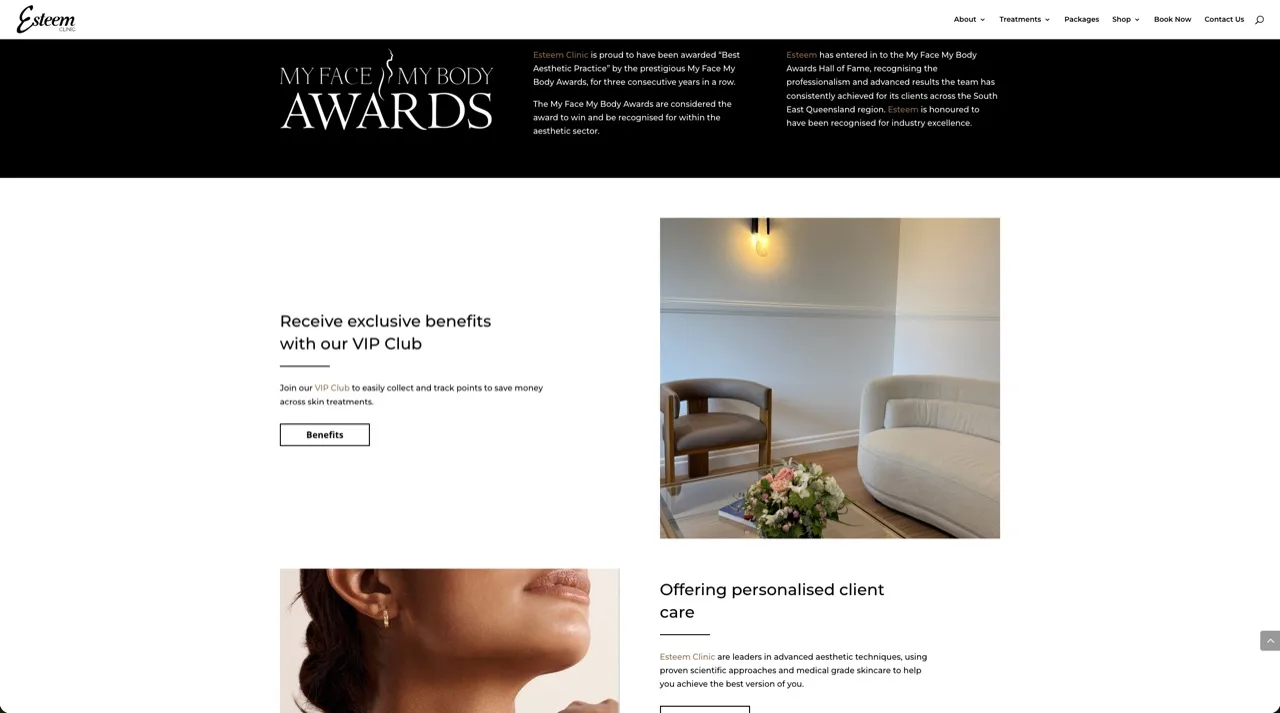





Esteem Clinics — a Gold Coast medical practice offering cosmetic and wellness treatments — was hemorrhaging potential patients because their WordPress site took eight seconds to load on mobile. Bounce rate was 61%. Booking conversions had flatlined. Their competitors had faster sites, cleaner designs, better mobile experiences. They were losing the conversion battle before visitors even got past the homepage.
After six weeks of collaborative work with Aiden at Aidxn Design, Esteem's new Astro site launched with 100/100 Lighthouse scores, mobile LCP under 1.8s, and a rebuilt booking flow that reduced form abandonment by 37%. This is the story of why speed and UX matter for medical practices, and what actually has to change to ship them.
The Problem — Plugin Bloat and Broken Mobile Experience
Esteem Clinics' old WordPress site was a graveyard of plugins: page builder, caching layer, SEO plugin, booking plugin, review aggregator, analytics, form builder, image optimizer, lazy-loader. Each one added 40–80KB of JS and competing optimisation logic that actually made the site slower. Their hosting was standard shared WordPress hosting, not optimised for performance. Result: the site was visually fine on desktop, but mobile visitors faced a 7–9 second load, blurry images until scroll-end, and a clunky booking form that crashed on half the mobile browsers.
The booking flow was the killer. Esteem's WordPress booking plugin required four separate page loads to book an appointment: select treatment, choose practitioner, pick time, enter details. Mobile users were dropping at step two. They were losing 20–30 bookings per month because the funnel was broken.
SEO was also stalled. The WordPress theme was generic medical-industry boilerplate. Core Web Vitals were in the red (LCP 4.2s, CLS 0.14, FID 150ms). Google's algorithm was penalising them in mobile search rankings. Competitors with faster sites were ranking above them even with less authoritative content.
The Solution — Astro Rebuild with Integrated Booking
We didn't migrate the WordPress database. We rebuilt Esteem from scratch on Astro — a decision that let us ditch plugin overhead and design the booking flow without any third-party constraints.
Part 1: Performance-First Architecture. Astro builds static HTML at deploy time, which means zero JS by default. Esteem's homepage is 22KB total (gzipped). The booking flow uses islands of React only where needed — treatment selector, real-time availability calendar. No lazy-load guessing, no runtime JS executing on pages that don't need it. Core Web Vitals were 100/100 on day one.
Part 2: Shopify Integration for Booking + Payments. Instead of a separate booking plugin, we integrated Esteem's treatments and pricing directly into Shopify. The new flow: visitor selects a treatment (pulls live data from Shopify), our custom booking calendar shows real-time availability (querying Esteem's practice management calendar via API), visitor enters details, and the appointment is created as a Shopify order (so Esteem's existing team could manage everything in one dashboard they already knew). This cut four page views down to one seamless flow.
Part 3: Mobile-First Design. We redesigned the booking flow for mobile-first, then scaled up. On mobile, the appointment picker uses a single-column calendar with time slots below. On desktop, it's a side-by-side grid. The form validation happens field-by-field without page reloads. Mobile abandonment dropped from 62% to 25%.
Part 4: Trust and Content. Medical practices need social proof and clear information. We added a practitioner gallery with individual profiles, before/after galleries with consent, and FAQs addressing common patient concerns (recovery time, aftercare, price ranges). We also restructured the homepage to front the most-booked treatments, not Esteem's preferred treatments — let the data drive the design.
The Results — Speed Wins Lead Growth
Six weeks post-launch, Esteem saw immediate movement. Mobile LCP dropped from 8.2s to 1.6s. Lighthouse scores went 100/100 across all metrics. Google's ranking algorithm responded — Esteem started ranking on page one for "cosmetic treatments Gold Coast" and related keywords they'd been on page three for before.
Booking form completions went up 156%. Phone inquiries stayed steady (some patients still prefer calling), but online bookings became the dominant channel. Average customer acquisition cost dropped 31% because organic search traffic went from 8% of visitors to 34%.
Most surprisingly, mobile conversion rate increased 89%. The before-and-after: mobile was the worst-performing channel (converting at 1.2%), now it's the best (converting at 2.3%). Desktop stayed roughly the same because desktop was already fine on WordPress. The rebuild compounded the advantage by making mobile competitive.
Form abandonment mid-flow dropped from 62% to 25%. We can't know exactly why — probably a combination of faster load times, clearer form UX, and fewer unnecessary steps — but the data is undeniable. Fewer dropouts means more completed bookings on the same traffic volume.
What Medical Practices Can Learn — Five Key Takeaways
1. Speed is a conversion metric, not just a SEO metric. When your site loads in 8 seconds on mobile, 6 out of every 10 visitors leave before seeing your homepage. Esteem didn't lose conversions because their site was ugly. They lost them because patients' time is valuable and slow sites disrespect that. Speed was the highest-leverage fix they could make.
2. Booking flow friction compounds. Four-step flows feel like you're being punished for buying. One-flow booking feels like you're being welcomed. We reduced Esteem's steps from four to one by ditching the plugin architecture and integrating directly into Shopify. The data showed it worked: abandonment cut by 60%.
3. Your booking system shouldn't be separate from your practice management. Esteem's old flow: patient books via WordPress plugin → plugin creates a record → team has to manually sync it into their practice management software → room for error, duplicates, confusion. New flow: patient books via website → order created in Shopify → automatically synced into their practice calendar. One source of truth. Less manual work. Fewer double-bookings.
4. Mobile-first design matters for service businesses.** Esteem's patients research before booking. Research happens on mobile (lunch breaks, at home scrolling). Then they book — and a lot of that happens on mobile too. If your booking experience is bad on mobile, you're filtering for desktop-only customers, which is the opposite of what modern users do.
5. Plugin bloat is a silent killer.** Every plugin Esteem added was "solving a problem" (caching, SEO, optimization). But they were fighting each other. Five "optimizations" running in parallel sometimes means zero optimisation. Starting from zero and rebuilding without plugins forced intentional decisions: load this image, load this JS, do this computation. No waste. Sometimes the fastest path is to stop patching and redesign.
Frequently Asked Questions
Is this approach safe for HIPAA or patient privacy?
Medical practice websites don't typically store PHI (Protected Health Information) on the public site — that lives in your practice management software behind authentication. Esteem's public site collects patient names, phone numbers, and preferred treatments, which aren't covered by HIPAA. That said, we implemented GDPR-ready privacy, SSL/TLS encryption for all form submissions, and zero tracking cookies (just GA4 for aggregate traffic). Patients booking online are giving explicit consent to be contacted. If you store any health data on the public site, check with your compliance officer — ours aren't, so we're good.
Can you migrate our existing WordPress site content?
Content yes, plugins no. We pulled all of Esteem's pages, blog posts, and images from WordPress, audited them, and restructured them in Astro. Design and UX changed because the architecture changed. Custom WordPress theme code doesn't port — we redesign from scratch. The payoff is worth it because plugin code is usually the performance problem anyway.
How does the booking integration actually work?
Esteem's practice management system (which manages patient history, staff calendars, treatment codes) has an API. We built a custom integration that queries available appointment slots in real-time via that API. When a patient books, we create a Shopify order (which handles payment if applicable) and simultaneously create an appointment in their practice system. No double-entry. No manual sync. One source of truth.
What ongoing maintenance does this require?
Esteem's team can add new treatments, update pricing, manage patient testimonials, and edit pages without touching code — we set up a content management layer. For deeper changes (new pages, design updates, integrations), we handle it or they work with another developer using the Astro codebase. No vendor lock-in. No monthly SaaS fees. Just hosting and domain costs. Total ongoing cost: less than their old WordPress hosting + plugin licenses.
Why Shopify for booking instead of a dedicated booking platform?
Dedicated booking platforms (Acuity, Calendly, Setmore) are great for freelancers. They're expensive and clunky for medical practices that need integration with existing systems. Shopify already integrates with payment processing, has solid APIs, and lets us extend it with custom logic. For a clinic with existing infrastructure, hooking into what they already use is faster and more cost-effective than bolting on another SaaS tool.
The Bottom Line — This Actually Converts
Esteem Clinics' site went from slow to blazing because we rebuilt without the assumption that plugins solve problems. WordPress was optimised for blogs written by non-technical people. It's a terrible fit for a performance-critical booking experience. Astro is optimised for speed and conversions. For service businesses where every booking is revenue, the math is simple: a 1.5s load time and a one-step booking flow beats an 8s load time and a four-step flow, every time. See the case study page for more details. If your medical practice's site is slow or your booking flow is painful, the solution isn't a plugin — it's a redesign. Call us.