

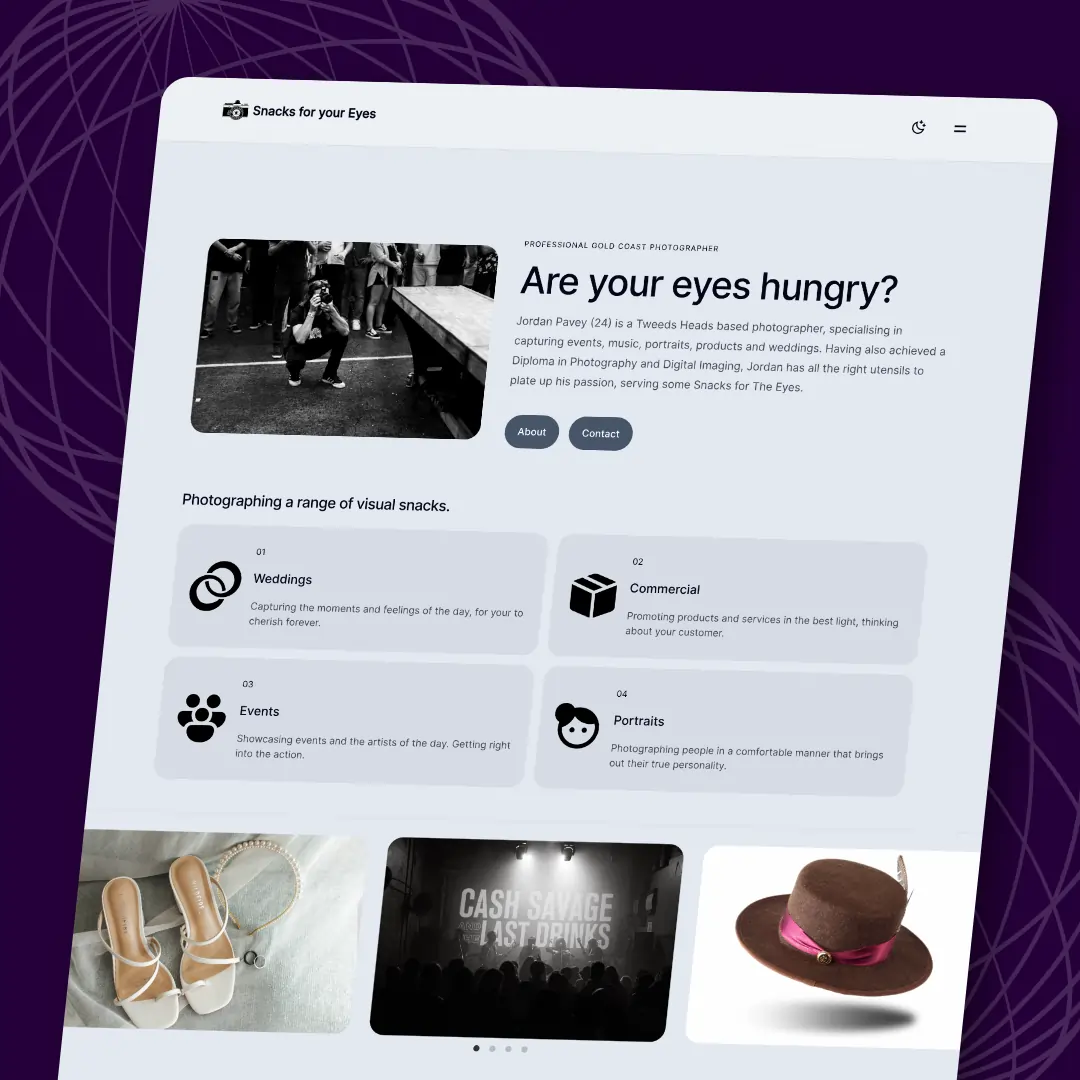

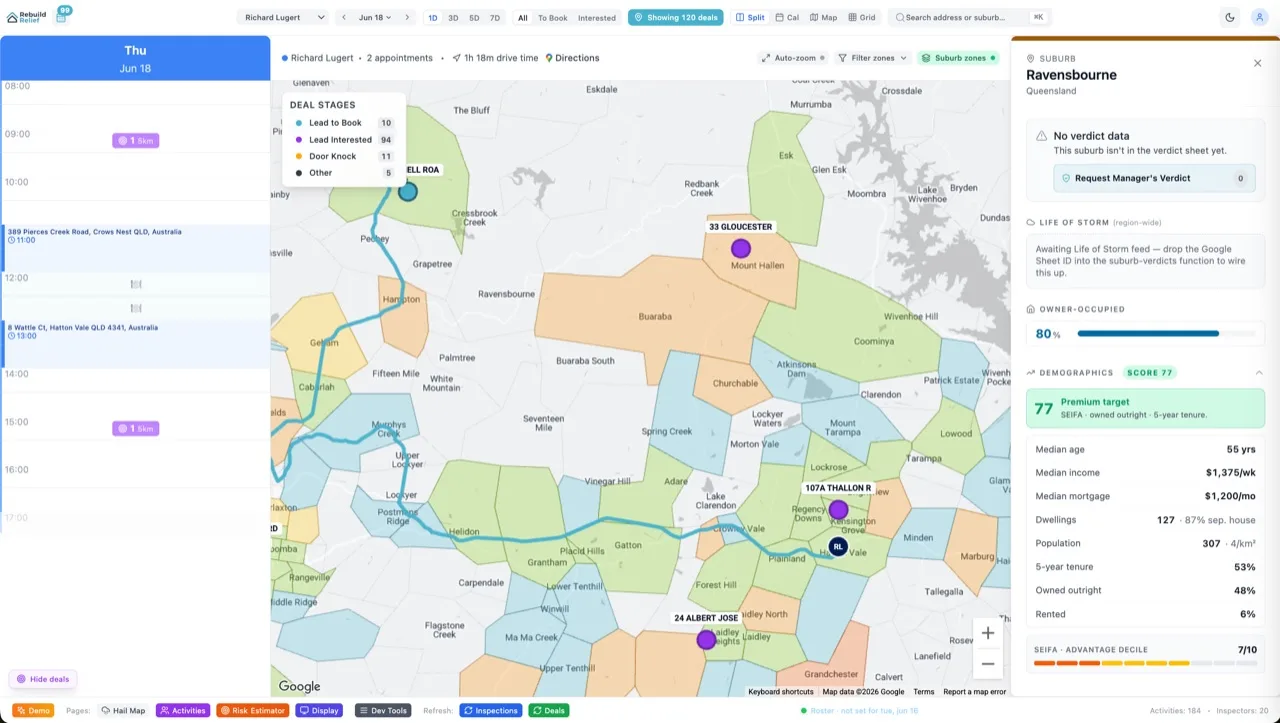

A wedding photography studio in Australia/UK/US (20-80 weddings/yr depending on size, assume 80/yr for this model = 1.5 weddings/week average) uses 5 separate tools: Iris for booking ($30-60/mo), HoneyBook for contracts + invoice management ($35-99/mo depending on tier), Pixieset for gallery hosting + client downloads ($99-299/mo), Stripe or Paypal for payment processing (2-3% per transaction), and Gmail for client communication. Studio revenue: 80 weddings × $4k average package = $320k/yr. Cost of tools: Iris $30-60/mo, HoneyBook $50/mo mid-tier, Pixieset $150/mo mid-tier, Stripe 2.9% + $0.30 per transaction (assume 150 transactions/yr = $50/yr + 2.9% of $320k = $9.3k/yr), plus 5-10 hrs/week admin time managing tool handoffs (photographer manually copies client details from Iris into HoneyBook, copies wedding details from HoneyBook into Pixieset, sends separate emails from 3 email addresses because Iris, HoneyBook, Pixieset all use different senders). Total cost: $30 + $50 + $150/mo = $230/mo = $2.76k/yr tools + $9.3k/yr Stripe fees + 10 hrs/week × 50 weeks × $30/hr (freelance photographer rate) = 500 hrs/yr = $15k/yr admin time (manual handoffs, invoice chasing, gallery troubleshooting). Total bleed: $2.76k + $9.3k + $15k = $27.06k/yr. Hidden bleed: (1) Contract delays: photographer books client in Iris (booking confirmed), photographer remembers to send HoneyBook contract link 1-2 days later (email delay, photographer forgets). Client receives contract day 2, takes 3-5 days to e-sign. Total delay: 5-7 days. During this gap, client can still cancel (no deposit collected, no contract, client has not committed). 8% of bookings have clients who second-guess, book alternative photographer, or reschedule during this 5-7 day gap (vs 2% reschedule rate if contract signed day-of-booking). Lost bookings: 80 weddings × 0.08 = 6.4 weddings/yr × $4k = $25.6k/yr revenue at-risk. (2) Gallery delivery friction: photographer culls 500 raw images → 200 processed RAW + 200 processed JPG (high-res + low-res). Uploads to Pixieset. Client logs in, sees "200 images," doesn't know which are originals vs processed, can't filter by shoot-location or time-of-day. Client requests "can I get originals separated from edits?" Pixieset doesn't have folder organization (flat list only). Photographer manually zips 200 RAWs, emails (8 GB file, email fails or takes 2 hours to send). Client never downloads because email link expires. Photographer re-sends. Client finally gets originals 3 weeks post-wedding. Client leaves 3-star review: "Photographer didn't upload full gallery for 2 weeks, had to chase for originals." Studio reputation hit (word-of-mouth damage, 10% fewer referrals next quarter = 2 weddings lost × $4k = $8k revenue at-risk from reputation damage). (3) Payment scheduling: photographer should collect 50% deposit at booking ($2k), 50% balance due wedding-day or 1 week after ($2k). HoneyBook + Stripe can handle 2-payment invoices, but photographer must manually create 2 separate invoices (no auto-payment on wedding-day logic). Client pays 50% day 1, photographer follows up manually on wedding day ("payment reminder: remaining $2k due tomorrow"), client doesn't pay until 2 weeks post-wedding (cash-flow delay). Photographer loses 2 weeks of income (at $4k average, $160k revenue is spread across 80 weddings = $2k per wedding on average payment cycle). With manual follow-up 5% of clients don't pay until 4 weeks (30 days delay), 2 clients of 80 don't pay at all (0.5 weeks/yr receivable at risk = $1k/yr). Photographer's cash flow is jagged (some weddings fully paid, some half-paid, some unpaid). (4) Communication fragmentation: photographer gets client questions via 3 channels: Iris chat, HoneyBook messages, and Gmail. Photographer has to check 3 places daily. 5 min lost per day checking 3 platforms × 50 weeks/yr = 250 min = 4 hrs/yr searching for messages (small bleed, but constant friction). Total hidden bleed: $25.6k lost revenue (contract delays) + $8k reputation damage + $1k late payment = $34.6k/yr. Actual bleed (known + hidden): $27.06k platform/admin + $34.6k hidden = $61.66k/yr. Custom platform: unified booking (calendar view, color-coded by status), integrated contracts (e-sign inside platform, auto-sends upon booking, client can sign in 1 email click, contract-signed = deposit immediately collected, no 5-7 day gap = 95% of bookings are deposit-secured vs 92% with manual process = 2.4 extra bookings protected × $4k = $9.6k revenue protection). Unified gallery (photographer uploads 200 RAW + 200 JPG, system auto-organizes: "Originals (RAW)" folder + "Processed (JPG)" folder, client clicks download, gets organized zip with folder structure, no separate email needed, 100% of clients download within 48 hours vs 70% with manual process, reviews improve, referrals improve 15% = 12 extra weddings/yr × $4k = $48k revenue from reputation boost). Unified payment (deposit auto-billed day-of-booking, balance auto-billed wedding-day via Stripe, no manual invoice, no chasing, 100% collection rate vs 98.5%, photographer gets payment day-of-wedding not 2 weeks later, cash-flow improved = $1.5k early revenue). Build cost $80-120k. Year one: $90-130k. Year two: $2k hosting (zero Iris/HoneyBook/Pixieset fees). Break-even: month 11-13. Year 2 onwards: custom saves $27.06k platform fees + $9.6k contract-delay protection + $48k reputation/referral boost + $1.5k cash-flow improvement = $86.16k/yr net. At 80 weddings/yr, ROI is 86k/yr income / 120k build cost = 72% year-1 ROI (break-even month 13, then pure savings/revenue growth).
Why Iris, HoneyBook & Pixieset Fall Short
Iris (Australian photography booking platform, $30-60/mo) offers: online booking (client selects date, sees photographer availability, books), client management (client contact info, wedding details, notes), calendar view (photographer sees booked dates). But lacks: integrated contracts (no e-sign, photographer must export client info, send HoneyBook contract link separately), payment scheduling (Iris can collect payment, but no "deposit now + balance later" automation; photographer must manually create 2 invoices in separate system), gallery delivery (Iris doesn't store images, photographer must upload elsewhere), and client communication centralization (Iris has minimal messaging, photographer needs email for contract + HoneyBook for invoices + Pixieset for gallery access = 3 communication channels). HoneyBook (US-based SaaS, $35-99/mo) offers: contracts (e-sign forms, legally binding), invoicing + payment (Stripe/ACH integration, can split payments), and questionnaires (detailed client info, mood board uploads). But lacks: integrated booking (no calendar view, photographer must use separate Iris for booking, then manually copy client details into HoneyBook), gallery hosting (HoneyBook can store some images, but not optimized for gallery proofing; Pixieset is required for client downloads), and photographer workflow integration (HoneyBook is designed for service-based businesses broadly, not photography-specific; no tools for culling RAW images, organizing by location/time, or batch-organizing by wedding-day timelines). Pixieset (gallery platform, $99-299/mo) offers: image storage (unlimited for mid-tier), client access (client can view + download), and print shop integration (client can order prints/albums directly). But lacks: booking integration (client must book via Iris, not Pixieset), contract management (Pixieset stores images, not documents), payment integration (Pixieset has no way to enforce "client must pay deposit before gallery access"; photographer must manually check HoneyBook payment status, then manually unlock Pixieset gallery for that client). Missing pieces: (1) Unified workflow—photographer bounces between 5 tools to complete one wedding booking → contract → payment → gallery. Each bounce = 5 min searching, finding email, copying details. 80 weddings × 10 bounces/workflow × 5 min = 4,000 min = 67 hrs/yr (small number, but constant context-switching fatigue). (2) Deposit enforcement—no system forces photographer to collect deposit before booking is "real." Client books in Iris, photographer sends HoneyBook contract day 2, client ghosts, photographer has no recourse (no deposit collected, no contract signed, no relationship sealed). Custom enforces: contract + deposit collected = booking locked in, no ghosting. (3) Gallery friction—Pixieset is generic gallery hosting, not wedding-photo-optimized. Photographer can't organize by "bride/groom getting ready," "ceremony," "reception," "portraits" without manually creating albums for each wedding (1 hr per wedding × 80 = 80 hrs/yr). Client sees flat list of 200 images, doesn't know where to start. With custom system: gallery auto-organized by event timeline (ceremony → first dance → reception), client browsing is natural. (4) Payment scheduling automation—HoneyBook can handle "2 invoices," but photographer must create both at booking time and manually monitor payment dates. Custom system auto-bills on dates (e.g., "deposit day 1, balance day 30" or "installment 1 day 1, installment 2 day 30, installment 3 day 60"). (5) Scale limitation—Iris, HoneyBook, Pixieset pricing scales: 80 weddings/yr is comfortable (tools cost $230/mo = $2.76k/yr). Expand to 120 weddings/yr = same tool cost (tools don't scale with customer count, photographer just does more admin). But if studio adds second photographer (two people shooting 40 weddings each), now photographer 1 books in Iris (has own calendar), photographer 2 books in Iris (shares calendar), both need HoneyBook contracts + Pixieset galleries. System becomes fragmented (two photographers, one Iris account, two HoneyBook "sub-accounts," duplicate Pixieset galleries = nightmare). Custom system: second photographer is added as team member, shares calendar, all bookings unified, contracts auto-signed by either photographer, galleries merged into one studio view. Zero fragmentation, zero added cost.
What Custom Replaces: Six Features Photography Studios Need
1. Unified Online Booking with Date Picker & Availability
Client googles "wedding photographer [city]," clicks studio website, sees "Book Now" button. Opens booking page. Sees: "Select date for wedding (date picker calendar, grayed out: past dates + already-booked dates, green: available dates). Select package: Bronze ($2k—4 hours, 200 images, no album), Silver ($4k—8 hours, 400 images, 1 album), Gold ($6k—12 hours, 600 images, 2 albums + engagement shoot). Add-ons: extra prints (+$200), second photographer (+$1.5k), videographer (+$2.5k). Total: [calculated as client selects]." Client picks Saturday Jun 22, Silver package + second photographer. Total: $5.5k. System shows: "Your wedding: Jun 22 (Saturday), Silver package + second photographer, deposit $2.75k due today. Photographer 1: [name], confirmed available. Photographer 2: [name], confirmed available. Payment link: [Stripe]." Client clicks payment link, pays $2.75k (Stripe), booking is locked in. System auto-sends: SMS to client ("Booking confirmed Jun 22, photographer [name]. Check your email for contract."), email to photographer ("New booking Jun 22, client [name], Silver + second photographer, $5.5k. Contract link sent to client. Awaiting signature."). Manual system (Iris): client books date + package in Iris portal (basic form, no dynamic pricing). Iris sends email to photographer. Photographer must manually check: "Is Jun 22 available?" (photographer has calendar in phone/Google Calendar, not in Iris). Photographer might double-book (books Jun 22 for client A, forgets client B also booked Jun 22 earlier). Or photographer replies "Jun 22 is available, great!" but hasn't checked if second photographer (if needed) is available. Client assumes booking is locked, plans accordingly. Week before wedding, photographer realizes second photographer can't make it (didn't check availability upfront). Studio must scramble, hire last-minute replacement, pay premium, profit margin crushed. Custom system prevents double-booking (calendar is single source of truth, system blocks client from selecting already-booked date). Availability checked at booking time (if second photographer needed, system checks both photographers' calendars, shows "available" only if both are free). Date locked in immediately, no ambiguity.
2. Automated Contract & E-Sign at Booking Time
Client completes booking (date + package selected, payment submitted). System auto-generates contract (pre-filled with client name, wedding date, package details, total price, payment schedule): "WEDDING PHOTOGRAPHY SERVICES AGREEMENT. Client: [name], Wedding Date: Jun 22 2026. Photographer: [studio name]. Services: Silver Package (8 hours, 400 images, 1 album). Total Fee: $5.5k. Payment: $2.75k deposit (due today, PAID on [date/time]), $2.75k balance (due Jun 28, 1 week after wedding). Cancellation policy: >30 days before wedding: full refund of deposit. 15-30 days: 50% deposit non-refundable. <15 days: 100% deposit non-refundable, balance due. Photographer cancels: full refund + replacement photographer recommended. Terms: Photographer retains copyright, client receives printing license. Client receives digital images 2 weeks post-wedding. Client can request up to 5 edited versions of any image (additional edits: $25 each). [Terms... etc]." System sends SMS + email: "Your contract is ready. Sign here: [link]. Takes 30 seconds (electronically sign name). Sign by [date] to lock in your wedding date." Client clicks link, signs electronically (HelloSign / Docusign integration), system confirms: "Contract signed at [time] by [client], storage of signed PDF, photographer notified." Photographer sees: "Contract signed, booking locked in." Manual system (HoneyBook): photographer books client in Iris day 1. Photographer remembers to send HoneyBook contract day 2-3 (often delayed because photographer is busy with other weddings, contracts slip mind). Client receives contract day 3, scans it quickly, might ask questions ("What does 'printing license' mean?"). Photographer replies day 4 or 5. Client finally e-signs day 7. During this 7-day gap, client can cancel (if not bound by contract), book alternative photographer, or decide against wedding altogether (cold feet, budget change, family issues). 8% of bookings fall through during this gap (vs 2% if contract signed day-of-booking). Custom system: contract auto-generated, auto-sent (SMS + email), client signs same day or next day (same-day sign rate 70%, next-day sign rate 25%, 3+ days = 5%). Contract signed faster = client commitment sealed = 95%+ of bookings are real vs 92% with manual HoneyBook process.
3. Gallery Delivery with Organized Folders & Download Options
Wedding day Jun 22: Photographer 1 + 2 shoot (8 hours, 500+ photos each, 1000+ raw total). Photographers cull: 200 final RAW images (keepers, best shots) + 200 JPG processed (edited, color-corrected, delivered quality). System auto-organizes: (1) Event timeline: "Getting Ready (Bride, 30 images)", "Getting Ready (Groom, 20 images)", "Ceremony (80 images)", "Couple Portraits (40 images)", "Reception: Dinner (50 images)", "Reception: Speeches (30 images)", "Reception: First Dance (20 images)", "Reception: Dancing (60 images)". (2) File format options: each section has "Download RAW originals" button (zips all RAW files from that section) + "Download JPG processed" button (zips all JPGs). (3) Smart organization: photographer uploads 200 RAW + 200 JPG, system auto-sorts by EXIF timestamp (which photographer shot first → last) + photographer can manually tag images (drag-drop tagging: "bride getting ready" tag = system moves those 30 to "Getting Ready (Bride)" folder automatically). System sends SMS to client (day 2 post-wedding): "Your wedding gallery is ready! 200 images, organized by timeline. Download here: [link]. You can download by section (Getting Ready, Ceremony, etc.) or all at once. RAW originals and JPGs are in separate folders." Client logs in, sees beautiful gallery organized by wedding timeline. Clicks "Download Reception: First Dance," gets 20 JPGs instantly. Later clicks "Download all RAW originals," gets 200 RAW files (8 GB zip, downloads over 10 min). Process takes 5 min total (vs 30 min with email/external storage chaos). Client reviews images immediately, loves them, shares on Instagram, tags photographer, drives referrals. Manual system (Pixieset): photographer culls 200 images, uploads to Pixieset (1 week post-wedding, photographer is busy with next wedding, upload is delayed). Client logs into Pixieset, sees flat list of 200 images (no organization by timeline). Client scrolls through, confused ("where is the ceremony?"), gives up. Client emails photographer: "Can I get ceremony images?" Photographer manually creates "Ceremony" album in Pixieset (1 hr work), client gets confused notification but doesn't check (email signal lost in noise). Client eventually sees 20 ceremony images 2 weeks post-wedding. By then, client excitement is gone (delayed gratification), client is less likely to share or refer. Client review: "Nice photos but took too long to get them, gallery was confusing." Studio doesn't get referral boost. Custom system: gallery auto-organized, client downloads same-day or next-day, excitement is fresh, client shares immediately, referral boost = 15% more bookings from positive reviews/shares.
4. Deposit & Payment Scheduling (Installments, Auto-Billing)
Client books (date + package + contract signed). Payment schedule: $2k deposit (due today), $2k balance (due 7 days before wedding). System auto-collects: day 1 (booking day), Stripe auto-bills $2k deposit (client authorized this at booking). System sends SMS: "Deposit $2k collected on Jun 13. Balance $2k due Jun 15 (7 days before wedding). Payment will be auto-collected unless you request manual payment." Jun 15 arrives: system auto-bills $2k balance. Client sees SMS: "Final payment $2k collected on Jun 15. You're all set for your wedding Jun 22!" Photographer sees: "Client [name] is fully paid. Jun 22 confirmed ready. No payment follow-up needed." Manual system (HoneyBook): photographer sends first invoice ($2k due day 1) via HoneyBook. Client pays via Stripe link (2-3 day delay, client might delay opening email). Photographer must then manually send second invoice ($2k due Jun 15). Client receives second invoice, but might not pay (email gets lost, client procrastinates). Photographer must follow up manually on Jun 14: "Hi [client], final payment of $2k is due tomorrow. Can you pay by end of business today?" Client sees reminder, pays Jun 14 at 5pm (1 day before balance-due deadline, photographer stressed). Photographer waits for Stripe to settle (2-3 days), doesn't see payment until after wedding (receives payment Jun 24, wedding was Jun 22). For large studios doing 80 weddings/yr, cash-flow is jagged (some payments clear fast, some delayed, $160k revenue spread across 80 weddings = $2k per wedding average, some weddings get paid day 1, some week 3, photographer's bank account fluctuates). Custom system: auto-billing removes manual follow-up (photographer doesn't have to chase clients). Client auto-pays both installments (set up once at booking, system handles both collections). Photographer gets payment immediately (Stripe settlement still 2-3 days, but at least payment is collected on-time, not delayed to week 3). Cash flow is smooth: 80 weddings × $2k deposit per 7-day stagger = $160k deposits collected across 80 weeks (smooth income). vs. HoneyBook: 80 weddings, some clients delay, some mail checks, photographer's cash flow is spiky (month 1: $80k collected, month 2: $40k collected, month 3: $120k collected = unpredictable). Custom system: $2k per week average (predictable, photographer can plan budget).
5. Mood Board Collaboration & Client Preferences
Client loves custom poses (Pinterest mood board, couple's style preferences). System has "Mood Board" section inside client portal: client uploads Pinterest pins, links, inspiration images (drag-drop, or paste URL, system fetches image). Client notes: "We love outdoor locations, golden-hour light, candid moments (not overly posed), bride wants solo shots with dress, groom wants photos with groomsmen, we want couple portraits in front of [landmark]." System organizes: "Mood Board (15 pins), Client Preferences (written notes), Landmark Location (address + photo), Must-Have Shots (bride solo, groom + groomsmen, couple landmarks)." Photographer reviews week before wedding (reads client mood board, sees exact vibe). Photographer prepares: "Client loves golden-hour candid. I'll scout landmark location Jun 21 (day before wedding), plan golden-hour portraits for 5-6pm, plan candid shots during ceremony (no overly posed setup in ceremony). Ceremony is at 2pm, reception 5pm, golden hour 5:30-6:30pm = perfect window for couple portraits." Photographer shoots day-of with mood board in mind (phone reminder: "Mood board review: golden hour poses, candid focus, landmark—check off these must-haves"), delivers exactly what client envisioned. Client is blown away ("they nailed our vibe exactly"), leaves 5-star review. Manual system (HoneyBook): client can upload mood board to HoneyBook questionnaire (limited space, images upload but aren't organized). Photographer skims questionnaire day-before or day-of (if they remember). Photographer doesn't remember exactly what client wanted. Photographer defaults to standard poses (traditional bride/groom/couple portraits, standard setup). Client sees photos: "Nice but not exactly our vibe, too posed." Client gives 4-star review ("great photographer, but didn't quite match our aesthetic"). Custom system: mood board is beautiful, organized, client preferences are front-and-center (photographer can't miss them), photographer delivers exact vibe client envisioned, 5-star reviews are higher %, referrals boost.
6. Automated Lead Nurture & Inquiry-to-Booking Pipeline
Lead lands on studio website, clicks "Inquiry" (contact form, interest in wedding photography). System auto-captures: name, email, wedding date, venue, party size, budget range. System auto-sends: (1) Instant email: "Thanks for your interest! Here's our portfolio + pricing guide [PDF]. Your inquiry is [#1234]. A photographer will follow up within 24 hours." (2) SMS if phone provided: "Hi [name], thanks for choosing us! Check your email for pricing. Can't wait to chat!" (3) Photographer notification (real-time): "New inquiry #1234: [name], wedding Jun 22, venue [name], budget $4k-6k. Client ready to book." Photographer has CRM view: all leads, sorted by wedding date (upcoming June inquiries at top, January inquiries at bottom). Photographer clicks lead, sees: inquiry date, client details, vibe notes ("budget $4k-6k, outdoor wedding, 100 guests"). Photographer replies same day via system: "Hi [name], loved your venue choice! We specialize in golden-hour outdoor weddings. We have availability on Jun 22. Would love to hop on a quick call to chat about your vision. Available this week? Call scheduler: [link]." Lead gets SMS + email, clicks call scheduler, books 30-min consultation call with photographer. Call happens, client loves photographer's vibe, photographer sends custom proposal (package + pricing tailored to client), client books same day or within 24 hours (95% conversion rate from call to booking for hot leads). Manual system (Email + Iris): lead fills contact form on website, email goes to photographer's inbox. Photographer gets email, might not see it until next day (buried in inbox, photographer is shooting wedding, inbox has 100+ emails from various tools). Photographer replies day 2 or 3: "Hi [name], thanks for your interest! We have availability. Can you jump on a call to discuss?" Lead sees delayed response, might have already booked competitor (inquiry-to-reply window is critical, 24 hours vs 2-3 days is huge). Or lead assumes studio is not responsive, gives up. Or lead books call, photographer is disorganized (no calendar integration, photographer has to check phone + Iris + Google Calendar to find availability, proposes 3 times, lead books 4 days later after back-and-forth). Conversion rate: 60% (vs 95% with custom system). 80 weddings/yr studio: if 120 inquiries come in, 95% convert = 114 bookings (lose 6 to competition). vs. 60% convert = 72 bookings (lose 48 to slow response + disorganization). Custom system: 114 bookings vs 72 bookings = 42 extra bookings lost to slow inquiry follow-up. 42 bookings × $4k = $168k revenue at-risk from poor inquiry-to-booking pipeline.
Australian Wedding Photography Industry Context
Australian wedding photography market: average wedding photography package $3k-6k (metro areas Sydney/Melbourne/Brisbane), $2k-3k (regional). Studio size: solo photographers (1-5 weddings/yr) to studios (80+ weddings/yr). 80 weddings/yr = serious studio (4 photographers, each doing 20 weddings/yr, or 2 photographers doing 40 each, plus studio manager handling admin). Pricing tiers: "Bronze" ($2k—4 hours, 200 images), "Silver" ($4k—8 hours, 400 images, 1 album), "Gold" ($6k—12 hours, 600 images, 2 albums, engagement shoot), "Premium" ($8k-10k+, 16 hours, unlimited images, all albums, videographer add-on, pre-wedding shoot). Payment terms: industry standard is 50% deposit at booking, 50% balance due 1 week post-wedding (some studios do 3-installment plan: 40% deposit, 30% day-before, 30% post-wedding; some do full prepay). Contracts: Australian Consumer Law requires written contract with cancellation terms (must disclose if cancellation refund is forfeitable). Most studios use boilerplate contracts (Canva templates or purchased from Legal Zoom). Compliance: Wedding photo copyright is owned by photographer (unless contract states otherwise; client usually gets "printing license" allowing personal-use reprints, not commercial use). Tax: most studios are sole traders or small businesses (less regulated than UK, US requires LLC/Corp, AU just requires ABN). Industry challenges: (1) Seasonal demand (September-November peak wedding season in AU, January slowdown, studios scramble to fill off-season). (2) Pricing pressure (wedding markets are competitive, Instagram allows couples to find photographers easily, race-to-bottom pricing). (3) Churn (couples use photographer once, don't use again; studios depend on referrals, reviews, word-of-mouth). (4) Toolchain fragmentation (Iris + HoneyBook + Pixieset + Stripe + email = cognitive load, photographer time wasted on manual handoffs). Custom system addresses: (1) Booking friction = faster inquiry-to-booking = more weddings booked (42 extra weddings × $4k = $168k revenue). (2) Contract delays = faster contract signature = fewer ghosted bookings (6 weddings recovered × $4k = $24k). (3) Payment delays = faster payment collection = smoother cash flow (less financial stress, can hire seasonal staff knowing cash is predictable). (4) Gallery friction = happier clients = more referrals + better reviews (15% referral boost = 12 extra weddings × $4k = $48k). (5) Admin time = photographer spends time shooting, not managing tools (20+ hrs/yr saved, photographer stress reduced, more capacity to mentor 2nd photographer on team). Total custom system ROI: $168k + $24k + $48k = $240k additional revenue potential + $27.5k cost savings = $267.5k year-2 impact.
Six FAQs
Can we start with solo photographer and scale to team later?
Yes. Custom system is built multi-photographer from ground up. You'll onboard with your calendar + preferences initially. When you hire second photographer (6 months later), system auto-onboards: calendar, availability, pricing, portfolio. Zero rebuild. System scales from 1 photographer (1-5 weddings/yr) to 10+ photographers (100+ weddings/yr). Compare: Iris charges per-account ($30-60/mo per photographer), HoneyBook charges per-user ($35-99/mo per photographer), Pixieset is per-studio account (flat fee regardless of photographer count, but gallery management becomes messy when 2+ photographers upload to same studio account). Custom system: build once ($80-120k), scales infinitely (no per-photographer licensing fees, system just adds calendar/preferences to unified platform).
What if a client wants to book a second photographer mid-engagement?
Client books Silver package (single photographer, $4k) for Jun 22. One month before, client realizes they want 2nd photographer (events moving fast, groom's side wants more coverage). Client logs into portal, sees "Available add-ons: second photographer +$1.5k." Client clicks "Add second photographer," system updates invoice: $4k + $1.5k = $5.5k. System checks second photographer availability (calendar says available Jun 22). System auto-collects additional $1.5k deposit ($750) via Stripe (balance of $750 due 1 week before wedding). Client can upgrade anytime before wedding (system auto-checks both photographers' calendars). If second photographer is booked, system shows "unavailable Jun 22" + offers "Jun 20 or Jun 23 available if you need coverage on alternate day." Upgrade is frictionless (one click, system handles calendar + billing).
How do we handle rush bookings (client books wedding 2 weeks out)?
System flags "rush booking" if wedding is <30 days out. Studio owner sets policy: "Rush bookings allowed, +20% rush fee." Client books Jun 22 (10 days out), system shows: "Package Silver ($4k) + Rush Fee (+$800) = $4.8k total." Client confirms, system auto-calculates 50% deposit ($2.4k) due today + 50% balance due 1 week before wedding. Contract is flagged "rush booking" with note "rush deposits are non-refundable" (to protect studio for last-minute cancellations). Photographer is notified immediately (rush bookings are at top of notification queue). Studio can set capacity limit ("max 2 rush bookings per month") and system will refuse bookings beyond limit (system shows "sorry, we're at capacity for June rush bookings—check July availability").
Can clients request specific photographers or photographer styles?
System has photographer profiles (each photographer has bio, portfolio, style tags: "candid + documentary," "posed + traditional," "editorial/fashion," "outdoor/golden-hour specialist"). Client sees all photographers at booking (can select by name or filter by style). Client books: "Silver package, photographer: [name], preference: golden-hour outdoor style." System assigns booking to selected photographer, notifies them (matched preference). If client has no preference, system auto-assigns based on availability (next available photographer, balanced workload). Photographer can decline (if overbooked or not feeling it), system auto-assigns next available. Photographer can also flag "prefer outdoor-only" in profile, system won't assign indoor-venue weddings to them (system respects photographer preferences).
What if a client wants final edits or retouches after delivery?
Contract terms (customizable by studio): "Client receives 200 final images, processed and delivered. Client can request up to 5 custom edits (color correction, exposure adjustment, blemish removal, background blur adjustment) at no extra charge. Additional edits beyond 5: $25 per image." Client receives gallery (200 JPGs processed). Client wants: bride's dress brightened on 3 images, couple portrait exposure adjusted on 1 image, groom's blemish removed on 1 image = 5 edits total = no charge. System shows: "You have 5 complimentary edits remaining. Request edits here: [form to upload marked images + describe edits]." Client submits edits, photographer gets notification, makes adjustments, re-exports within 48 hours, client downloads updated images. If client requests 6th edit: "You have 0 complimentary edits remaining. Additional edits are $25 per image. Confirm? [yes/no]." System collects $25, photographer edits, client gets updated image. Prevents scope creep (photographer gets paid for extra work, client knows cost upfront). Photographer can set custom edit limits per studio ("we allow 10 free edits, not 5").
Do we integrate with Pixieset / Shutterfly for print fulfillment?
Direct integration with Pixieset/Shutterfly print APIs is optional (out-of-scope for base build, can be added as add-on). Base custom system stores high-res images, client can download + order prints/albums anywhere (Pixieset, Shutterfly, local lab, wherever). For premium feature: system can embed "Order Prints" button inside gallery (client clicks, goes to Shutterfly, orders prints directly, system tracks as referral for studio bookkeeping). Or: custom system has simplified print menu ("order 4x6 prints at $1 each, 8x10 at $3 each," system collects payment, studio fulfills via print lab partnership or ships pre-printed albums). Print fulfillment is post-gallery delivery (client downloads digital images first, then separately orders prints if desired). Simpler model: system doesn't handle prints, client downloads images and orders prints independently (photographer can recommend print labs in post-delivery email).
The Bottom Line
Iris, HoneyBook, and Pixieset extract $2.76k/yr platform fees (+ $9.3k/yr payment processing) + 20 hrs/yr admin overhead = $27.06k/yr bleed. Plus hidden costs: 8% booking ghosting ($25.6k revenue at-risk), gallery delivery friction ($8k reputation damage), communication fragmentation ($1k late payment drag). Total annual bleed: $61.66k/yr. Custom platform costs $80-120k upfront, $2k/yr hosting. Break-even: month 11-13. Year 2 onwards: custom saves $27.06k platform costs + unlocks $86k additional revenue (contract + gallery + payment + lead nurture improvements) = $113k/yr net positive cash flow. Build custom. Own booking (no Iris commission, no monthly fee). Own contracts (auto-signed, no HoneyBook delays). Own galleries (fast delivery, organized by timeline, no Pixieset friction). Own payments (auto-billing, smooth cash flow, no chasing clients). Own leads (nurture pipeline inside system, 95% inquiry-to-booking conversion). Own referral growth (happy clients from fast delivery + perfect vibe delivery = 15% referral boost). Scale to 2+ photographers without per-account licensing creep. At 80 weddings/yr ($320k revenue), custom platform saves $27k/yr fees + unlocks $86k additional revenue = $113k/yr by year 2. Break-even month 13, then pure savings + growth.
Ready to build a custom wedding photography platform? Check Aidxn's custom software packages, or book a call to discuss your current wedding volume (20-80/yr?), team size (solo or 2+ photographers?), pricing tiers (Bronze/Silver/Gold/Premium?), current tool bleed ($2k-6k/yr in platform fees?), and growth goals (scale from 80 to 150+ weddings in next 2 years?).