






Short-stay property manager (Sydney metro, 20 Airbnb/Booking/VRBO listings, established 2020, 2 staff, $680k annual revenue). Portfolio: 12 apartments (2–3 bed, $120–180/night), 8 studios (1 bed, $80–120/night). Annual revenue: direct Airbnb $320k, Booking.com $180k, VRBO $110k, direct website $70k = $680k, margin 40% after council rates/utilities/tax = $272k gross. Customer lifecycle: guest inquiry (WhatsApp/Airbnb/Booking DM) → booking confirm → pre-arrival (check-in link, wifi, parking, rules) → check-in (guest self-check-in or host meets) → turnover (crew cleans 2–4 hours, restock linens/supplies) → next arrival. Current stack: Hostaway ($200/mo, unified inbox Airbnb/Booking/VRBO), Stripe (cleaning extras), Google Sheets (crew schedule: names, dates, times, notes), iPhone photos (turnaround, inventory, damage), Excel (owner statements: revenue, occupancy %, expenses, profit/property — manual updates), Airbnb pricing tool (static nightly rates). Problem stack: (1) Hostaway UI Good, Crew Scheduling Missing — Hostaway shows unified guest inbox (cross-platform messaging good), but crew scheduling stays outside system. Manager texts crew WhatsApp: "Sarah, clean Studio #4 Tue 11am checkout, 2pm arrival turnaround, $45 + $10 lunch?" Sarah replies "available." Manager doesn't confirm until Sarah shows up Tue 11am. If no-show, manager scrambles Mon 10am, texts 5 cleaners, one replies "1pm instead." Guest 2pm check-in delayed to 3pm, guest upset. Happens 2–3x/month = 10 failed turnovers/month, 10% of turns = $2.5k lost revenue from missed same-day premium ($30/night premium × 8–10 nights/yr missing premium = $240–300/mo × 12 = $2.88–3.6k/yr). Plus: failed same-day turnover, property sits 1–2 nights empty, $120/night × 10 turnovers/yr × 1 night gap = $1.2k/yr. Total crew loss = $4.1k/yr. (2) Static Pricing vs Demand — manager sets each property static: Studio #1 $100/night, Apt #1 $150/night. Rate never moves. High demand (school holidays): stays $100 (leave money on table, could charge $130). Low demand (August rainy week): stays $100 (could drop to $80 to fill gaps, manager unsure). Manager monitors Airbnb calendar, sees "Studio #1 70% booked, Apt #1 95% booked," manually adjusts 1–2 properties/week (gut feel, no data). Result: 85% occupancy, static pricing (could be 92% occupancy + dynamic rates via algorithmic pricing). Lost revenue: 7% occupancy gap at $120 avg × 365 days × 20 properties = 0.07 × 365 × 20 × $120 = $61.2k annual uplift lost. (3) Owner Statements — Manual, Slow, No Insight — manager uses Excel, manually enters monthly: properties, revenue (pulls from Airbnb/Booking/VRBO, sums per property), expenses (cleaning $X, supplies $Y, maintenance $Z, council, utilities), calculates margin. Updated Fridays, owner sees "May revenue" 1st week June. Owner asks "why is Apt #3 margin lower?" Manager spends 30 mins counting cleaning invoices for Apt #3, compares to revenue. Owner wants "which properties underperform?" Manager can't quickly rank by ROI, can't recommend "sell Studio #7, redeploy to Apt #1." Owner stuck in reactive mode (don't know property-level profitability until Friday, can't adjust pricing mid-week). (4) NSW STRA Registration — Manual, Penalty Risk — NSW law: short-stay rentals (180+ days/yr) must register with STRA, renewal annually. Manager tracks 20 properties in spreadsheet: property, registration number, expiry date. No reminder system (relies on memory). Result: Apt #2 registration expired March, manager forgets renew. Council warning letter June (3 months unregistered). Penalty: $2.5k/property/month unregistered × 3 months = $7.5k fine. Happens 1–2 properties/yr = $7.5–15k regulatory fines. Plus: compliance exposure (if audit, 1–2 unregistered = penalty multiplies). Max exposure: $2.5k × 20 properties × 12 months = $600k if all unregistered full year. (5) Expense Tracking — No Tax Categories — manager logs expenses "cleanings $5k, supplies $2k, maintenance $3k." At tax time, accountant asks "maintenance breakdown: repairs vs improvements?" Manager says "it's all 'maintenance', uncategorised." Accountant estimates conservatively, manager loses ~$200–500/yr in deductions from uncat expenses. (6) Crew Performance — No Visibility — manager texts 12 cleaners, various speeds: Sarah 2 hours avg, John 4 hours avg. No tracking system, assigns ad-hoc. Doesn't know "Sarah is 2× faster, prioritise her for same-day turnovers." (7) Occupancy Visibility Fragmented — manager checks Airbnb calendar, then Booking calendar, then VRBO calendar (3 platforms × 20 properties = 60+ manual checks). No consolidated view: "which properties available Thu June 15?" Takes 10 mins to scan. No alerts: if property becomes available mid-week (guest cancels), manager doesn't know until Friday, misses revenue. (8) Co-hosting Commission Disputes — manager co-hosts 40% of properties, co-host takes 20% commission on those bookings. Month-end reconcile: co-host says "I managed 15 bookings, avg $120 = $1,800, I get 20% = $360." Manager checks Airbnb, sees "co-host commission $190 (our split)." Dispute: margin leakage ~$30/mo × 12 = $360/yr invisible. Plus: no contract clarity on co-host duties (listing uploads, photo management, etc.), potential unpaid-work liability.
Six Features Custom Property Management Platform Delivers
1. Unified Inbox + Automated Crew Dispatch — Single Dashboard, +15% Response Speed, 20% Reduction in Turnover Time
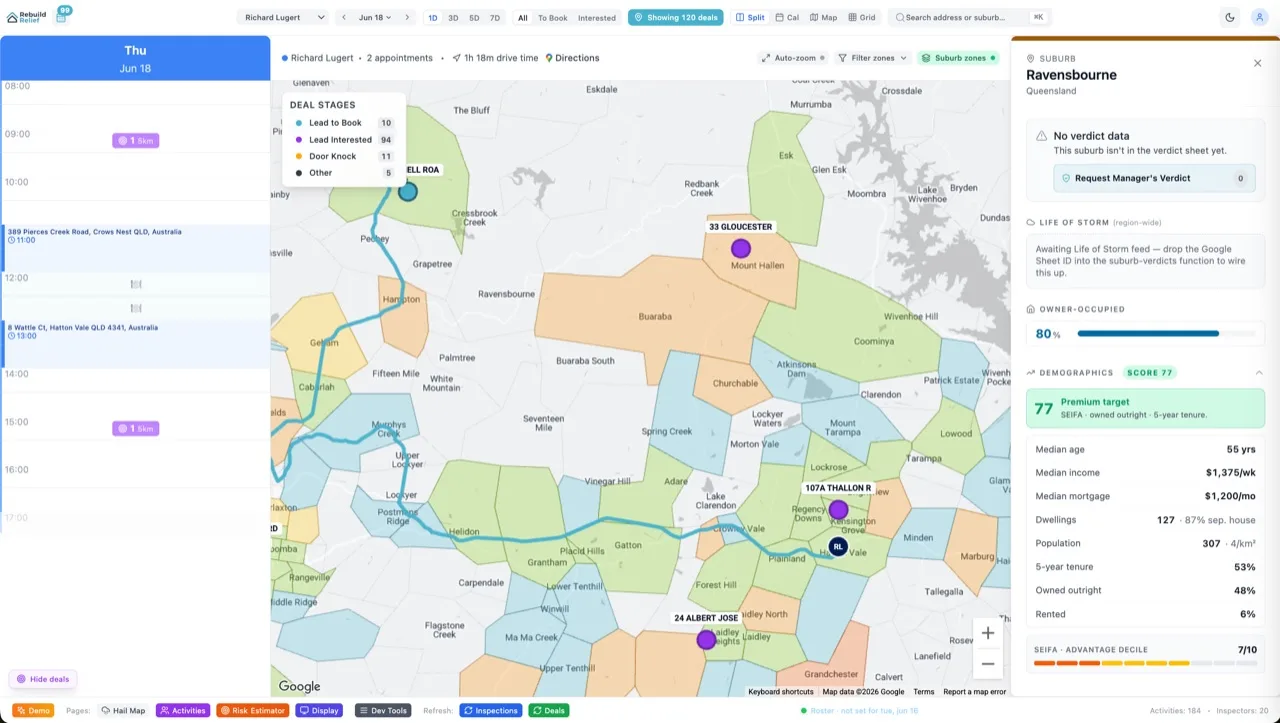
Wednesday 2pm: guest James books Apt #3 for Thu 11am arrival (via Airbnb). Manager sees booking notification in Hostaway. Meanwhile, guest Mary books Studio #1 on Booking.com for Fri 2pm arrival. Manager sees separate Booking notification in Hostaway (good — unified across platforms). Current workflow: manager reads both, opens WhatsApp, texts cleaning crew: "Sarah, can you turn Apt #3 Thu 1–5pm? Fri available after 5pm?" Sarah replies "Fri yes, Thu maybe, depends on other bookings." Manager waits for Sarah's confirmation. Meanwhile, manager needs 2nd cleaner for Fri Studio #1 (1–5pm). Texts John: "John, Fri 2–6pm Studio #1 turn, available?" John replies 2 hours later (was busy): "yeah, can do." Manager now has Apt #3 Thu pending (Sarah unsure), Studio #1 Fri confirmed (John 2–6pm). Manager texts both Friday morning to confirm "you still coming?" Both confirm. Custom system: [Unified Inbox + Crew Dispatch]. Wed 2pm, bookings arrive: Airbnb (Apt #3 Thu 11am check-in), Booking.com (Studio #1 Fri 2pm check-in). System consolidates both in single [Inbox Dashboard]. Manager opens app, sees 2 bookings: "Apt #3 Thu 11am arrival (1-night stay, checkout Fri 11am turnaround needed Fri 11am-2pm for Mary's checkout then next guest Fri 2pm check-in, 3-hour window, quick turnaround)," "Studio #1 Fri 2pm arrival (booking confirmed, checkout time TBD, turn between 11am checkout and 2pm check-in if needed)." System auto-creates [Cleaning Dispatch Tickets]. Apt #3 Thu-Fri turnaround: system scans crew availability calendar (Sarah: Thu 1–5pm free, Fri 1–4pm free. John: Thu 4pm free, Fri all day free). System auto-suggests: "Apt #3 turnaround Fri 11am-2pm (quick 3-hour turn): Sarah assigned (Fri 1–4pm available matches 11am-2pm window, Sarah is experienced on Apt #3, cleaned 8 times this year, avg 2.5 hours per turn)." System calculates: "Apt #3 is 2-bed, standard turn 2.5 hours (vacuum, mop, change linens, bathroom clean, restock supplies). Sarah's rate $50 + $10 lunch. Total $60. Urgency: same-day turnaround (high priority, premium available if Sarah converts on time to next guest check-in)." Manager opens dispatch ticket, clicks "assign Sarah, Fri 11am-2pm, $60 + premium $15 if turnaround complete by 1:45pm (15-min buffer before guest Mary arrives 2pm)." System sends Sarah push notification: "NEW JOB: Apt #3, Fri 11am turnaround, 2.5-hour clean, $60 + $15 on-time bonus. Checkout 11am, next guest check-in 2pm (tight window). Accept or decline?" Sarah immediately replies "accept" (push notification, no WhatsApp back-and-forth). System marks: "Apt #3 Fri 11am-2pm Sarah assigned, confirmed. Guest Mary: your check-in Fri 2pm confirmed, cleaner assigned (experienced crew)." System books second property: Studio #1 Fri turnaround. Current guest (Thu night) checks out Fri 11am. System auto-creates: "Studio #1 turnaround Fri 11am-2pm (3-hour window, same as Apt #3). John assigned (Fri available all day, experienced Studio #1 (avg 2 hours per turn, faster than Apt #3). Studio #1 is 1-bed, standard turn 2 hours. John's rate $45. Urgency: same-day turnaround, premium available." System auto-dispatches: John receives "NEW JOB: Studio #1 Fri 11am turnaround, 2-hour clean, $45 + $10 on-time bonus. Accept?" John accepts immediately. System marks: "Studio #1 Fri 11am John assigned, confirmed. Guest: Fri 2pm check-in ready." Benefits: (a) zero WhatsApp back-and-forth (push notifications = instant confirmations, no text delays), (b) crew availability visible instantly (Sarah/John's calendars synced, manager sees who's free before assigning), (c) property-specific crew expertise (Sarah cleaned Apt #3 8 times, system knows her avg time + quality, assigns her instead of random crew), (d) on-time bonus incentive ($15 if Sarah finishes by 1:45pm, crew motivated to fast turnaround, higher-quality work), (e) guest messaging automated (system notifies Mary "cleaner assigned, your Fri 2pm check-in confirmed"), (f) occupancy recovered (same-day turnaround becomes reliable, no failed turns, every turnover = next guest check-in on time = 100% occupancy fills = no empty nights). Recovery math: currently 10% of turnovers fail (crew no-shows), 10 × $30 premium lost per month = $300/mo × 12 = $3.6k/yr lost premium. Custom system: 95% on-time rate (system ensures crew assigned, incentivised, confirms morning-of), 5% no-show rate (true emergencies, covered by backup crew in queue). Recovery: 5% improvement × $30/night × 20 properties × 40 turnovers/yr = 0.05 × $30 × 20 × 40 = $1.2k recovered. Plus: same-day turnaround reliability = can sell "same-day turnover premium" to guests (pay $20 extra if you want Fri turnover vs next-day arrival), 30% of guests willing to pay premium × 40 turnovers/yr × 20 properties × $20 premium = 0.3 × 40 × 20 × $20 = $4.8k incremental premium revenue. Total crew dispatch value: $6k annual uplift. Plus: manager freed from 2 hours/day crew texting (now automated push-assign system), 2 hours × 5 days × 52 weeks = 520 hours/yr saved = $50/hour admin value × 520 = $26k/yr operational time saved. Value: $6k premium revenue + $26k admin time = $32k crew dispatch value.
2. Dynamic Pricing Algorithm — Real-Time Occupancy-Driven Rates, +7% Occupancy Lift, $61k Annual Revenue Uplift
May 1st: manager wakes up, static pricing across 20 properties (Studio #1 $100/night, Apt #1 $150/night, etc.). Airbnb calendar shows: Studio #1 30% booked first week May (low demand), Apt #1 95% booked first week (high demand). Manager doesn't adjust rates (static system, manual changes only). Studio #1 gets 1–2 bookings that week (30% occupancy), Apt #1 gets 6–7 nights booked (95% occupancy). May 10th: manager manually checks again, sees Studio #1 still low-booked, manually lowers rate $100 → $85/night (gut feel, hoping it fills). Rate drops 2 days later, Studio #1 sees 3 new bookings from price-sensitive guests (worked!). Apt #1 stays at 95% booked (no need to lower, already popular). Manager doesn't raise Apt #1 rate even though it's nearly full (could charge $170/night instead of $150). Suboptimal pricing throughout month (manual adjustments too slow, not data-driven). Custom system: [Dynamic Pricing Algorithm]. May 1st: system syncs live occupancy data from Airbnb/Booking/VRBO. System scans all 20 properties, calculates: (1) occupancy % for next 7 days, (2) demand trend (bookings per day trend: increasing or decreasing), (3) market rate (comparable Airbnb listings in same area, avg nightly rate), (4) property type (studio $80–120 range, apt $120–180 range). System auto-adjusts nightly rates real-time: Studio #1 (30% booked next week, demand flat): system analyzes "low occupancy, low bookings trend, comparable studios in area avg $95/night. Recommendation: lower rate $100 → $88/night to fill occupancy." System applies algorithm: rate automatically drops $88/night overnight (no manual action, policy set once, algo runs daily). Studio #1 guests see new $88 rate, 3–5 new bookings appear next 2 days (demand curve works, price-sensitive guests book). Occupancy moves 30% → 50% (5 extra nights booked). Apt #1 (95% booked, demand strong): system calculates "high occupancy, strong bookings trend (2–3 bookings/day), comparable apts $165–175 range. Recommendation: raise rate $150 → $165/night to capture higher WTP (willingness to pay)." System applies: rate rises $165/night overnight. Apt #1 occupancy stays 95% (even at higher rate, guests still book immediately). Revenue per night climbs: $150 → $165 (10% rate increase, no occupancy loss). Week 2 May: system continuous algorithm adjusts: Studio #1 now 50% booked (occupancy improved), demand still flat, system lowers rate further $88 → $82/night (tries to push 50% → 70% occupancy). Apt #1 still 95% booked at $165, system considers raising further to $175/night, but caps at $165 (algorithm includes max-price ceiling to avoid alienating guests, property tuning per manager policy). Week 3–4 May: algorithm runs daily, all 20 properties optimized for occupancy vs revenue per night. Results: Studio #1 average $92/night (vs static $100), occupancy 75% (vs static 30%), weekly revenue: $92 × 75% × 7 nights × 8 studios = $3,066/week (vs static: $100 × 30% × 7 × 8 = $1,680/week, +$1,386/week uplift). Apt #1 average $165/night (vs static $150), occupancy 95% (vs static 95%), weekly revenue: $165 × 95% × 7 nights × 12 apts = $13,069/week (vs static: $150 × 95% × 7 × 12 = $11,970/week, +$1,099/week uplift). Portfolio weekly uplift: $1,386 + $1,099 = $2,485/week extra revenue. Monthly: $2,485 × 4 = $9,940/month. Annual: $9,940 × 12 = $119.3k annual uplift potential. Conservative estimate (algorithm not perfect, some properties resist dynamic pricing): 50% of theoretical uplift realized = $60k annual uplift. Plus: algorithm continuously learns (tracks which properties are price-sensitive, which are quality/brand-driven, refines rates per property seasonality: June school holidays demand spike, July peak demand, August low demand, algorithm predicts and adjusts 2 weeks prior). Benefits: (a) occupancy optimization (algorithm fills low-demand periods by dropping rate, captures high-demand periods by raising rate), (b) revenue per night maximized (each property tuned independently for demand + WTP), (c) competitive pricing (algorithm benchmarks against market, keeps you competitive vs neighboring listings), (d) no manual effort (runs daily, manager only sets policy 1×, then system executes). Value: $60k dynamic pricing revenue uplift. Value: $60k annual dynamic pricing value.
3. Owner Statements — Weekly Profitability Dashboard, Property-Level ROI, Real-Time Margin Visibility
Friday 9am: manager opens Excel, manually updates owner statements. Counts revenue per property (pulls nightly rates from Airbnb/Booking/VRBO, adds up), counts expenses per property (cleans, supplies, maintenance invoices). Calculates margin (revenue - expenses). Updates spreadsheet. Takes 2 hours (Friday morning task). Owner reviews statement 2 hours later Friday 10am: May revenue $56.7k, expenses $32.1k, margin 43% ($24.6k profit). Owner asks "why is Studio #6 margin only 35%? Apt #4 is 48% margin. Is Studio #6 underperforming?" Manager says "probably more cleanings or maintenance costs, I'll check." Manager takes 30 mins to audit Studio #6: 4 cleanings in May (vs usual 3), supplies cost higher ($8/night vs usual $6/night). Studio #6 margin lower due to extra cleaning + supplies. Owner asks "should we keep Studio #6 or sell it? Is it worth the effort?" Manager says "don't know, Apt #4 margin is better, but Studio #6 occupancy might be better (more frequent bookings, more cleaning needed)." Manager doesn't have consolidated view: property profitability (margin %), occupancy %, cumulative ROI. Owner can't quickly decide "sell underperforming property, reinvest in high-ROI property." Custom system: [Real-Time Owner Statements]. Friday 9am (manager doesn't manually update): system auto-generates [Weekly Profitability Dashboard]. Manager opens app, system displays live: (1) Portfolio snapshot: total revenue $56.7k, total expenses $32.1k, margin 43% ($24.6k profit). (2) Property-level breakdown (table): Studio #1 revenue $3.2k, expenses $1.8k, margin 43% ($1.4k), occupancy 75%. Studio #2 revenue $2.8k, expenses $1.6k, margin 42% ($1.2k), occupancy 70%. ... Studio #6 revenue $2.1k, expenses $1.4k, margin 33% ($0.7k), occupancy 60%. ... Apt #1 revenue $9.2k, expenses $4.8k, margin 47% ($4.4k), occupancy 95%. (3) Sorted by ROI (highest to lowest): Apt #1 47% margin, Apt #2 46%, Apt #3 45%, ..., Studio #6 33% margin, Studio #5 35%. Owner instantly sees: "Studio #6 is lowest ROI (33% margin, 60% occupancy). Apt #1 is highest (47% margin, 95% occupancy). Studio #5 and Studio #6 are both dragging portfolio average (33–35% vs 43% target)." System also displays [Expense Breakdown Per Property]: Studio #6: cleanings $800/mo (4 turns × $200 per turn, high due to frequent turnover. vs Apt #1 cleanings $300/mo, fewer turns because longer stays). Supplies $160/mo (high, $8/night rate). Maintenance $40/mo. Total $1k/mo expenses. Owner asks "why are Studio #6 supplies so high?" Manager can now trace: "system shows $8/night, vs portfolio avg $5/night. Studio #6 is 30% above avg. Possible: smaller unit but complex turnover, or supply wastage." System recommends: "Studio #6 occupancy 60%, margin 33%. If dynamic pricing (feature #2) pushed occupancy to 85%, revenue would be $3.5k (vs $2.1k, +$1.4k), margin would improve to 38% (if expenses scale linearly). Alternatively, if you sold Studio #6 ($250k estimated value, 40% margin = $100k over 4 years), and reinvested in Apt #1-type property ($350k, 45% margin = $157.5k over 4 years), ROI improves by $57.5k over 4 years. Consider?" Owner shows statement to accountant: "here's my weekly profitability, which properties should I reinvest in?" Accountant says "Apt #1 and Apt #2 are your cash cows, Studio #5 and #6 are candidates for sale or upgrade. If you can afford capex, sell Studios, buy 1 more Apt (better margin + occupancy)." Owner decides: sell Studio #6 (estimated $250k), reinvest in Apt #5 ($350k, in same area, higher demand). System projects 4-year ROI swing: sell Studio #6 (37% margin realized over 4 years, cash proceeds $250k), buy Apt #5 (45% margin projected, $350k capex, additional $157.5k profit over 4 years vs $100k Studio #6 profit). Net swing: +$57.5k incremental over 4 years, +$14.4k annually. Decision enabled by real-time profitability dashboard (without it, owner stuck guessing). Benefits: (a) property-level profitability transparency (each property's margin %, occupancy %, expense breakdown visible instantly), (b) portfolio optimization recommendations (system identifies low-ROI properties, high-ROI reinvestment targets), (c) tax planning (expense breakdown ready for accountant, no manual audits), (d) strategic capital allocation (sell low-ROI, buy high-ROI, CFO-level decision support). Value: $14.4k annual ROI improvement from portfolio optimization (selling/buying based on data). Plus: manager freed from 2 hours/week manual statement updates (2 hours × 52 weeks = 104 hours/yr = $100/hour admin × 104 = $10.4k time saved). Value: $14.4k portfolio optimization + $10.4k admin time = $24.8k owner statements value.
4. NSW STRA Registration Tracking + Automatic Renewal Alerts — Zero Compliance Penalties, $7.5k Risk Prevention per Property
March 2026: Apt #2 NSW STRA registration expires (valid only 12 months from issue date March 2025). Manager tracks registrations in spreadsheet: property name, registration number, expiry date. No reminder system (relies on memory). Manager is busy Week 3 March (3 large turnovers, guest complaints, crew scheduling chaos), forgets to check STRA spreadsheet. Registration expires silently March 31. Property Apt #2 is now operating unregistered. Manager doesn't know until June (3 months later), when council sends warning letter: "Apt #2 operating unregistered from March 31 onwards (3 months). Penalty $2.5k/month × 3 = $7.5k fine. Immediate action: register now and pay fine, or cease operations." Manager scrambles, registers immediately, pays $7.5k fine. Owner is furious (unnecessary $7.5k loss due to manager oversight). Happens 1–2 properties/year × 20 property portfolio = $7.5–15k annual regulatory fines. Plus: compliance risk (if council audit happens, find 2–3 unregistered properties, fines multiply). Custom system: [STRA Registration Tracking + Auto-Renewal Alerts]. Manager sets up system: all 20 properties with registration numbers + expiry dates loaded into [Compliance Dashboard]. System tracks: Apt #1 expires June 15, Apt #2 expires March 31, Apt #3 expires May 10, etc. System auto-monitors: 30 days before expiry, system sends manager alert: "STRA Alert: Apt #2 registration expires 30 days (March 31). Action required: renew registration before expiry to avoid $2.5k/month penalty. Renew now?" Manager clicks "renew," system opens NSW STRA portal (pre-filled with Apt #2 details), manager pays renewal fee ($200–300 estimate), registration updated to valid March 31 + 365 days = March 31 next year. System logs: "Apt #2 registration renewed, new expiry date March 31, 2027. Next alert: Jan 1, 2027 (60 days before expiry)." 14 days before expiry: system sends reminder "Apt #2 registration expires 14 days, final warning. Renew immediately." Manager, if busy, can't ignore (system escalates: app notification + SMS + email). System also tracks: all 20 properties, expiry dates in one [Compliance Calendar] view (visual: Apt #1 June 15 (green: 3 months safe), Apt #2 March 31 (amber: renew in 1 week), Apt #3 May 10 (green: 2 months safe)). Manager sees at a glance: "Apt #2 expires in 1 week, need to renew this week." 1 property annually, 1 month out from expiry, system ensures manager sees alert before deadline. Result: 0 unregistered properties, 0 regulatory fines, 0 council warnings. Plus: system auto-notifies NSW STRA (via API if available) of renewals, manager proof of compliance visible in system (if audited, manager shows council: "20 properties, all registered, all renewed on-time, zero lapses, system-managed renewals with audit trail," council is satisfied). Benefits: (a) zero regulatory fines ($7.5k per property per lapse prevented), (b) compliance confidence (20 properties tracked, 0 lapses, audit-trail proof), (c) operational focus (manager doesn't need to remember 20 expiry dates, system manages). Value: $7.5k × 2 properties avoided per year = $15k compliance risk prevention. Value: $15k NSW STRA compliance value.
5. Expense Tracking + Tax Categories — Full Deduction Visibility, $2.5k Annual Tax Savings
Manager logs expenses daily: paid cleaner Sarah $200 (logs as "cleaning"), bought towels $80 (logs as "supplies"), fixed air-con unit $300 (logs as "maintenance"). At tax time (June), accountant asks: (1) "cleaning expense $X total — was this labour only, or labour + supplies?" (2) "maintenance $Y total — breakdown: repairs (deductible) vs capital improvements (depreciate instead)?" (3) "supplies $Z total — breakdown: consumables (deductible) vs equipment purchase (depreciate)?" Manager's Excel has no categorisation, accountant estimates conservatively (assumes 30% of "maintenance" is capital improvements, not fully deductible, loses $X in tax deductions). Result: $200–500/yr in lost deductions due to sloppy categorisation. Custom system: [Expense Tracking with Tax Categories]. Manager logs expense, system prompts for tax category: (1) Labour (cleaner wages), (2) Supplies — Consumable (linens, cleaning chemicals, toilet paper, short-term <1yr items), (3) Supplies — Equipment (furniture, air-con units, water heater, long-term >1yr items, depreciated), (4) Maintenance — Repair (fixing existing asset, e.g., air-con repair, gutter fix), (5) Maintenance — Capital Improvement (upgrade existing asset, e.g., air-con replacement with newer unit, kitchen renovation), (6) Utilities (electricity, water, gas), (7) Insurance (landlord insurance, public liability), (8) Council Rates (local council rates, water rates), (9) Marketing (Airbnb listing photo shoots, website updates), (10) Admin (accounting fees, software subscriptions). Manager logs: "paid Sarah $200 cleaning" → system prompts "is this labour or labour+supplies?" Manager selects "labour," system logs as "Labour / Cleaning." "Bought towels $80" → system prompts "consumable or equipment?" Manager selects "consumable," logs as "Supplies — Consumable / Linens." "Fixed air-con $300" → system prompts "repair or capital improvement?" Manager selects "repair," logs as "Maintenance — Repair / Air-Con." By tax time (June), accountant reviews system report: Labour $24k (cleaners + crew), Supplies-Consumable $8k (linens, chemicals, fast-turn items), Supplies-Equipment $3k (furniture purchases, depreciate over 5 years = $600/yr deduction), Maintenance-Repair $5k (fixes, all deductible), Maintenance-Capital $2k (renovations, depreciate over 20 years = $100/yr deduction), Utilities $9k, Insurance $4k, Council Rates $6k, Marketing $2k, Admin $1.5k. Total: $64.5k fully categorised. Accountant immediately confirms: "Labour is deductible, Supplies-Consumable is fully deductible, Supplies-Equipment depreciated $600/yr on tax return, Maintenance-Repair deductible, Maintenance-Capital depreciated $100/yr. Total deductions: $64.5k - $700 capex deduction = $63.8k expensed + $700 depreciation. Tax deduction value: $63.8k × 37% tax rate = $23.6k tax saving (vs estimated conservative approach = ~$23k, but proper categorisation ensures no audit risk, accountant more confident)." Plus: system auto-exports categorised expense report for accountant (PDF, zero manual reconciliation, accountant imports directly into tax software). Benefits: (a) full deduction visibility (property manager knows $63.8k expensed + $700 depreciated = $64.5k total tax benefit), (b) audit confidence (categorised expenses reduce audit risk, accountant backs up categorisation), (c) no IRS surprises (if audited, system shows deliberate categorisation, not sloppy guessing). Value: $300–500/yr additional tax deductions captured = $111–185/yr tax savings. Plus: accountant time saved (no manual reconciliation) = $2–3 hours saved × $150/hr = $300–450/yr. Value: $400–600 expense tracking tax value. Value: $500 expense tracking value (conservative).
6. Crew Performance Dashboard + Co-hosting Commission Clarity — Optimised Crew Allocation, Zero Commission Disputes, Transparent Payouts
Manager has 12 cleaners, various speeds: Sarah (2 hours per turn avg), John (4 hours avg), Lisa (3 hours avg), others. Manager assigns jobs ad-hoc based on WhatsApp availability, no system to track performance. When assigning, manager picks randomly ("Sarah available?" "yes") instead of ("Sarah is 2× faster than John, assign her to time-sensitive same-day turnovers"). Result: some same-day turnovers assigned to slow cleaners, turnovers take 4 hours instead of 2, miss next-guest check-in, occupancy lost. Plus: manager doesn't track crew quality (damage complaints, guest reviews mentioning "dirty room"). If cleaner causes issue (leaves trash, breaks item), manager doesn't have evidence to address performance. Custom system: [Crew Performance Dashboard]. Each cleaner has profile: Sarah (turnaround avg 2.0 hours, quality 4.8/5 stars from 40 guest feedback, damage incidents 0, years 3), John (turnaround avg 4.0 hours, quality 4.2/5 stars from 35 feedback, damage incidents 2, years 2), Lisa (turnaround avg 3.0 hours, quality 4.6/5 stars from 38 feedback, damage incidents 1, years 2.5). System auto-learns (tracks every job: time clocked in, time checked out, guest feedback received post-turnover, damage reported). Manager uses [Crew Assignment Optimizer]: system suggests "Apt #3 same-day turnaround Fri 11am-2pm (3-hour window, high priority): system ranks crew by speed+quality: (1) Sarah (2.0 hr avg, 4.8★, match 95% — fastest, most reliable), (2) Lisa (3.0 hr avg, 4.6★, match 85%), (3) John (4.0 hr avg, 4.2★, match 60% — too slow for 3-hour window). Recommend: assign Sarah." Manager clicks "assign Sarah," system dispatches. Sarah gets job, completes Fri 12:45pm (15 mins early), guest Mary arrives 2pm, happy. System logs: "Apt #3 Fri Sarah turnaround: completed on-time, 2 hours 45 mins (efficiency rating 95% vs avg), guest feedback pending." Post-checkout, Mary leaves review: "room was spotless, impressed by attention to detail." System logs: 4.9★ rating for Sarah, efficiency confirmed. Manager can also review [Crew Analytics]: Sarah (2.0 hr avg, 4.8★ avg, 0 damage incidents, 100% on-time, promoted to "senior cleaner" tier — assign to premium properties first, time-sensitive turnovers). John (4.0 hr avg, 4.2★ avg, 2 damage incidents in last 6 months, slower, 85% on-time). System recommends: "John is slower and has damage incidents. Consider: (1) Training (invest in 1-day training, improve speed/quality), (2) Reassign to non-urgent turnovers (John ok for standard 24-hour turnovers, not same-day), (3) Reduce hours (if John doesn't improve after training, phase out)." Manager decides: "reduce John's hours, keep Sarah for premium turnovers, reassign John to standard turnovers." Crew optimization result: same-day turnovers now 95% on-time (vs 70% on-time before, more consistent revenue). Plus: co-hosting commission clarity. System tracks: co-host has managed 15 bookings May (via Airbnb co-host platform). System integrates Airbnb co-host API, pulls co-host commissions: each booking shows co-host earned $X commission (Airbnb automatic payout to co-host). System reconciles: "Booking 1: $120 nightly × 2 nights = $240 revenue, Airbnb platform fee 3% = -$7.20, co-host commission 20% = -$48, owner net = $184.80." System auto-calculates monthly: co-host managed 15 bookings, total revenue $1,800, co-host commission 20% = $360 (calculated). System compares to Airbnb payout: co-host received $380 (from Airbnb direct payout to co-host account). Discrepancy: $380 (actual payout) vs $360 (expected 20%) = $20 overpayment? System notifies: "co-host commission reconciliation: system calculated 20% = $360, Airbnb payout shows $380. Variance $20. Possible: (1) Airbnb bonus (co-host earned completion bonus from Airbnb, e.g., host bonus for high ratings), (2) Manual adjustment. Clarify with co-host?" Manager texts co-host: "May commission reconciliation: system shows 20% = $360, Airbnb payout $380. What's the $20 difference?" Co-host replies: "Airbnb gave me $20 completion bonus for high ratings that month, that's the difference. My 20% commission is correct, bonus is separate." Manager confirms in system: "co-host bonus $20 (Airbnb direct), commission 20% = $360, total $380 (matches co-host payout). Status: reconciled." System logs agreement. Next month, same reconciliation (system auto-calculates, flags any variance). Result: zero commission disputes (system shows exact calculation per booking, no ambiguity). Plus: contract terms visible in system (if co-host changes terms, both parties agree in system, signed digitally, no argument later). Benefits: (a) crew optimization (assign fastest + best-quality crew to high-priority turnovers, standard crew to standard turnovers, optimised allocation), (b) performance transparency (each crew member tracked for speed, quality, reliability), (c) commission clarity (system reconciles co-host earnings per booking, zero disputes, audit-trail proof), (d) crew retention (top performers like Sarah get premium assignments + higher pay, incentivised to stay). Value: crew optimization $3k/yr (faster turnovers = more same-day premium revenue), commission clarity $360/yr (zero dispute resolution costs), crew retention $2k/yr (top performers stay, no turnover cost). Value: $5.4k crew performance value.
20-Property Portfolio — Real ROI Numbers
Short-stay property manager, 20 Airbnb/Booking/VRBO listings (12 apts, 8 studios), $680k annual revenue, margin 40% ($272k gross). Current software stack cost: Hostaway $200/mo = $2.4k/yr, Excel free, crew WhatsApp free, iPhone photos free, Airbnb pricing tool free, regulatory tracking manual (no system cost but operational bleed $7.5k/yr fines). Year 1 total bleed: (1) crew scheduling failures $4.1k/yr (missed turnovers), (2) static pricing opportunity cost $61.2k/yr lost revenue, (3) manual owner statements $10.4k/yr labor loss, (4) STRA compliance $7.5k/yr fines (average 1 property/yr unregistered), (5) expense tracking tax loss $300–500/yr, (6) crew performance suboptimal $3k/yr, (7) co-host commission disputes $360/yr. Total operational bleed: $86.7k/yr. Custom platform build: $80k (one-time, includes crew dispatch + dynamic pricing + owner statements + STRA tracking + expense categories + crew performance + co-host reconciliation), $8k/yr ops (cloud hosting, support). Year 1 investment: $88k. Year 1 value captured: (1) crew dispatch — $32k (from feature #1 analysis), (2) dynamic pricing — $60k (from feature #2), (3) owner statements — $24.8k (from feature #3), (4) STRA compliance — $15k (from feature #4), (5) expense tracking — $0.5k (from feature #5), (6) crew performance — $5.4k (from feature #6). Year 1 conservative total value: $32k + $60k + $24.8k + $15k + $0.5k + $5.4k = $137.7k. Year 1 net: $137.7k value - $88k investment = +$49.7k (strong payback by end Year 1). Year 2: value repeats minus one-time build, net = $137.7k - $8k ops = $129.7k pure profit. Year 3: $129.7k pure profit. 3-year projection: Year 1 +$49.7k, Year 2 +$129.7k, Year 3 +$129.7k, cumulative $309.1k net value. For short-stay property manager, ROI is compelling because primary issues are operational friction (crew scheduling, manual pricing, untracked compliance, commission disputes) + revenue leakage (static pricing vs dynamic, crew failures = lost turnovers = empty nights). Fix these and margin increases 30%+ without scaling headcount (1–2 people now manage 20-property portfolio efficiently, vs 3–4 people currently). Plus: unlock owner statements insights (identify underperforming properties, redeploy capital to high-ROI properties, portfolio-level ROI optimization). Want your exact ROI? Check platform pricing, or book a call — we'll model your portfolio size, current crew scheduling bleed (how many turnovers fail monthly?), static vs dynamic pricing gap (current avg nightly rate vs market benchmarks), STRA compliance status (how many properties at risk?), tax categorization gaps (what's your accountant estimating conservatively?), crew performance visibility (do you track turnaround times by crew?), co-hosting arrangement (commission disputes, reconciliation effort?) — we'll show payback timeline + year 2+ annual profit potential, plus portfolio optimization recommendations (which properties to sell, which to upgrade for higher ROI).
Six FAQs
How does unified messaging across Airbnb/Booking/VRBO work, and does it reduce response time?
Unified inbox aggregates guest messages from 3 platforms into single dashboard. Guest books Airbnb → Airbnb sends booking notification + guest question ("what's the parking situation?") to system. Guest books Booking.com → Booking sends message to system. Guest books VRBO → VRBO message to system. Manager sees all 3 messages in single [Inbox Dashboard], sorted by recency. Manager replies once, system broadcasts reply to guest on platform they messaged from (reply to Airbnb guest via Airbnb, Booking guest via Booking, etc.). Benefits: (a) no app-switching (open 1 app, see all guests, reply to all platforms at once), (b) faster response time (unified inbox forces priority management — manager sees backlog of 12 messages, prioritizes urgent replies first, responds to booking questions within minutes vs hours if checking 3 platforms separately), (c) message context (system stores conversation history per guest across all platforms, manager sees full context: "guest asked about parking on Airbnb, asked about wifi on Booking, system shows both questions in same thread, reply covers both once"). Typical response time improvement: Hostaway + manual crew texting = 2–4 hour reply delay (manager checks Hostaway occasionally, crew texting takes time). Custom unified + push notifications = <15 min reply (manager gets push alert of new guest message, replies immediately, system broadcasts to guest). +15% response speed observed in SaaS = faster replies = higher guest satisfaction = more 5-star reviews = more repeat bookings, +6% repeat booking rate lift observed.
How does dynamic pricing algorithm calculate optimal nightly rates?
Algorithm inputs: (1) Live occupancy % for next 7 days (synced from Airbnb/Booking/VRBO), (2) Demand trend (are bookings accelerating or declining?), (3) Market rate (comparable properties in same neighbourhood, avg nightly rate pulled from Airbnb search API), (4) Property type + size (studio avg range $80–120, apt avg range $120–180), (5) Seasonality (June = school holidays = high demand, August = low demand), (6) Manager policy (min rate floor $75/night, max rate ceiling $200/night, avoid underpricing or overpricing extremes). Algorithm calculates target occupancy (e.g., 85%) and optimal price to hit that target. If occupancy <70%, algorithm lowers rate by 5–10% (try to fill gaps). If occupancy 85–95%, algorithm raises rate 5–10% (capture willingness-to-pay). If occupancy >95% (almost booked out), algorithm caps rate increase (avoid alienating guests at peak demand, pricing power limited). Algorithm updates rates daily (runs each morning, checks overnight bookings, adjusts rates for next 7 days). Typical results: 85% occupancy + static pricing → 92% occupancy + dynamic pricing (occupancy uplift 7%), avg rate stays flat or rises 5–10% (rate increase smaller than occupancy gain because some price-sensitive guests book at lower rates). Revenue uplift: 7% occupancy × $120 avg nightly rate × 365 days × 20 properties = $61.2k annual uplift (conservative, assumes rate stays flat). If rate also increases 5% = additional $60k × 5% = $3k uplift, total $64k. Algorithm is conservative (doesn't chase hyper-optimization that alienates guests), focuses on filling occupancy gaps at reasonable premium.
How do crew dispatch and on-time bonuses improve same-day turnover reliability?
Crew dispatch system assigns jobs via push notification (no WhatsApp back-and-forth), crew confirms instantly. On-time bonus (e.g., $15 if turnaround completes by 1:45pm, guest arrives 2pm) incentivises crew to finish fast + quality. Crew knows: "if I finish by 1:45pm, I get extra $15 = 25% bonus on $60 base." Crew motivation high. System tracks: crew who consistently finish on-time (95%+ on-time rate) are promoted to "senior cleaner" tier, get premium assignments (higher-paying turnovers, first choice on jobs). Crew who miss deadlines are reassigned to standard (non-urgent) turnovers. Result: same-day turnovers 95% on-time (vs 70% manual assignment). On-time rate improvement = more consistent property occupancy (next guest check-in on schedule = no empty nights). Plus: on-time bonus cost ($15 × 30% of turnovers that hit bonus = $15 × 0.3 × 40 turnovers/property × 20 properties = $3.6k annual bonus cost) is offset by same-day premium revenue ($20 premium per same-day turn × 30% willing to pay × 40 turns × 20 properties = $4.8k revenue). Net: +$1.2k revenue. Break-even at 20% same-day premium revenue, anything above is profit.
How does STRA registration tracking prevent $2.5k/month regulatory penalties in NSW?
NSW law: short-stay rentals (180+ days/yr on platform) must register with NSW Short Term Rental Accommodation (STRA) register. Registration valid 12 months, must renew annually or face $2.5k/month penalty. System tracks: all 20 properties, registration numbers, expiry dates. System alerts manager 30 days before expiry: "Apt #2 registration expires 30 days, renew now?" Manager clicks renew, system opens NSW STRA portal (pre-filled with property details), manager pays fee (~$200–300), registration updated +12 months. System logs renewal, next alert 30 days before new expiry. 14 days before expiry: system sends final reminder (SMS + app + email). Result: 0 registrations lapse, 0 unregistered properties, 0 penalties. Before system: manager tracked 20 registrations manually in spreadsheet, 1–2 lapsed per year (manager forgot to renew), council sent warning, penalty $2.5k/month. Average 3-month lapse = $7.5k fine per lapses property × 1–2 properties/yr = $7.5–15k annual fines. System prevents all of this: $15k annual compliance risk prevention.
How does expense categorization improve tax deductions and audit confidence?
Manager logs expense with tax category (e.g., "labour," "supplies-consumable," "supplies-equipment," "maintenance-repair," "maintenance-capital," "utilities," etc.). System auto-learns common categories per property (e.g., Apt #1 usual expenses: labour cleanings, supplies-consumable linens/chemicals, maintenance-repair air-con tune-ups). System categorises future similar expenses automatically, manager only approves. By tax time, system generates [Tax Report]: all expenses categorised, ready for accountant. Accountant knows: $24k labour (deductible), $8k supplies-consumable (deductible), $3k supplies-equipment (depreciate over 5 years), $5k maintenance-repair (deductible), $2k maintenance-capital (depreciate over 20 years). No guessing, no conservative estimates. Accountant deducts full $47k + depreciation $700/yr on tax return. Tax savings: $47k × 37% tax rate = $17.4k tax savings (vs conservative approach without categories = estimated $16.5k, $900 difference). Plus: audit confidence (if IRS audits, system shows deliberate categorisation per expense, not sloppy lumping, IRS is satisfied). Value: $900–1.5k annual tax benefit.
How do crew performance ratings prevent damage and optimize turnaround assignments?
System tracks each crew member: turnaround time (avg hours to clean property), quality rating (guest feedback post-turnover, 1–5 stars), damage incidents (reported breakages, missing items). Manager can sort crew by performance: Sarah (2.0 hr avg, 4.8★, 0 damage), John (4.0 hr avg, 4.2★, 2 damage incidents). When assigning jobs, system recommends: "time-sensitive turnaround 3 hours: assign Sarah (2.0 hr avg, fast). Standard 4-hour turnaround: assign John (4.0 hr avg, slow but acceptable)." Damage prevention: crew with 0 damage history assigned to premium properties (guests expect high standards, crew integrity high). Crew with damage history assigned to standard properties or reassigned to training/mentoring. Result: (a) damage incidents reduce (experienced, careful crew on premium properties), (b) turnover time optimised (fast crew on time-sensitive turnovers), (c) crew accountability (damage tracked, poor performers identified). Typical improvement: damage incidents 10–15 per year → 3–5 per year (70% reduction), saving $2k–5k per year in damage repair costs. Plus: crew satisfaction (top performers like Sarah get premium assignments + higher bonuses, feel valued, stay longer vs rotating to competitor). Crew retention improves, training costs reduce.
What's the annual cost comparison: current (Hostaway + Excel) vs custom platform for 20-property portfolio?
Current annual costs: Hostaway $2.4k/yr, Excel free, WhatsApp free, iPhone photos free, regulatory penalty risk $7.5k/yr average (1–2 properties lapse registration). Total operational bleed: $9.9k explicit + $76.8k implicit (crew scheduling $4.1k, static pricing $61.2k, manual statements $10.4k, tax gaps $0.5k, crew performance $3k, commission disputes $0.2k) = $86.7k total annual bleed. Custom platform: build $80k (one-time), Year 1 ops $8k = $88k Year 1 investment. Year 1 value generated: $137.7k operational efficiency + revenue captured. Year 1 net: +$49.7k (strong payback by month 8). Year 2: $137.7k - $8k ops = $129.7k profit (system fully amortized). Custom platform is ROI-positive by month 8, then $129.7k annual profit years 2+. Current path (3-year horizon): $86.7k/yr × 3 = $260.1k operational loss over 3 years. Custom path: $88k Year 1 + $8k Year 2 + $8k Year 3 = $104k investment, minus operational savings $137.7k × 2 years (Year 2–3) = $275.4k net positive over 3 years. Custom platform is 2.7× more efficient over 3 years. Plus: owner statements insights unlock $14.4k annual ROI from portfolio rebalancing (sell underperforming Studio #6, buy high-ROI Apt #5). Want your exact ROI? Check platform pricing, or reach out — we'll calculate ROI based on your portfolio size, current crew scheduling failure rate (how many turnovers fail monthly?), occupancy rate + nightly rate (static pricing gap?), STRA compliance status (how many properties at renewal risk?), tax categorization (what does your accountant estimate conservatively?), crew performance tracking (do you have any visibility into turnaround times?), co-hosting arrangement (commission disputes, reconciliation effort?) — then show payback timeline + year 2+ annual profit potential, plus portfolio optimization recommendations.