


Every January the same thing happens. Design Twitter explodes with trend predictions that look incredible in a Figma mockup and completely fall apart the moment a developer tries to build them for a real client with real content and real users on a 4G connection in regional Queensland.
So let us talk about the web design trends actually shipping in 2026 — not what looks good on a mood board — and which of them actually move the numbers that matter.
Partial Hydration Is Now Table Stakes
The biggest shift this year is not visual at all. It is architectural. The sites winning in 2026 are the ones that made the jump to partial hydration frameworks like Astro and server components in Next.js.
These are not new technologies anymore — they are table stakes. If your agency is still shipping a 2MB React bundle for a five-page marketing site, you are leaving money on the table. Literally. Google's ranking algorithm punishes slow sites, and your client's bounce rate proves it.
This is why we build on Astro with React islands: static-first pages that load in under a second and score 95+ on PageSpeed, with interactivity only where a page actually needs it.
Variable Fonts as a Performance Play
Variable fonts have finally hit mainstream adoption — not as a novelty, but as a performance play. One variable font file replacing four or five static weights means fewer network requests, smaller payloads, and smoother typography across breakpoints.
We are using Inter Variable and Geist on almost every project now. The days of loading Google Fonts from a CDN and hoping for the best are over.
The typography win compounds with the architecture win. A variable font served from your own domain, subset to the characters you actually use, loads once and renders everywhere — no flash of unstyled text, no layout shift, no third-party request in your critical path.
Bento Grids: Hierarchy or Noise?
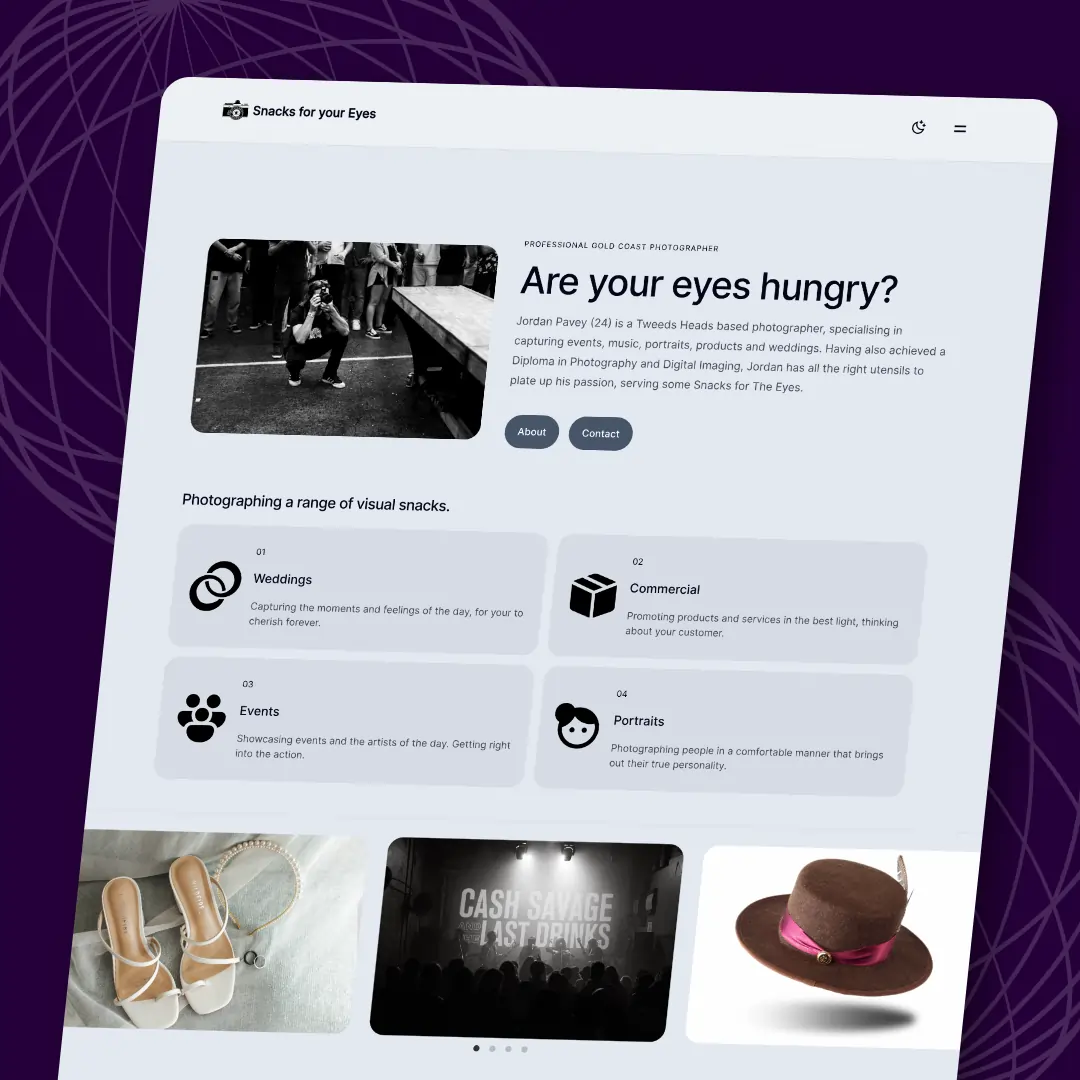
Bento grid layouts are everywhere, and I have mixed feelings about them. When done well — like Apple's product pages — they create visual hierarchy that actually guides the eye. When done poorly, which is most of the time, they are just a masonry grid with rounded corners and a gradient.
The difference is content density. Bento works when each cell has a clear purpose. It fails when designers fill cells with decorative noise because the grid demands it. Before you reach for a bento layout, ask whether your content genuinely has six-plus parallel things to say. If it does not, a simple stacked layout will communicate more with less.
Scroll-Driven Animations Without JavaScript
Micro-interactions and scroll-driven animations are the real winners this year. The CSS scroll-timeline API is now supported across all major browsers, which means you can build parallax effects, progress indicators, and reveal animations without a single line of JavaScript.
No GSAP. No Intersection Observer hacks. Pure CSS. This is a genuine game-changer for performance-conscious teams, because motion no longer has to cost you bundle size.
AI in Production Design Workflows
AI-generated design elements are creeping into production, but not the way you would expect. Nobody serious is shipping full AI-generated layouts. What is actually happening is designers using AI for texture generation, SVG pattern creation, and copywriting first drafts.
The tools are assistants, not replacements. If someone tries to sell you a fully AI-generated website, run. The output is generic, the code is bloated, and your brand will look like everyone else's.
Dark Mode Grows Up
Dark mode is no longer optional — it is expected. But the trend in 2026 goes beyond a simple colour inversion. The best dark modes now use carefully tuned surface elevation, where lighter shades of dark indicate elements closer to the user.
Material Design 3 popularised this, and it has become the standard. If your dark mode is just white text on a black background, you are doing it wrong.
Spatial Design and Depth
Spatial design is having a moment, largely driven by Apple Vision Pro's influence on web thinking. Even for 2D screens, designers are adding depth through layered glassmorphism, z-axis awareness in scroll interactions, and 3D elements via Three.js and WebGL.
We have been doing this for clients for years, and it is satisfying to see the industry catch up. The key is restraint — a subtle depth cue beats a spinning 3D model every time.
Trends That Convert vs Trends That Decorate
Here is the filter that separates a trend worth adopting from Dribbble bait: does it move a visitor closer to taking action, or does it just look impressive in a portfolio shot? That is the entire premise of conversion-focused web design, and it is ruthless with trends.
The death of the hero slider
The trend I am most excited about is the death of the hero slider. Carousels have been conversion killers for a decade, and designers are finally replacing them with static hero sections that load instantly and communicate a single clear message.
Your homepage has three seconds to convince someone to stay. Do not waste them on a sliding animation they will never see.
Performance is the trend that pays
Fast sites rank higher, convert better, and cost less to host. Every trend on this list that survives contact with real users is, at its core, a performance or clarity win. Everything else is decoration.
The Verdict
The best web design trend of 2026 is not a visual style at all — it is the industry finally optimising for outcomes over aesthetics. Partial hydration, variable fonts, CSS-native motion, and honest static heroes all point the same direction: faster pages, clearer messages, better conversion rates.
If your site is still riding 2021's trends (or 2021's bundle sizes), that is fixable. Our web design service builds on exactly this stack — modern architecture first, trends only where they earn their place.