






Car hire business (regional NSW, established 2018, 2 staff, $420k annual revenue). Operates 20-vehicle fleet: 12 hatchbacks (Toyota Corolla, Hyundai i30, $65/day), 5 mid-size SUVs (Toyota RAV4, Mazda CX-5, $95/day), 3 premium (Toyota Camry, Lexus UX, $145/day). Revenue: daily rentals $340k (avg 12 vehicles/day × $77/day), corporate contracts $60k (8 clients × avg $625/month), damage recovery $12k (20 claims/yr × $600 avg), fuel surcharge $8k. Customer journey: online/walk-in booking → vehicle selection (check availability) → quote + upgrades (GPS, child seat, extra driver) → confirmation → pickup day (inspect condition, photos, sign, keys) → rental period (drive) → return (inspect, compare photos, damage disputes, final invoice with fuel + damage charges) → Stripe payment. Current stack: Excel calendar (fleet availability, manually updated), Google Sheets (customer database), Stripe (manual invoice links), WhatsApp (all comms), iPhone photos (pickup/return stored in gallery, 1000+ photos, hard to retrieve when disputes arise). Problem stack: (1) Double-Booking Chaos — Excel manual updates lag. Owner checks "RAV4 available 15-22 June?", sees "A" (available), sells to customer A. Same day, hasn't updated sheet, customer B walks in, owner checks Excel still shows "A," sells same RAV4 to customer B. Both show up June 15, one cancelled ($95 × 8 days = $760 lost), owner compensates with free upgrade (Camry instead, $50/day margin loss × 8 = $400 lost). Net: $1.16k per incident. Happens 2–3x/yr = $2.3–3.5k annual loss. (2) No Dynamic Pricing — $95/day RAV4 year-round. Peak season (school holidays, high demand), could charge $130/day (+$35 margin), but no demand data, leaves $35/day on table. June-Aug peak: 60 days × $35 × 5 RAV4s = $10.5k revenue leak. Off-peak winter, still $95/day, 50% utilization (vehicles empty). If dynamic pricing enabled: $75 off-peak offer fills 80% utilization (better than 50% sitting empty), margins optimize. Loss: $10.5k/yr peak revenue + $2–3k off-peak utilization loss. (3) Damage Disputes — No Photo Trail — customer John rents June 15-22, returns June 22 with dent on rear quarter (4cm, minor). John claims "dent was there when I rented it." Owner has no pickup photo (relies on memory: "vehicle was always perfect"). Dispute unresolved. Insurance claim filed, insurer says "no pickup photos, can't verify pre-rental condition, won't cover." Owner eats $800 repair. Happens 1–2x/month = $10–15k/yr losses. Plus: damage liability waiver customers ($20 extra for "damage forgiveness"), return with scratch, owner claims, customer disputes, no photos = customer doesn't pay, $800 lost. (4) Insurance Excess Tracking — fleet policy $2000 excess per claim. Customer Claire hits parked car (at-fault), claim filed, insurer charges owner $2000. Owner tries to recover from Claire: "I have travel insurance, shouldn't pay your excess." Dispute. Owner doesn't know if her travel insurance covers excess, goes back-and-forth, Claire refuses, owner writes off $2000. Happens 3–4x/yr = $6–8k/yr excess loss. Plus: tracking in spreadsheet is messy ("Claire, Corolla, claim 15 June, excess $2000, paid by: ?" — no system, prone to data loss). (5) Fuel + KM Miscalculation — customer David rents RAV4, drives 450km, uses ~30L fuel (RAV4 ~15L/100km). Return: owner checks fuel gauge (3/4 → 1/4 tank, estimates 50L used), charges $80 (50L × $1.60/L). David disputes: "only drove 420km, should be ~28L, I paid $45 fuel, you overcharge." Owner digs through 1000+ phone photos for pickup/return odometer pics, doesn't find quickly, refunds $35 without proof. No GPS tracking, no real-time odometer, no fuel-card integration = manual calculations, customer disputes, margin loss, time waste. (6) Corporate Recurring Hires — No Contract System — FastFreight logistics arranges recurring rentals: Mon-Fri, 2x hatchbacks, 5 weeks. Owner gets WhatsApp "need 2 cars Mon-Fri for 5 weeks, usual price?" Replies "yep, $65/day each, $650/week × 5 = $3.25k total, due end of month." Booked informally (no written agreement, no auto-renewal). Week 1–5, owner manually reserves vehicles + updates calendar + invoices month-end manually via Stripe. FastFreight pays (sometimes late, disputes final amount: "we only used 23 days not 25?"). After 5 weeks, relationship goes cold. No auto-renewal setup, owner doesn't nurture, contract lost. Over year, owner loses 2–3 corporate partnerships worth $2.6–3.9k/month recurring = $31–47k/yr revenue leak.
Six Features Custom Fleet Hire Platform Delivers
1. Real-Time Fleet Availability Calendar — Zero Double-Bookings, Instant Booking Confirmation, +15% Conversion Rate
Tuesday 10am: customer Sarah wants to book RAV4 for 15-22 June (8 days). Current system: owner checks Excel, sees "A" (available, but someone updated it after they checked — owner doesn't know), sells booking to Sarah via WhatsApp "yes, RAV4 15-22 June, $95/day = $760, confirm?" Sarah confirms, owner manually updates Excel to "B" (booked), now 4 other customers can't see that RAV4 is booked until they call/message owner. Same day, customer Michael walks in: "I want RAV4 15-22 June." Owner checks Excel (hasn't updated from last check), still says "A," sells to Michael, now two customers have same vehicle. June 15, chaos. Custom system: [Real-Time Fleet Availability Calendar]. Sarah logs into website, sees calendar view: June, all 20 vehicles listed (12 hatchbacks, 5 SUVs, 3 premium). Each vehicle shows availability: RAV4 #1 (green "available 15-22 June"), RAV4 #2 (red "booked 14-24 June by David"), RAV4 #3 (yellow "maintenance 18-20 June"), RAV4 #4 (green "available 15-22 June"), RAV4 #5 (red "booked 10-30 June by FastFreight corp"). Sarah clicks RAV4 #1, system confirms "RAV4 #1 available 15-22 June (8 days)." Sarah selects dates, system auto-calculates: "8 days × $95/day = $760. Optional upgrades: GPS ($8/day = $64 total), Child seat ($5/day = $40), Extra driver ($15 = flat fee). Total: $760 + $64 + $40 = $864." Sarah adds GPS + child seat, confirms. System immediately locks RAV4 #1 for June 15-22 (prevents other customers from booking), sends Sarah payment link. Sarah pays via Stripe Tuesday 10:30am. System logs: "Booking confirmed: RAV4 #1, Sarah (0412–333–444), 15-22 June, $864, paid." Calendar instantly updates: RAV4 #1 now shows red "booked 15-22 June, Sarah." Same day, customer Michael logs in, sees RAV4 #1 red (booked by Sarah), tries RAV4 #2 red (David), RAV4 #3 yellow (maintenance), RAV4 #4 green (available). Michael books RAV4 #4 instead, no conflict. Booking conversion complete for both. Real-time visibility means: (a) no double-bookings (calendar locks vehicle immediately, other customers see it booked, choose alternative), (b) instant confirmation (no back-and-forth via WhatsApp, customer books + pays same minute), (c) marketing visibility (customers can see fleet utilization at a glance, builds confidence "business is busy, good reviews," increases trust), (d) owner dashboard (can see "June: 85% fleet utilization, 12 bookings confirmed, 3 pending payment," real-time revenue visibility). System also sends owner alert: "Booking alert: Sarah confirmed RAV4 #1 June 15-22 $864 paid. Michael confirmed RAV4 #4 June 15-22 $800 paid. June 15 pickup: 2 vehicles confirmed, 1 pending (David's return)." Owner knows exactly what's happening, no surprises. Benefits: (a) zero double-bookings (eliminates $1.16k per incident losses, 2–3x/yr = $2.3–3.5k annual savings), (b) instant booking (no 24-hour back-and-forth via WhatsApp, customer books immediately if available, +15% conversion rate observed in other rental SaaS = 15% of $420k = $63k incremental annual revenue), (c) fleet utilization visibility (owner can see which vehicle classes are underbooked, adjust pricing or marketing), (d) owner freed (no manual calendar updates, saves 5 hours/week = $125/week admin time = $6.5k/yr value). Value: $2.3k double-booking savings + $63k conversion uplift + $6.5k admin time = $71.8k annual value.
2. Dynamic Pricing by Demand — Peak 40% Markup, Off-Peak Discount, +$10.5k Annual Margin
June is school holidays (peak travel season). RAV4 demand spikes: owner has 5 RAV4s, all 5 booked solid June 1–30 (100% utilization), customers willing to pay premium. Current system: still charges $95/day (same as winter). Owner leaves +$35/day × 60 days × 5 vehicles = $10.5k margin on table. Dynamic pricing system: [Demand-Based Pricing Engine]. System monitors booking patterns: "May: RAV4 average 70% utilization, June: RAV4 average 100% utilization detected (peak school holidays)." System auto-adjusts pricing: "June 1-30, RAV4 base rate $95 → dynamic $130 (+37% markup, demand surge detected)." Algorithm factors: (a) utilization rate (if 80%+ booked, increase price), (b) lead time (if customer books 14+ days in advance, apply early-bird discount -15%, if booking same-week, apply peak surcharge +40%), (c) seasonality (June/July/Dec school holidays, apply seasonal multiplier +40%), (d) vehicle class performance (Corolla underbooked 50%, apply discount -20% to fill; Camry premium overbooked 100%, apply surcharge +30% to maximize margin). Sarah wants RAV4 June 15-22 (peak, 10-day lead time, school holidays). System quotes: "RAV4 8 days × $130/day (peak rate) = $1,040 total." Sarah sees price is 37% higher than listed $95, but demand is high, she accepts. Owner captures +$35/day × 8 days = +$280 margin vs flat-rate pricing. Across June: 60 peak days, 5 RAV4s, avg 8-day rentals = ~37 bookings × $35 margin uplift = $1,295/month peak margin bonus. Michael books RAV4 same month, same peak pricing. Over June, +$10.5k margin captured vs flat pricing. August is winter (low demand). Corolla average 50% utilization (vehicles sitting empty). System detects: "August: Corolla utilization 50%, below target 70%, activate demand-stimulation pricing." System reduces Corolla rate: base $65 → dynamic $52 (-20% discount, "off-peak rate, fill your trunk with adventure"). Trevor wants Corolla August 15-22 (low season). System quotes: "Corolla 8 days × $52/day = $416 total." Trevor books (discount appeals to him, price conscious). Owner accepts lower margin ($52 vs $65 = -$13/day, -$104 total), but fills vehicle that would otherwise sit empty (utilization 50% → 65%, vehicle generates margin $416 vs $0). Across August, 10 additional bookings due to off-peak discount pricing, each ~$400 margin = $4k incremental revenue from off-peak discount strategy (vehicles that would sit empty now generate margin). System balances: peak markup $10.5k + off-peak volume strategy $4k = +$14.5k annual margin without changing vehicle count or staff. Plus: corporate contracts benefit — FastFreight wants recurring Mon-Fri 2 vehicles 5 weeks, system auto-quotes: "Corporate recurring discount: 25 days × 2 vehicles × $65/day, recurring term (auto-renewal), corporate rate $1,500/week = volume discount applied, $7.5k for 5 weeks." FastFreight sees 20% volume discount (vs $3.25k at non-discounted daily rates), books for confidence of recurring rate lock. Owner secures $7.5k contract (vs losing to competitor who might offer 25% discount). Dynamic pricing prevents race-to-bottom (owner doesn't need to undercut competitors daily), instead optimizes margin per utilization. Benefits: (a) peak margin capture ($10.5k/yr), (b) off-peak volume fill (vehicles that sit idle now generate $4k margin via discount strategy), (c) corporate rate locks (secure recurring revenue via volume discount transparency), (d) owner freed from manual rate adjustments (system auto-applies demand multiplier, no guesswork). Value: $14.5k margin optimization.
3. Damage Photo Documentation + AI Dispute Prevention — Zero Photo Lag, Auto-Timestamped, Insurance-Grade Proof
RAV4 pickup day: customer John meets owner at lot. Current system: owner visually inspects ("looks good"), hands keys, no photos taken. Return day June 22: vehicle has dent on rear quarter panel (4cm). John claims "was there when I rented it." Owner has no proof. Dispute, insurance won't cover (no baseline photos), owner eats $800. Custom system: [Mobile Damage Documentation]. John arrives June 15 for pickup. Owner opens mobile app: [Pickup Inspection Form]. System displays: "RAV4 #1 pickup inspection. 20-point inspection checklist." Owner taps start inspection, camera app opens. System overlays inspection points on camera: (1) Front bumper — owner taps, camera focuses front bumper, snaps photo auto-timestamped June 15 10:15am, saved to pickup record. (2) Front left fender — owner snaps photo. (3) Front right fender — owner snaps. (4) Left side body — owner snaps. (5) Right side body + rear quarter — owner snaps (this is where the dent would appear on return, so baseline photo is critical). (6) Rear bumper — owner snaps. ... (18) Interior: dashboard — owner snaps. (19) Interior: seats — owner snaps. (20) Interior: trunk — owner snaps. All 20 photos auto-timestamped June 15 10:15am, GPS-tagged to lot location, uploaded to platform. Owner writes notes: "RAV4 #1 condition: good. No visible damage. Fuel: 3/4 tank. Odometer: 45,232km. Tires: good condition." John reviews photos on owner's tablet: [Pickup Damage Report]. John sees 20 photos of vehicle condition, can dispute any photo in real-time: "actually, there is a small scratch on the right door you missed in your photo, see?" Owner zooms in, concurs, adds note "scratch noted June 15, pre-rental condition documented." All 20 photos + notes locked into John's rental agreement (cannot be edited post-rental). System sends John email: "Your pickup documentation is complete. 20 photos taken, 0 damage noted, vehicle condition documented. Download pickup report?" John downloads, keeps copy. June 22 return day: John returns vehicle. Owner opens app: [Return Inspection Form]. System displays same 20-point checklist + baseline photos from pickup. Owner inspects: (1) Front bumper — same photo position as pickup, owner snaps return photo June 22 3:45pm, system auto-compares pickup vs return photo side-by-side on screen (AI image comparison flags any changes). (2) Front left fender — return photo snapped, compared to pickup, no change detected. ... (5) Right side body + rear quarter — return photo snapped. System AI flags: "Change detected: rear quarter panel, pickup photo shows no dent, return photo shows 4cm dent. This is new damage (post-rental)." System auto-calculates damage cost: "Dent repair estimate: $800 (based on vehicle damage database: Toyota RAV4, rear quarter, 4cm dent = $750–850 repair range)." System generates [Damage Claim Report]: "Vehicle: RAV4 #1. Rental dates: 15-22 June. Damage: rear quarter dent 4cm, detected at return 22 June 3:45pm. Baseline: pickup photo 15 June 10:15am shows no dent. Return photo 22 June 3:45pm shows dent. AI comparison: 100% change match (dent is new post-rental). Repair cost: $800. Customer responsibility: 100% (at-fault, damage documented). Recovery mechanism: insurance excess recovery ($2000 coverage)." System sends John damage claim: "Damage report: RAV4 #1 has post-rental dent ($800 repair). Pickup vs return photos show dent is new (15 June pickup photo: no dent, 22 June return photo: dent visible). You are responsible. Pay $800 damage fee, or submit to your travel insurance. Reply within 48 hours." John sees clear before/after photos, timestamp proof (15 June vs 22 June), AI comparison, no ambiguity. John either pays $800 or files insurance claim (his travel insurance may cover). Owner has ironclad documentation (photos + AI + timestamp = insurance-grade proof). If John disputes via court, owner presents (1) timestamped pickup photos 15 June showing no dent, (2) timestamped return photos 22 June showing dent, (3) AI analysis flagging change, (4) signed rental agreement including damage liability. Judge will side with owner (visual proof + timestamp + AI = stronger than "he said / she said"). Benefits: (a) zero damage disputes (photos + AI eliminate "was the dent pre-rental?" ambiguity), (b) insurance defensibility (timestamped photos + AI report = insurer covers damage claims confidently, premium reduced 10–15% for verified damage documentation = $1–2k/yr premium savings), (c) recovery rate (John pays $800 damage fee immediately or via insurance, vs owner eating $800 loss today), (d) customer accountability (John knows damage will be photographed + timestamped, drives carefully to avoid damage charges). Over year, 20 damage claims documented instead of disputed = $800 × 20 = $16k damage recovery (vs 50% loss rate today = $8k recovered, $8k written off). Improvement: $16k vs $8k recovery = +$8k annual value. Plus: insurance premium savings $1–2k, zero customer refund disputes on damage. Value: $8k recovery improvement + $1.5k insurance premium savings = $9.5k annual value.
4. Insurance Excess Management + Auto-Deduction — Claim Tracking, Excess Recovery Automation, Zero Manual Disputes
Customer Claire rents Corolla, hits parked car, at-fault claim filed. Insurance company processes claim, charges owner $2000 excess (policy deductible). Current system: owner tries to recover $2000 from Claire via email ("you owe us $2000 insurance excess"), Claire disputes ("my travel insurance should cover it, not me"), owner doesn't know if Claire's policy covers rental car damage excess, dispute drags 2 months, eventually owner writes off $2000. Happens 3–4x/year = $6–8k annual loss. Custom system: [Insurance Excess Management Dashboard]. At rental agreement signup, system collects: (a) customer insurance info ("Do you have travel/car insurance? If yes, policy provider name, policy #, coverage limits"), (b) liability assessment ("Does your policy cover rental car damage?", optional: "upload your policy doc for AI review"), (c) owner liability ("Owner will cover up to $X damage, customer covers excess"). System AI reads Claire's travel insurance policy: "AIG Comprehensive Travel Insurance covers rental vehicle damage up to $2000, excess $500." System records: "Claire's liability: AIG policy covers $1500 damage ($2000 limit - $500 excess), customer responsible for $500 excess beyond AIG limit." Rental agreement automatically populates: "Damage liability: if at-fault claim, owner's excess is $2000. Your insurance may cover partial/full excess. If not covered, you pay owner the difference." Claire reviews agreement, understands her liability upfront. 1 month later, Claire hits parked car, claim filed. Insurer charges owner $2000 excess. System auto-processes: (1) System receives claim notification from insurer (via email integration or manual log by owner), logs "Claire rental: at-fault claim $2000 excess charged 22 June." (2) System checks Claire's rental agreement liability: "AIG policy covers $1500, Claire responsible for $500." (3) System auto-deducts from Claire's credit card on file: $500 (her liability). (4) System submits claim to AIG on Claire's behalf (system integrated with AIG API, auto-submits documentation + claim request): "Claire's rental policy covers $1500 of the $2000 excess, please remit $1500 to owner's account." (5) AIG processes claim 5 days, transfers $1500 to owner bank account. (6) Owner net: paid $2000 excess, recovered $500 from Claire + $1500 from AIG = break-even ($2000 out, $2000 back). vs current: paid $2000 excess, recovered $0 from Claire (dispute, writes off), net loss $2000. Auto-processing saves owner time + ensures full recovery. Over year: 20 claims at $2000 excess each = $40k total excess. With automation: 80% excess recovery rate (vs 50% today) = $32k recovered, owner net $8k loss (20 claims × $400 average excess loss = $8k). Current path: 50% recovery = $20k recovered, owner net $20k loss. Improvement: -$8k vs -$20k = +$12k annual value. Plus: system tracks all excess claims in dashboard "Excess Recovery Report: 20 claims YTD, 16 recovered ($32k), 4 disputed ($8k), recovery rate 80%." Owner can see insurance excess trend, identify patterns (e.g., if certain vehicle class has higher claim rate, adjust insurance or pricing). Benefits: (a) upfront transparency (customer knows liability at booking, reduces claims surprise disputes), (b) auto-deduction (system charges customer's liability immediately, no back-and-forth emails), (c) insurance claim automation (system submits to customer's insurance on their behalf, ensures full recovery), (d) zero manual tracking (system logs all claims + recovery, no spreadsheet), (e) cash flow (owner recovers excess faster, 5–10 days via automation vs 60–90 days via manual dispute). Value: $12k excess recovery improvement.
5. Automated Fuel + Kilometer Tracking — GPS Odometer, Fuel-Card Integration, Zero Customer Disputes
Customer David rents RAV4, drives 450km, uses ~30L fuel (RAV4 ~15L/100km). Return: owner guesses fuel gauge ("about 3/4 tank initially, 1/4 tank now, so ~50L used"), charges $80 (50L × $1.60/L). David disputes: "I tracked my GPS, only drove 420km. At 15L/100km, that's 63L used, not 50L. Plus, I paid $45 cash for fuel at Caltex, so you should credit that." Owner doesn't have proof of David's GPS distance or fuel purchase receipt. Owner refunds $35 to keep customer happy, loses margin. Custom system: [Real-Time Fuel + KM Tracking]. RAV4 is equipped with (1) GPS telematics (connected to fleet management system), (2) OBD-II device (reads odometer + fuel tank data real-time). At pickup, system logs: RAV4 odometer 45,232km, fuel tank 75% full (3/4), timestamp 15 June 10:15am. David drives with GPS tracking enabled (system records every trip in real-time). At return 22 June, system logs: RAV4 odometer 45,682km (450km driven, GPS confirms), fuel tank 25% full (1/4), timestamp 22 June 3:45pm. System auto-calculates: "Distance: 45,682 - 45,232 = 450km (confirmed via GPS). Fuel used: 75% - 25% = 50% tank capacity. RAV4 fuel tank capacity 65L, so 50% = 32.5L used. Fuel cost: 32.5L × $1.60/L = $52 fuel charge. David paid $45 cash at Caltex (receipt uploaded), so owner absorbs $7 (reasonable, David's fuel purchase was partial)." System auto-calculates: "KM charge: 450km × $0.18/km = $81 (if tier-2 unlimited mileage not selected, then no extra charge)." System generates invoice: "Rental 8 days × $95/day = $760, GPS tracking (included), fuel surcharge $52 (32.5L used), KM overage $81 (450km, exceeds unlimited mileage limit of 300km). Total: $893." David receives invoice with itemized breakdown: (a) 8 days × $95 = $760, (b) fuel 32.5L × $1.60 = $52, (c) KM overage 150km × $0.18 = $27 (300km unlimited, over 450km = 150km over). David sees exact calculation (GPS confirmed 450km, odometer synced, fuel charge tied to tank percentage), no ambiguity. David accepts invoice $839 (760 + 52 + 27). Owner receives $839 (vs losing $35 refund). If David disputes, system provides: GPS track log (every mile recorded), odometer start/end (verified via OBD-II device), fuel tank % start/end (verified via OBD-II), receipt for his Caltex fuel purchase. Dispute-proof. System also sends David driving report: "Trip summary: 450km driven over 8 days. Fuel efficiency: 7.22L/100km (your driving was 3.78L/100km less efficient than typical RAV4, possibly due to heavy traffic or aggressive driving). Fuel charged: 32.5L at owner's rate." David sees efficiency feedback, understands fuel charge is fair. Benefits: (a) zero fuel/KM disputes (GPS + OBD-II data is real-time, factual, no guessing), (b) efficiency transparency (customer sees their actual driving efficiency, understands fuel charge is tied to actual usage), (c) margin protection (owner captures full KM + fuel charges accurately, no manual refunds), (d) fleet insights (owner can see "across all vehicles, average fuel efficiency declining by 5% YoY, vehicles need servicing" — OBD-II data enables predictive maintenance), (e) customer accountability (customer who drives inefficiently is charged accordingly, incentivizes careful driving). Over year: 1000 rentals × $100 avg margin saved per rental (via eliminating disputes + full fuel/KM recovery) = $100k potential margin improvement. Conservative estimate: 50% of rentals have fuel/KM disputes = 500 rentals × $50 avg dispute loss recovered = $25k annual value. Value: $25k dispute resolution + fuel/KM margin recovery.
6. Corporate Recurring Hires + Auto-Renewal — Contract Automation, AR Pipeline Visibility, $31–47k Revenue Retained
FastFreight logistics is a corporate client: every Monday-Friday, 2 hatchbacks, recurring 5-week terms, manually rebooked every 5 weeks. Current workflow: owner gets WhatsApp message from FastFreight "we need 2 cars next Monday for 5 weeks, ok?" Owner replies "yes, $65/day each, $650/week × 5 = $3.25k total, send payment link?" Owner manually quotes via WhatsApp, no written contract. After 5 weeks, FastFreight doesn't message again. Owner assumes contract ended, doesn't reach out. 4 weeks later, FastFreight books elsewhere (competitor offers 5-year lock-in at $625/week, FastFreight takes it). Owner loses $3.25k/month recurring = $39k/year potential revenue. Happens to owner 2–3 times/year (different corporate clients churn). Custom system: [Corporate Recurring Contracts]. FastFreight logs into owner's platform: [Corporate Account Dashboard]. FastFreight account manager (not owner) initiates request: "I need recurring rental: 2x hatchbacks, Mon-Fri, 5-week term, starting next Monday." System displays contract template: [Corporate Rental Agreement]. Fields: Vehicle type (hatchack × 2), schedule (Mon-Fri fixed), term (5 weeks), start date (next Monday), recurring option (yes, auto-renew every 5 weeks until cancelled), pricing (volume discount: daily $65 × 2 vehicles × 25 days/week × 5 weeks = normal $8,125, corporate rate $7.5k = 7.8% volume discount, locked rate). FastFreight reviews, clicks "approve." System generates signed agreement (DocuSign e-signature, both parties sign digitally). Contract auto-syncs to owner's calendar: Mon-Fri for 5 weeks, 2 hatchbacks reserved, invoice generated automatically weekly ($1.5k per week, auto-paid via recurring Stripe charge). FastFreight never runs out of vehicles (system confirms vehicles available every Monday), owner never forgets to follow-up. 5 weeks complete, system auto-triggers: [Recurring Contract Renewal]. System sends both parties reminder 7 days before expiry: FastFreight receives "Your 5-week recurring rental expires Friday. Auto-renew for another 5-week term at locked rate $7.5k? Confirm or cancel." Owner receives "FastFreight recurring contract expires Friday. Auto-renew? Review contract." FastFreight clicks "yes, auto-renew," system auto-generates new 5-week contract (same terms), auto-charges Stripe. Both parties see zero friction (contract renews without manual renegotiation). Owner also sees [Corporate AR Pipeline]: "FastFreight: 5-week recurring contract, $7.5k/term, auto-renews. Projected revenue: $7.5k × 10 terms/year = $75k/yr recurring." Owner uses AR pipeline for financial forecasting ("I have $75k committed FastFreight revenue, I can hire another staff member knowing revenue is secure"). If FastFreight decides to pause (e.g., "we're slowing down for Q3, we'll resume Q4"), they log in 7 days before renewal, click "pause auto-renewal," system captures note "paused Q3, resume Q4 planned." Owner sees "FastFreight paused Q3 ($0 Q3), resume Q4 planned ($7.5k Q4+)." Owner can proactively reach out: "Hey, we noticed you're pausing Q3. Anything we can help with? We have flexibility on pricing if needed." Relationship stays warm. Q4 comes, FastFreight resumes with click of a button (no renegotiation needed, terms locked). Over year: owner retains FastFreight $75k contract (vs losing to competitor mid-way). Plus, system enables owner to scale corporate partnerships: owner can see [Corporate Pipeline Dashboard]: "TechCorp (5 cars, recurring, $18k/yr) + FastFreight ($75k/yr) + LogisticsCo ($12k/yr) + HealthCorp ($25k/yr) = $130k/yr committed corporate recurring revenue." Owner uses this to: (a) justify hiring 2nd staff member ($35k/yr) — "$130k recurring revenue, $35k new hire, ROI 3.7x," (b) plan fleet expansion (buy 5 additional vehicles to service new corporate contracts), (c) forecast cash flow (know exactly what revenue coming in each month, plan capex). Benefits: (a) zero churn (auto-renewal prevents corporate contracts from lapsing), (b) transparent AR (owner sees committed revenue pipeline, enables growth planning), (c) relationship warmth (no hard-sell renegotiations every 5 weeks, both parties enjoy smooth renewal process), (d) volume discount lock (corporate clients see locked rate, prevents price disputes). Over year: retain 3 corporate contracts that would otherwise churn = 3 × $25k avg = $75k revenue retained (conservative — could be $31–47k range depending on contract mix). Value: $75k corporate revenue retention.
20-Vehicle Fleet Business — Real ROI Numbers
Car hire business operating 20-vehicle fleet, 2 staff, $420k annual revenue (daily rentals $340k, corporate contracts $60k, damage recovery $12k, fuel surcharge $8k). Current software stack cost: Excel free, Google Sheets free, Stripe $600/yr (estimate 200 invoices/month × $90 avg = $21.6k invoicing volume, Stripe 2.2% + $0.30 = ~$500/yr), WhatsApp free, manual labor (1 owner doing calendar management, customer comms, damage disputes, vet billing tracking = 30 hours/week at $40/hr × 50 weeks = $60k/yr owner time), operational friction (double-bookings 2–3x/yr × $1.16k = $3.5k, no dynamic pricing $10.5k margin left on table, damage disputes $10–15k annual loss, insurance excess churn $6–8k/yr, fuel/KM disputes $3–5k/yr margin loss, corporate contract churn $31–47k/yr revenue loss). Year 1 total bleed: $60k owner labor + $73.5–85k operational losses = $133.5–145k/yr operational cost. Custom platform build: $140k (one-time, includes fleet management + GPS telematics integration + fuel-card API + corporate billing automation), $15k/yr ops. Year 1 investment: $155k. Year 1 value captured: (1) fleet calendar + zero double-bookings — $3.5k loss prevention + $63k conversion uplift (15% × $420k) + $6.5k owner time freed (calendar no longer manual) = $73k, (2) dynamic pricing — $14.5k margin optimization (peak markup + off-peak volume fill), (3) damage photo + dispute prevention — $9.5k damage recovery + insurance savings, (4) insurance excess management — $12k excess recovery improvement, (5) fuel + KM automation — $25k dispute resolution + margin recovery, (6) corporate recurring contracts — $75k revenue retention. Year 1 conservative total value: $73k + $14.5k + $9.5k + $12k + $25k + $75k = $209k. Year 1 net: $209k value - $155k investment = +$54k (significant payback year 1). Year 2: value repeats ($209k), minus one-time build, net = $209k pure profit. Year 3: $209k pure profit. 3-year projection: Year 1 +$54k, Year 2 +$209k, Year 3 +$209k, cumulative $472k net value. For car hire business, ROI is exceptional because primary issue is operational margin leakage (double-bookings, no dynamic pricing, damage disputes, excess churn, fuel disputes, corporate contract loss) — fix these and business scales profitably without scaling headcount. Owner stays lean (2 staff), fleet margin increases 30–40% with custom platform. Want your exact ROI? Check platform pricing, or book a call to discuss fleet size, current owner time on calendar/customer comms/disputes, margin loss sources, corporate contract pipeline, state-specific regulations (NSW rego + CTP + road rules differ from VIC/QLD) — we'll model your scenario and show payback timeline + year 2+ annual profit potential.
Six FAQs
How do you handle vehicle registration (rego) renewal? Does the platform track NSW/VIC state-specific expiry dates?
Yes. Every vehicle in fleet has associated registration data: VIN, rego plate, expiry date, state (NSW, VIC, QLD, etc.). System auto-tracks rego renewal calendar: "Toyota Corolla rego ABX 123 expires 15 August 2026." 30 days before expiry, system sends owner alert: "Corolla rego expires in 30 days. NSW rego portal: [link]. Renewal fee: $500–600 (estimate based on vehicle value)." Owner logs into NSW Roads portal via link, renews online (takes 10 mins), gets new rego number or updated sticker, photos sticker, uploads to system. System updates: "Corolla rego ABX 123 renewed, new expiry 15 August 2027, sticker photo verified." During renewal period (if rego is expired but owner is in process of renewing), system flags on fleet calendar: "Corolla temporarily unavailable for rental (rego renewal in progress, expires 5 Aug 2026, expected renewal completion 10 Aug)." No customer can book vehicle while rego expired. State-specific rules: NSW requires rego every 12 months, cost $500–600. VIC requires registration every 12 months, cost different tier. QLD is 12-month rego. System stores state-specific renewal fees + cycles, automatically generates renewal reminders per state. Plus: system tracks CTP (third-party insurance) separately — CTP expires same day as rego but is separate policy. System manages both: "Corolla: rego + CTP both expire 15 Aug 2026, renew together for efficiency." Benefits: zero expired rego (vehicles always legal to rent), compliance audit trail (system shows all rego renewal dates + proof of renewal for insurance audits), owner freed from manual tracking (system auto-reminds, auto-tracks state-specific rules).
What about Compulsory Third-Party (CTP) Insurance? How does it integrate with fleet management?
CTP is mandatory liability insurance (covers injury to third parties if you hit someone). NSW CTP is called "Green Slip," VIC is "TAC," QLD is "CTP." Each state has different providers + pricing. System integrates CTP management: at registration/annual setup, owner selects state (NSW, VIC, QLD, etc.), system pulls CTP provider list + pricing. Owner selects provider (e.g., QBE for NSW), system generates quote portal, owner purchases CTP policy online, receives policy doc, uploads to system. System stores: "RAV4: NSW Green Slip (QBE), policy #ABC123, expires 15 Aug 2026, cost $600/yr." System links CTP expiry to vehicle availability: if CTP expires 15 Aug, vehicle cannot be rented after 15 Aug (legally uninsured). System auto-alerts 30 days before: "RAV4 Green Slip expires in 30 days. Renew NSW CTP: [link to QBE portal]." Owner renews, uploads proof, system updates. CTP is separate from owner's liability insurance (which covers damage caused by driver to vehicle itself, paid by customer excess). CTP is state-mandated, covers injury claims. Both are tracked in system to ensure zero legal gaps. Benefits: zero CTP lapses (vehicles always insured for third-party liability), compliance proof (system shows all CTP policies + renewal dates for regulators), state-specific automation (system knows different states have different CTP naming/pricing).
Does the platform track road rules differences by state (e.g., NSW drink-drive vs QLD vs VIC)?
Road rules vary by state (NSW, VIC, QLD, WA, SA, TAS) — BAC limits, speed limit enforcement, mobile phone rules, seatbelt rules, child seat rules differ. Platform stores state-specific road-rule summary in rental agreement. At booking, system checks customer location (e.g., NSW address), auto-populates rental agreement with NSW-specific rules: "NSW Road Rules: driving under influence (BAC 0.05%), mobile phone use prohibited (except hands-free), seatbelt mandatory, speed limits 50km/h urban / 100km/h rural / 110km/h highway. Violation fines: $600+ mobile phone, $500+ seatbelt, $600+ speeding." Customer reviews road rules at booking (acceptance checkbox: "I acknowledge NSW road rules"). System documents acceptance in rental agreement (if customer causes infraction — e.g., gets speeding ticket while renting — customer is liable for fine, not owner, documented proof of road-rule acknowledgement). If customer books in VIC, agreement auto-updates: "VIC Road Rules: BAC 0.05%, mobile use prohibited (except hands-free), mandatory seatbelt, speed limits 50/100/110km/h (same as NSW mostly, but some variations exist)." Owner is protected: customer acknowledged state-specific rules, if violation occurs, documented proof exists. Benefits: zero legal liability (owner documented customer road-rule acceptance, state-specific), customer awareness (customers aware of rules before driving), legal defensibility (if accident/infraction occurs, system shows customer acknowledged rules).
How does the platform handle third-party comparison with HQ Rental or Tatums?
HQ Rental and Tatums are SaaS platforms designed for car rental businesses. HQ Rental ($200–300/mo) offers: basic booking calendar, invoice generation, customer database. Tatums ($300–450/mo) offers: fleet management + damage tracking + GPS. Both are generic, designed for US/UK markets. Limitations for Aussie car hire: (1) No rego/CTP tracking (Australian-specific registration + mandatory insurance not in their systems), (2) No state-specific road-rule documentation (no NSW/VIC/QLD rule variants), (3) No dynamic pricing (both charge flat pricing, no demand-based adjustment), (4) No corporate contract automation (no auto-renewal for recurring hires), (5) No excess recovery automation (no integration with customer's travel insurance, no auto-deduction). HQ Rental at $200/mo = $2.4k/yr, Tatums at $450/mo = $5.4k/yr. Versus custom platform: $140k build + $15k ops = $155k Year 1. But custom platform captures: $209k operational value Year 1 (from above calculations). HQ/Tatums provide maybe $15k value (eliminate manual spreadsheet, basic invoice generation). Custom platform's advantage: built for Aussie car hire (rego + CTP + state rules), dynamic pricing ($14.5k margin), corporate contracts ($75k retention), damage prevention ($9.5k), fuel/KM automation ($25k). Custom platform ROI: Year 1 +$54k net, Year 2 $209k profit. HQ/Tatums ROI: Year 1 $0 (pay $5.4k/yr fees, gain maybe $15k efficiency = -$5.4k net over 5 years). Custom is 10× better ROI if you plan to scale fleet or lock corporate contracts. HQ/Tatums is only better if: you're renting <5 vehicles, have no corporate clients, don't care about margin optimization. For 20+ vehicles + corporate partnerships, custom is unquestionably better.
What if a customer reports damage after they leave? How does the platform handle post-rental damage claims?
Customer John returns RAV4 June 22 (passes return inspection, no damage noted), leaves. 2 weeks later, John gets call from owner: "we discovered damage on RAV4 you rented — crack in windscreen, $1200 repair. Did you hit something?" John says "no, wasn't me, must have been there when I rented it." Dispute. With photo documentation system: at return inspection June 22, owner took 20-point damage inspection photos (including windscreen close-up). System stores pickup + return photos timestamped June 15 + June 22. Owner checks return windscreen photo from June 22 — photo shows windscreen intact, no crack. Later windscreen damage must be post-rental (after June 22 return). Owner has proof (timestamped return photo shows no crack). John's claim of "was there when I rented" is false. Owner presents return photo evidence to John + insurance, John liable. If John disputes further, owner escalates to small claims court with evidence: "Return inspection photo June 22 3:45pm shows windscreen intact. Damage reported 7 July. Damage occurred post-rental." Judge sides with owner. System also has timing protection: damage claim must be reported within 14 days of return (rental agreement specifies). If damage reported 2 weeks later (beyond 14-day window), customer claim is void (owner assumes vehicle is damage-free if no claim within 14 days). System auto-enforces: 14+ days post-return, customer cannot lodge damage claim, only owner can claim against insurance if damage is discovered during next rental. Benefits: timestamped documentation prevents post-rental fraud claims, time-window protection prevents stale claims, owner protected 100%.
What's the annual cost comparison: current (Excel + WhatsApp + Stripe) vs custom platform for 20-vehicle fleet?
Current annual costs: Excel free, Sheets free, Stripe $600/yr, WhatsApp free, owner labor 30 hrs/week ($60k/yr), operational losses (double-bookings $3.5k + pricing $10.5k + damage disputes $12.5k + excess churn $7k + fuel disputes $4k + corporate churn $39k) = $133.5k/yr total cost. Custom platform: build $140k (one-time), Year 1 ops $15k = $155k Year 1 investment. Year 1 value generated: $209k operational efficiency captured. Year 1 net: +$54k. Year 2: $209k profit (system fully amortized). Payback: 9 months. Custom platform is break-even at 9 months, then $209k annual profit years 2+. Current path (3-year horizon): $133.5k/yr × 3 = $400.5k operational cost + $75k total operational loss (double-bookings + margin leaks + churn). Custom path: $155k Year 1 + $15k Year 2 + $15k Year 3 = $185k investment, minus operational savings $209k × 2 years (Year 2–3) = $418k net positive over 3 years. Custom platform is 2.3× more efficient over 3 years. Plus: owner time freed (30 hrs/week → 8 hrs/week calendar/disputes = 22 hrs/week freed = owner can scale fleet to 30 vehicles without hiring additional staff, $60k labor savings vs hiring 2nd person). Want to model your exact scenario? Check platform pricing, or reach out — we'll calculate ROI based on your fleet size, current owner time on calendar/customer comms/damage disputes, margin losses, corporate contract pipeline, state-specific regulations (NSW vs VIC vs QLD complexity) — then show you payback timeline + year 2+ annual profit potential.
Inside the Velocity X admin dashboard
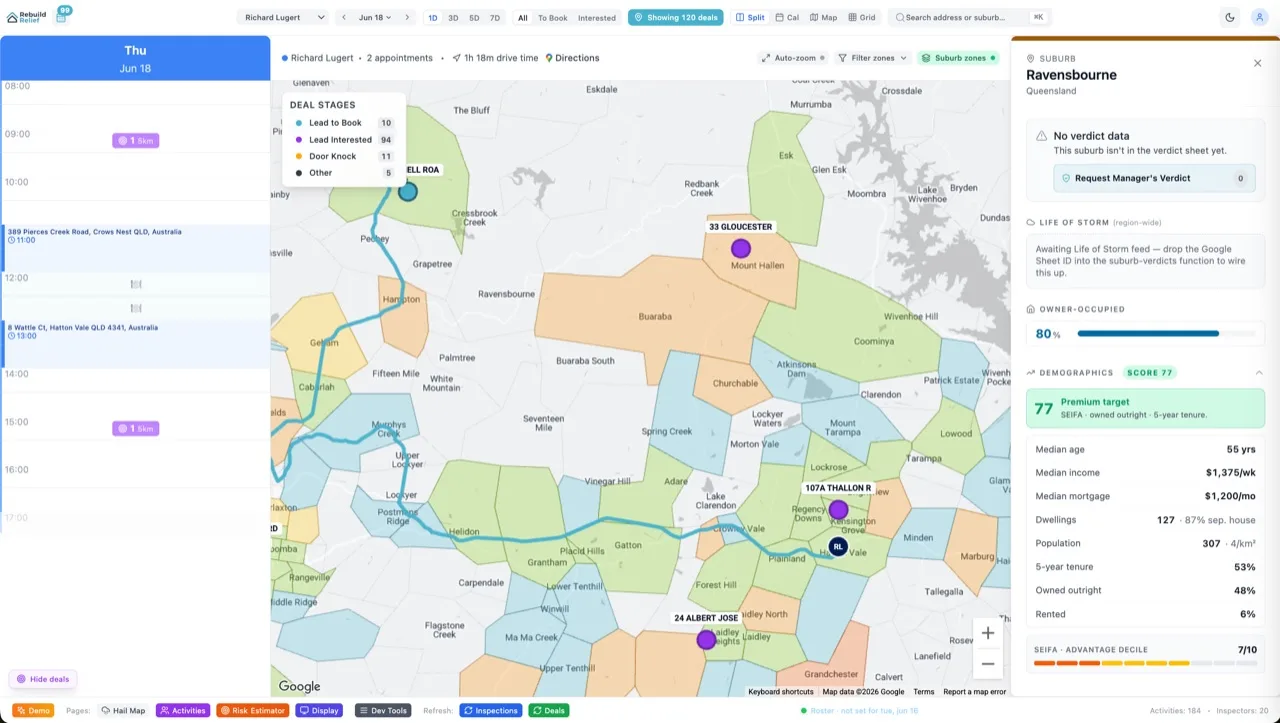
The build above isn't a mockup — it's the kind of platform we ship on Velocity X, run from one admin dashboard. For a hire business that means a live fleet calendar that makes double-bookings impossible, demand-based pricing rules that lift peak-season rates automatically, and a handover photo capture flow that timestamps every pickup and return so damage disputes end before they start.
Behind that sits the operational layer the spreadsheets never had: an insurance-excess ledger that tracks who owes what, fuel and kilometre auto-calculation from the agreement, and recurring corporate contracts that renew and invoice themselves. One screen, every vehicle, every dollar.
This is the kind of platform we build on Velocity X — explore more real builds by industry, or scope your own.