


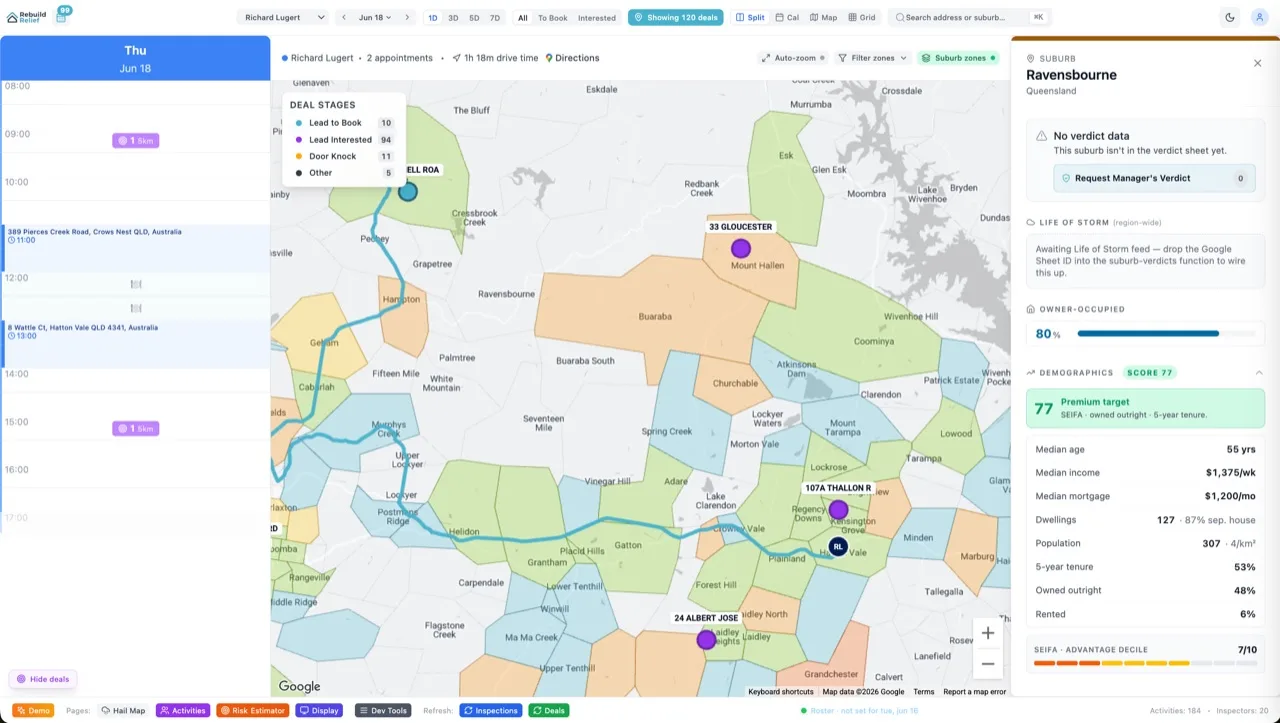

Power users live in their keyboard. They don't click sidebars, scroll through tabs, or hunt for buttons — they press ⌘K, type three letters, and jump. Inside Velocity X dashboards, ⌘K opens a command palette that fuzzies across customers, deals, actions, reports, and pages. Type "esteem", and you see "Esteem Clinic" customer + related deals. Type "weekly", and you get "Run weekly report". Type "org", and you switch between organizations instantly. No sidebar navigation. No loading screens. Just intent → result.
This pattern originated in developer tools (VS Code, Linear, Arc). It's now table stakes in any app that wants to feel fast and responsive to power users. Dashboard command palettes are the missing link between navigation UX and keyboard-first workflows.
Why Command Palettes Beat Menu Navigation
Sidebars are visual hierarchies — they work for discoverability. But once you know the app, they're friction. Click sidebar → wait for menu → find item → click → load. A command palette compresses that: press key → type → enter → done. For users who spend 4+ hours a day in your app, keyboard-first workflows are 2–3× faster and feel less taxing.
Command palettes also solve the discoverability tax. A user might never scroll to the "Run Reports" section in the sidebar, but if they press ⌘K and see "Run weekly report" as option 3, they'll try it. Discovery happens without sidebar clutter. You're rewarding power users without punishing newcomers — the sidebar still exists.
Architecture: cmdk + Indexed Actions
Velocity X dashboards ship a <CommandPalette /> React component built on cmdk (25kb gzipped). cmdk is purpose-built for this — it handles the input, keyboard navigation (arrow keys, typeahead, grouping), accessibility (ARIA roles, focus traps), and fuzzy matching natively. You wire up data, it renders the UX.
The data layer is three feeds: Actions (create deal, run report, archive customer), Customers (indexed by name + industry + account tier), and Pages (my deals, analytics, settings). Each item has a title, description, icon, and metadata (which org owns it, user permissions). The search is fuzzy and instant — cmdk does the matching in-memory, no server calls.
A basic implementation: cmdk renders an input box with a dropdown list. Users type, results filter in real time. Keyboard shortcuts: Arrow Up/Down navigate, Enter selects, Escape closes. You can group results by category — "Customers" section, "Actions" section, "Pages" section — so context is clear even as the palette narrows.
Keyboard-First Workflows in Practice
Create a deal for Esteem Clinic: Press ⌘K, type "esteem", click customer, cmdk shows "Create deal for Esteem", press Enter. Form opens side-panel (not modal). Switch org: Press ⌘K, type "org", see list of accessible orgs, arrow key to the one you want, Enter. Run a weekly report: Press ⌘K, type "weekly", see "Run weekly report", press Enter, report queues and background polls status. No sidebar clicks, no page reloads.
Advanced workflows stack. You can press ⌘K, type "create", see both "Create deal" and "Create contact", arrow to one, press Enter, fill the form, press Cmd+S to save, and press ⌘K again to chain the next action. Power users will chain 5+ actions in a session without touching the mouse. This is why investing in command palette UX pays dividends for high-frequency users.
Permissions & Scoping
The palette respects user permissions. A user with "deal creation" disabled won't see "Create deal" as an option. The index is computed per-user at login and cached in the frontend state (Zustand, Redux, or Context). When a user switches org, the palette re-indexes for that org's customers and deals. This keeps the search results relevant and prevents users from seeing actions they can't perform.
Sensitive data — customer names, deal amounts, org names — is still searchable but rendered as a read-only palette result. If you press Enter on "Esteem Clinic", the app navigates to /dashboard/customers/esteem-clinic, where RLS policies gate what data loads. The palette doesn't leak data; it just surfaces what the user already has permission to see.
Frequently Asked
How do I avoid command palette bloat?
Limit the action count to 20–30 core actions (create deal, create contact, run report, archive, etc.). Paginate customer/deal results — show top 10, then "more results". For large orgs with 1000+ customers, consider a two-stage palette: first search narrows down, second stage shows actions for that customer.
What if I'm on mobile?
Mobile doesn't get ⌘K (no hardware keyboard). Show a search icon in the dashboard header. Tap it, get a full-screen modal with keyboard and a fuzzy input field — same results, touch-optimized. The underlying cmdk logic is the same; UX adapts.
Can I customize the command palette with my brand colors?
Yes. cmdk ships unstyled — you wire up Tailwind classes or CSS to every element. Velocity X dashboards use shadcn/ui + Tailwind, so the palette inherits your design system. Change a color variable, palette updates.
How does it handle real-time updates?
The palette index is static at render time, but if a user creates a new deal while the palette is open, you can either re-index (call the indexing function again) or just close and reopen the palette. For highly dynamic data, consider a hybrid: static actions + server-side fetch for customer/deal results. Trade-off: latency for freshness.
What if two items have the same name?
Use metadata to disambiguate. "Esteem Clinic (VIC)" vs "Esteem Clinic (NSW)". Render the location in the palette description so the user picks the right one. Metadata also helps ranking — if you search "esteem vic", the VIC clinic ranks higher.
Can I add custom keyboard shortcuts?
Yes. cmdk supports pinned shortcuts (e.g., press ⌘⇧P for "Run report", ⌘⇧D for "Create deal"). Wire them at the component level. For power users, publish a cheat sheet. They'll memorize the ones they use daily.
The Bottom Line
Command palettes are the UX hedge for power users. They signal that your app respects their time and workflow. Build a cmdk palette, index your core actions + entities, respect permissions, and watch your daily active users spend less time navigating and more time doing. Velocity X dashboards include command palettes out of the box. Or check how ⌘K search works for marketing sites — the pattern is cross-cutting.