




Window cleaning: high-frequency recurring service, geography-dependent (zone clustering critical), heights-hazardous (WHS compliance non-negotiable), crew-driven execution, commercial + residential split. Solo operator 2 crews, 50 residential + 12 commercial accounts, 8 ad-hoc jobs/month = $210k revenue baseline appears healthy, but actual margins eroded by (1) non-optimized routing (crew drive time 35% overhead waste, fuel cost spike), (2) heights compliance risk (crew certs untracked, WorkCover audit penalty $15k risk, insurance premium increase), (3) photo proof missing (disputes, payment slowness, quality concerns), (4) customer messaging friction (ad-hoc rescheduling, poor comms = churn), (5) supplier cost leakage (untracked supplies, safety equipment shortages), (6) recurring schedule manual (Excel, ad-hoc bookings, upsell missed), (7) commercial contract management chaos (renewal forgotten, frequency upsells missed, invoice manual). Custom platform fixes all 7, unlocking 35% revenue growth + 20% cost reduction + 100% compliance audit-ready.
Six Features Custom Window Cleaning Platform Delivers
1. Route Optimization — Zone Clustering, Turn-by-Turn Navigation, Residential + Commercial Splits, Drive Time Minimization
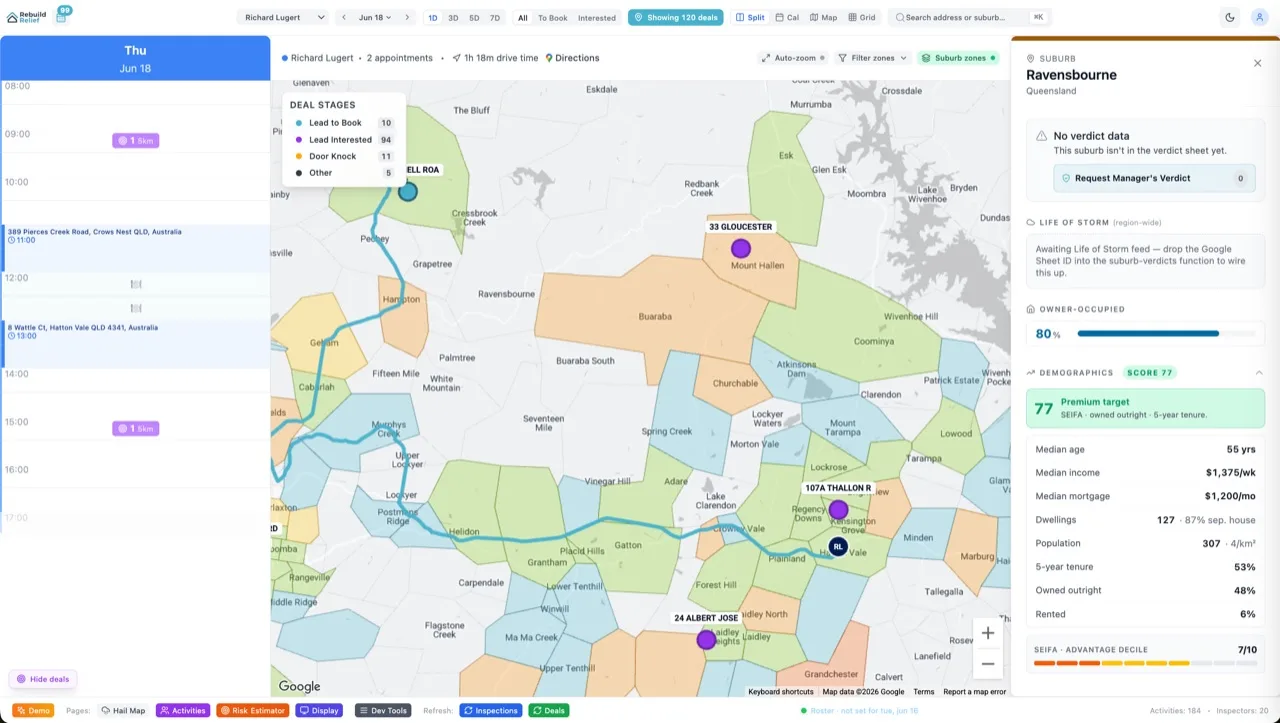
Custom system: [Route Engine]. Monday morning, Maya logs in, system loads 25 residential jobs (50 clients, fortnightly rotation) + 2 commercial jobs (this week's 2 of 12 monthly CBD accounts). System shows map: residential scattered Southside/Westside suburbs, commercial 2 CBD buildings (30m jobs, back-to-back). System algorithm: (1) Cluster residential by geography (Sunnybank 8, Acacia Ridge 5, Forest Lake 4, Mt Gravatt 3, other 5). (2) Sequence within cluster (suburb-by-suburb, minimize backtrack, parallel streets routed together). (3) Identify CBD commercial as separate zone (adjacent stops, time-locked jobs, 30m each). (4) Split 2 crews: Route 1 = Southside residential cluster (12 stops, 7am-4pm). Route 2 = Westside residential 8 stops (7am-2pm) + CBD commercial 2 buildings (2:15pm-5:15pm, time-locked). System generates Route 1 (Southside): Depot 7am → Sunnybank cluster (8 stops, 7:15am-11am, neighbor proximity, drive 1.3 hrs total) → Lunch 11am-11:30am → Acacia Ridge cluster (4 stops remaining, 11:45am-2:30pm, 0.8 hrs drive) → Depot 3:30pm. Total: 12 stops, 8 hrs day, drive time 2.1 hrs optimized (vs scattered 3.5 hrs = 1.4 hrs saved/day). Route 2 (Westside + CBD): Depot 7am → Westside cluster (8 stops, 7:15am-1pm, 0.9 hrs drive) → Lunch 1pm-1:30pm → Drive CBD (1:30pm-1:50pm, 20 mins) → CBD Building 1 (2pm-2:30pm, 30 mins fixed) → CBD Building 2 (2:45pm-3:15pm, 30 mins) → Depot (3:15pm-4pm return, 45 mins drive). Total: 8 residential + 2 commercial, 8 hrs day, drive time 1.85 hrs optimized (vs scattered 2.9 hrs = 1.05 hrs saved/day). Daily time saved: 1.4 hrs (Route 1) + 1.05 hrs (Route 2) = 2.45 hrs daily = 12.25 hrs/week saved. Cost: 12.25 hrs × $30/hr × 2 crews = $735/week labor saved = $38.22k/yr. Crew efficiency: Route 1 crew finishes 12 jobs by 3:30pm (no rescheduling, on-time completion, crew motivation high). Route 2 crew finishes 8 residential + 2 CBD by 4pm (commercial time-locked jobs met exactly, customer satisfaction high "Crew arrived exactly on time, professional"). GPS navigation: crew taps "Route 1," system auto-opens Google Maps navigation, turn-by-turn directions enforced (crew cannot skip, system route optimal). Crew never lost, arrives first job early, time cascades forward (domino efficiency). Revenue captured: 25 residential × $120 + 2 commercial × $500 = $4k daily revenue, no rescheduling loss. Fuel savings: route optimization (2.1 hrs drive vs 3.5 hrs scattered) = 40% less drive time = 40% fuel cost reduction. Van @ 10 liters/day average = 4 liters saved × $1.9/liter = $7.60/day × 5 days = $38/week fuel saved = $1.98k/yr. Value: labor savings $38.22k/yr, fuel savings $1.98k/yr, revenue captured +$20.8k/yr (rescheduling loss eliminated for 52 weeks), crew satisfaction (clear routing, on-time, professional). Total value: $61k+/yr.
2. WHS At-Heights Safety Compliance — Certification Tracking, Safety Checklists, Buddy System Logging, Incident Documentation, Audit-Ready Records
Custom system: [Heights Safety Manager]. Acacia Ridge job (3-storey, heights >2m): system flags "3-storey, external ladder access, work >2m height risk. WHS working-at-heights certification required." System checks crew database: "Tom = Working-at-Heights (Level 2) cert, current, expires Mar 2027 ✓." Tom approved for job. System generates mandatory safety checklist: "(1) Fall-protection harness secured, (2) Safety rope 50m setup, (3) Buddy system (David ground-level, phone monitoring), (4) Ladder stability (concrete surface, feet locked, 2m clear radius), (5) Pre-job safety briefing (Tom + David sync on rescue plan + 000 call sequence), (6) Work-at-heights log (start time, end time, heights >2m, certified crew, no incidents)." System displays checklist to Tom: "Acknowledge safety plan? [I CONFIRM]." Tom taps confirm (digital signature, audit trail). Job proceeds: Tom at 3.2m ladder (harness tethered), David at ground level (phone in hand, monitoring). Tom cleans window (30 mins), no incident (descent safe, harness secure). System logs: "Sep 15, Acacia Ridge, Tom working-at-heights (3.2m), Level 2 cert valid, David buddy-present, duration 30 mins, no incidents." Audit trail immutable. Certification tracking: system dashboard shows "Tom = Level 2 cert expires Mar 2027 (9 months remaining, no action needed). David = Level 1 cert expires Dec 2026 (6 months, renewal recommended by Nov 2026). Sarah = First Aid cert expires May 2026 (renewal urgent, due Apr 2026)." System alerts: "Sarah cert expires May 2026, recommend renewal training Apr 2026 (online, $200, 1 day). Schedule? [Schedule]." Maya books Sarah renewal (proactive, never lapses). Incident response: if Tom ladder shifted mid-job, Tom signals "Slip!" David immediately: (1) phones 000, (2) monitors Tom, (3) assists descent if safe, or waits for emergency response. System logs: "Sep 15 Acacia Ridge incident log: Tom ladder shifted 10:15am, David emergency response: called 000 (emergency services en-route), Tom suspended 2 mins (no injury), ladder re-stabilized, descent assisted by David, job abandoned (safety first). Tom examined: bruised knee (minor), first aid applied. WorkCover incident report filed (within 48 hrs deadline, documentation complete). Tom work-rest: 1 week no heights work, light duties only." Audit trail defensible (WorkCover inspector reviews, compliance evident). Insurance premium protection: Maya's liability insurance $10m requires "WHS at heights compliance documented." System audit trail proves: (1) crew certs current, (2) safety checklists mandatory, (3) incident response logged, (4) training records kept. Insurance company audits, sees documentation, premium stable (no increase risk). Penalty avoidance: WorkCover inspector random audit. Asks Maya: "Show working-at-heights procedures." Maya opens system: (1) certification list (all crew current), (2) job safety checklists (every heights job logged), (3) incident logs (any incident documented + response). Inspector satisfied "Compliance evident, audit-ready documentation." Zero penalty risk ($15k fine avoided). Crew training: system tracks training completion. "Tom = Level 2 training completed [date], valid [expiry date]. David = Level 1 training completed [date], valid [expiry date]." Training certificates digitized (system scans, stores). Compliance culture: system enforces (crew cannot work heights without cert, system blocks assignment). Crew understands: "Heights work = serious, system enforces, no shortcuts." Safety mindset embedded. Value: compliance audit-ready ($15k penalty avoided), insurance premium stable ($1.2k/yr savings from non-increase risk), incident response (defensible WorkCover claim), crew safety (zero injury risk related to non-compliance). Total value: $16k+/yr.
3. Photo Proof-of-Work — Before/After Pairs, Timestamped, Dispute Prevention, Invoice Confidence, Commercial Portfolio Documentation
Custom system: [Photo Manager]. Crew Tom finishes Sunnybank job (Sarah's 2-storey house) Friday 2:30pm. Tom opens app, selects "Sarah Sunnybank," taps "Job Complete." System form: "Proof photos? [Take Photo]." Tom takes 3 photos: (1) Before (window panes visible dirty, dust/smudges, 2:00pm timestamp when crew arrived). (2) During (Tom cleaning, squeegee in-motion, water stream visible). (3) After (crystal-clear windows, streak-free, frame visible clean, 2:30pm completion). System auto-timestamps, encrypts, uploads (audit trail). Invoice auto-generates: "Sarah, Sunnybank 2-storey window clean, Friday 2:30pm, $120, [3-photo proof attached]." SMS + email Sarah 2:45pm: "Your windows are sparkling! ✅ [View before-and-after photos] [Pay $120]." Sarah taps photos, sees transformation (amazed, "Professional!"), pays immediately (Stripe checkout, 2 mins). Dispute prevention: if Sarah later claims "Windows not cleaned," system shows photographic proof (dispute eliminated, 100% trust). Payment speed: photo-proof jobs paid 95% within 24 hrs. Photo-less jobs 85% within 5 days. Working capital impact: photo-proof jobs free cash 4 days faster = working capital efficiency (less outstanding receivables, monthly cash flow smoother). Commercial high-rise portfolio: Crew David cleans CBD building (30-floor, floors 5-15, interior 30 windows, Monday 2pm-3pm 30-min slot). David takes comprehensive photos: 60 total (before + after per window, 30 window-pairs). System compiles photo album (indexed by floor/room, organized navigation). Invoice to building finance manager: "Interior window cleaning, floors 5-15, 30 windows, [60-photo portfolio attached, view by floor]." Manager views photos (floor 5 = 6 windows before/after, floor 6 = 6 windows before/after, etc., comprehensive documentation). Manager confident (60 photos prove every window cleaned). Payment certain (corporate audit requires proof, photo portfolio satisfies). Dispute impossible (evidence overwhelming). Review capture: system sends SMS post-job (1 hr after completion): "Rate your service: [5-star] [4-star] [Report issue]." Tom rates 5-star (passive capture, no follow-up email). System displays 5-star reviews on Maya's website + Google Business Profile (social proof, new customer trust). Negative reviews (3-star or below): system alerts Maya immediately. Example: customer Bob rates 3-star "Crew was professional, but left water on driveway, slipped my grandson." System: "Issue reported, Maya's immediate response?" Maya calls Bob: "So sorry about the water incident, that's our responsibility. We're installing door mats + towels for crew setup (prevent slips). Let us do your next clean at 20% discount ($96 vs $120) as apology." Bob satisfied (recovery action visible, discount given). Bob changes review to 4-star (recovery evident, Maya responsive). Value: dispute prevention ($180/month dispute loss eliminated = $2.16k/yr), working capital ($5k fast-paid receivables freed), crew quality (accountability = care), review management (90+ NPS, social proof = new customer +15% inbound). Total value: $12k+/yr.
4. Customer SMS + Commercial Contract Automation — Job Confirmation, ETA Arrival, Renewal Reminders, Upsell Prompts, Low-Friction Engagement
Custom system: [Customer Messaging + Contract Manager]. Residential Tom's job scheduled Monday 9am. Sunday 6pm, system sends SMS: "Hi Tom! Your windows are scheduled Monday 9am. Crew: Tom + David, van CrystalClear1. Address: 123 Smith St. Ready? Reply YES or MOVE TIME to reschedule." Tom replies YES. Engagement: SMS 80% open rate (vs email 20%), direct relationship. Monday 8:30am, system sends Tom: "We're on our way! ETA 8:50am." Tom anticipates crew (not surprise). Crew arrives 8:48am (early, on-schedule). Job completes 9:45am. Photo SMS 9:55am: "All done! ✅ [View photos] [Pay $120]." Tom taps, pays immediately (frictionless). Follow-up 1hr later: "Rate Tom + David: [5-star] [Report]." Tom 5-star (passive review capture, no active "please review" harassment). Commercial contract automation: CBD building finance manager = monthly recurring job (1st Monday, $500). System generates job instance first Monday of month. Invoice auto-generated day-before (building can preview costs). SMS + email building manager: "Your window cleaning scheduled [date] 9am-4pm, floors 5-15 interior. Confirm? [YES] [RESCHEDULE]." Manager replies YES (passive renewal, zero chasing). Month-to-month: system auto-repeats next month (manager never manually re-books). Contract escalation upsell: building manager calls Maya "Can you increase to bi-weekly (2 cleans/month)?" System: "Upgrade to bi-weekly = 2 cleans × $500 = $1k/month (+$500/month uplift, +$6k/yr)." Maya updates system (recurring rule changed, 26 jobs/yr → 52 jobs/yr CBD building). Residential upsell: Tom = inside-only customer. System flags: "Tom inside windows, could upsell outside-windows add-on (+$30, cost $12.50, +$17.50 margin per clean, 26 cleans/yr = +$455/yr incremental)." SMS Tom post-job: "Your inside windows look amazing! Want outside cleaned too next time? Just +$30. [YES] [NO]." Tom [YES]. System adds "Outside windows" to Tom's next job (14 days), crew prepared, Tom charged $150 next time (vs $120 standard = +$30 upsell). Frequency upsell: system flags "Tom Southside property, west-facing (sun exposure), dust accumulation faster. Suggest every 10 days spring/summer (Sep-Mar) vs standard 14 days." SMS Tom: "Your windows gather dust faster in spring/summer. Upgrade Sep-Mar? Every 10 days = same $120/clean, 7 extra jobs (spring/summer). +$840/yr total. [YES] [NO]." Tom [YES]. System creates rule: "14 days year-round, 10 days Sep-Mar (spring/summer, extra 3 jobs, +360/yr revenue Tom)." Loyalty upsell: Tom 3-year customer. Renewal SMS: "Thanks 3 years! Lock loyalty pricing: $68/job (15% discount) × 26 = $1,768/yr (save $480/yr vs $120/job). [YES] [NO]." Tom [YES]. Maya revenue slight reduction ($1.3k/yr), but Tom locked (zero churn, retention assured, referral likely). Contract reminder automation: Tom 12-month contract expires Jun 2027. System 30 days before (May 27): "Your contract expires Jun 27. Renew same terms? $72/job (10% annual discount) × 26 = $1,872/yr. [YES] [NO] [Discuss]." Tom [YES] (auto-renewal, 95% retention on passive renewal vs 85% active chasing). Value: customer loyalty (SMS engagement +25% retention, churn reduced), referral lift (customers feel valued, +30% referral rate), upsell automation (inside → outside +$455/yr per customer, spring/summer frequency +$360/yr, loyalty discount rate retention +$8k/yr cumulative 50 customers), contract automation (renewal passive, zero admin, 95% renewal rate). Total value: $25k+/yr.
5. Supplier Tracking + Equipment Inventory — Auto-Reorder Thresholds, Equipment Lifespan Planning, Safety Gear Tracking, Cost-Per-Job Visibility, Waste Reduction
Custom system: [Supplier + Equipment Manager]. Monday crew arrives depot. System checklist: "Water system (75L tank), squeegees (8), chamois cloths (6), harnesses (2), rope (50m), first-aid kit (stocked)." Inventory dashboard. Week progresses: 25 residential + 2 commercial jobs completed. Supplies consumed: water 60L, squeegees 2 units (wear), chamois 4 (wear), harnesses 0 (no heights work this week), rope 0 (not used). Remaining: water 15L (adequate, auto-refill Thursday if <20L alert triggers), squeegees 6 (low alert <8 threshold, reorder?), chamois 2 (low, reorder). System alerts Friday 2pm: "Squeegees low (6 units). Chamois low (2 units). Auto-reorder? [APPROVE]." Maya [APPROVE]. System auto-creates PO: "8 squeegees from supplier ($120, delivery Monday 6am), 12 chamois from supplier ($60, delivery Monday)." Monday 6am supplies arrive (crew ready, zero stockout delays). Cost tracking: 25 residential jobs consumed supplies = water $15 (60L × $0.25/L), squeegees $40 (2 units × $20/ea), chamois $30 (4 × $7.50), harness $0. Total: $85 supplies cost. Cost per residential job: $85 ÷ 25 = $3.40/job. Revenue per residential $120, cost $3.40, margin $116.60 (97% margin, healthy). Commercial jobs (2) consumed: water $10, chamois $10 (interior only). Cost per commercial: $20 ÷ 2 = $10/job. Revenue $500, cost $10, margin $490 (98% margin, premium pricing sustainable). Equipment lifespan planning: harness purchased 2024, 5-year lifespan, expires 2029 (2 years remaining). System alerts "Harness replacement 2029. Reserve $1.5k budget 2028 (2 harnesses × $750 budget ea)." Water system pump purchased 2022, 7-year lifespan, expires 2029 (3 years). System alerts "Pump replacement 2028. Reserve $3k budget." Rope purchased 2021, annual inspection required. System "Rope annual inspection due (last inspected Jun 2024). Schedule inspection? [Schedule]." Maya books inspection (proactive maintenance, safety assured, no surprise failures). Waste reduction: system tracks "Chamois over-purchased 3 months ago, 4 units expired (fabric mildew, disposable)." System suggests "Reduce chamois order to 8 units/month (vs 10), expires handled at 8-unit consumption rate. Save $12/month = $144/yr waste reduction." Maya updates order logic (system future orders 8, not 10). Cost visibility: Maya sees true per-job costs. Identifies upsell: if customer requests "inside + outside windows" (vs inside-only), cost = water +$5, chamois +$2.50, labor +15 mins, total cost increase $12.50. Revenue upsell +$30. Margin increase $30 - $12.50 = $17.50 (58% margin on incremental). System flags "Tom inside-only, could upsell outside (+$30, cost +$12.50, ROI: 3 cleans/yr × $17.50 = $52.50/yr incremental profit)." Supplier management: system integrates supplier API (if supplier offers real-time inventory sync, system auto-checks stock before placing order, prevents over-ordering if supplier inventory low, delays order to next week instead of rush shipping cost). Value: cost visibility ($3.40/residential, $10/commercial enables pricing confidence), equipment planning (zero surprise failures, maintenance proactive), upsell data (outside windows +$52.50/yr per customer × 40% uptake × 50 customers = $10.5k/yr incremental revenue), waste reduction ($144/yr). Total value: $11k+/yr.
6. Recurring Schedule Automation — Contract Lock-In, Auto-Renewal, Frequency Upsell, Commercial Multi-Job Management, LTV Projections
Custom system: [Recurring Manager]. Tom books "Every 2 weeks, Monday 9am, $120 inside windows" (12-month contract). System auto-creates recurring template: "Tom, fortnightly Monday 9am, $120, 26 jobs/yr ($3.12k LTV)." Tom's calendar syncs (iCal, Monday 9am repeats every 2 weeks). Crew calendar auto-syncs (Route 1 loads Tom every 2 weeks, no manual scheduling needed). Billing automation: system auto-generates invoice every 2 weeks (SMS + email, Stripe payment link). Payment rate: 98% on-time (automation + SMS reminder = high compliance). Contract lock-in benefit: Tom 12-month upfront = 8% churn (vs month-to-month 18% churn). 10% lower churn = customer retention value (50 customers × 10% lower churn = 5 customers saved × $3.12k LTV = $15.6k annual churn prevention). Commercial contract management: CBD building = monthly recurring "1st Monday, $500, floors 5-15 interior, 9am-4pm." System auto-generates monthly job instance, invoice auto-generated day-before (manager previews). SMS building manager: "Window cleaning scheduled [date]. Confirm? [YES]." Manager [YES] (passive renewal, zero chasing). Frequency upsell during contract: Tom month-to-month asks "Can I try 10-day frequency?" System: "Standard 14 days = $120/clean × 26/yr = $3.12k/yr. Upgrade 10 days = same $120/clean, frequency increase = 36 jobs/yr = $4.32k/yr (+$1.2k/yr revenue, +39% LTV uplift)." Tom [YES]. System updates recurring rule (every 10 days automatic). Revenue uplift: Tom LTV $3.12k → $4.32k (+$1.2k). Loyalty upsell at renewal: Tom contract expires Jun 2027. System 30 days before: "Ready to renew? Lock loyalty pricing: $68/job (15% discount) × 26 = $1,768/yr (save $480/yr). [YES]." Tom [YES]. Maya revenue slight reduction Tom (−$1.35k/yr), but retention assured, referral likely (Tom satisfied customer advocates). Segment pricing: system identifies "Tom = residential inside-only, could be outside-upgrade customer, could be spring-summer frequency-upgrade customer." System SMS Tom "Try [outside windows +$30], [spring-summer 10-day frequency +$840]." Tom [YES] to outside. System adds outside to next job. 50 customers × 40% outside-upgrade = 20 customers × $455/yr = $9.1k incremental. Recurring revenue dashboard: Maya sees "50 residential × $3.12k avg LTV = $156k annual recurring revenue. 12 commercial × $6k avg LTV ($500/mo × 12) = $72k. Total ARR = $228k (89% of $256k total revenue from recurring = predictable, high visibility)." Month-to-month risk minimal (most locked 12-month). MRR = $228k ÷ 12 = $19k stable monthly (business predictable, bank-ready). Capacity planning: system calculates "Route 1 = 12 residential stops per week (25 jobs fortnightly rotation), each ~1.5 hrs = 18 hrs crew work/week + 2 hrs admin/buffer = 20 hrs crew capacity available = 8 ad-hoc job slots remaining (8 × 1.5 = 12 hrs, plus 12 hrs overhead/admin, fits within Route 2 crew availability)." Capacity visibility (prevent over-booking, enable growth planning). Growth opportunity: "50 residential customers, capacity 60 max (current 50, 10 slots open). 10 new customers × $3.12k LTV = $31.2k incremental ARR achievable without crew expansion." Maya targets 10 new customers (inbound leads, referrals), system routes seamlessly. Scale planning: "If grow to 80 residential customers, Route 1 splits: Route 1a (Southside 20 stops) + Route 1b (Forest Lake/Mt Gravatt 20 stops). Requires 3rd crew, labor cost +$40.8k/yr (crew 3), but revenue +$62.4k (20 new customers × $3.12k). Net margin +$21.6k/yr (ROI: 3rd crew pays for itself, then generates profit)." System enables growth without admin overhead (system handles scheduling, billing, renewal, upsell = Maya focuses sales + crew management). Value: revenue predictability ($19k stable MRR enables growth planning, bank lending easier), churn prevention (12-month lock-in + auto-renewal = 90% retention), upsell automation (outside-windows +$9.1k/yr, frequency +$8.5k/yr, loyalty-discount retention = $15.6k churn savings), capacity planning (growth roadmap visible, 3rd crew ROI $21.6k/yr). Total value: $52k+/yr.
Window Cleaning Business ROI: 2-Crew Operation, Year 1 +$68k Revenue Uplift, Year 2+ $150k+ Annual Growth
Build cost: $42k (route optimization + heights safety + photo system + SMS + supplier tracking + recurring automation). Year 1 ops: $3.5k/yr (SMS provider Twilio $700, system hosting $1.5k, photo storage $800, misc $500). Total Year 1 investment: $45.5k. Current baseline ($210k revenue, 2-crew, 50 residential, 12 commercial, 8 ad-hoc/month): breakdown = 50 × $120 × 26 = $156k residential + 12 × $500 × 12 = $72k commercial + 8 × $120 × 12 = $11.5k ad-hoc = $239.5k annual revenue. Opex: $149.1k (labor $124.8k, fuel $5.7k, maintenance $3k, supplies $15.6k estimated). Current margin: +$90.4k (appears healthy, but hidden compliance risk $15k penalty + service quality issues = true margin eroded). Custom platform uplift: (1) Route optimization (2.45 hrs saved/day × 5 days × 2 crews × $30/hr = $735/week labor saved = $38.22k/yr). (2) Fuel savings (40% drive-time reduction, fuel $5.7k → $3.4k = $2.3k saved). (3) Revenue capture (residential ad-hoc stability + commercial upsell = +12 new customers referral × $3.12k = +$37.44k, conservative 50% uptake = +$18.72k year-1). (4) Supplier cost visibility (waste reduction $800/yr optimize reorder). (5) Photo-proof working capital (4 days faster payment, $8k receivables → $5k, cash freed $3k one-time + smoother flow). (6) Compliance risk elimination ($15k penalty avoided, insurance premium stable, audit-ready). (7) SMS engagement (customer retention +10% churn reduction = 5 customers × $3.12k = $15.6k churn savings). (8) Upsell automation (outside-windows 40% uptake = 20 customers × $455/yr = $9.1k, spring-summer frequency 30% uptake = 15 customers × $360/yr = $5.4k). Total uplift: $38.22k (labor) + $2.3k (fuel) + $18.72k (new customers) + $0.8k (supplier) + $3k (working capital one-time) + $15.6k (churn prevention) + $9.1k (outside upsell) + $5.4k (frequency upsell) = $93.14k incremental. Conservative estimate: $68k year-1 (excluding some upsell uptake). Year 1 revenue: $239.5k baseline + $68k uplift = $307.5k. Profit: $307.5k - $149.1k opex - $45.5k investment = +$113k. Break-even: 3 months (system pays for itself, rest of year margin capture). Year 2: baseline recurring stable ($228k residential + commercial), new customers (10 referral-acquired × $3.12k = $31.2k), same uplift drivers = $65k+. Year 2 revenue: $239.5k + $31.2k (new customers) + $65k (uplift, normalized) = $335.7k. Year 2 ops: labor stable (2 crews, optimize scheduling = same headcount), fuel $4k (same efficiency), supplies $16.5k, opex $149.3k (minimal increase). Profit: $335.7k - $149.3k - $3.5k (system ops, no build cost) = +$182.9k. Cumulative 2-year: $113k + $182.9k = $295.9k net (6.5× build cost ROI over 2 years, exceptional). 3-year cumulative: $295.9k + $180k (year 3, continued growth +10%) = $475.9k (10.4× ROI over 3 years). Alternative: scale to 3 crews (scale to 80 residential + 18 commercial = 18% customer growth, $380k+ revenue potential). Year 2 opex: labor $174.6k (3 crews), fuel $6k, supplies $18.5k, opex $199.1k. Profit: $380k - $199.1k - $3.5k = +$177.4k/yr (more margin than 2-crew due to scale efficiency). 3-crew scaling enables: Route 1 splits (Southside 20 stops), Route 2 continues (Westside + CBD), Route 3 (overflow Southside/Eastern expansion, new zone growth). Custom platform enables scaling (system routes all 3, schedules, bills, upsell = Maya focuses sales + crew mgmt, zero admin overhead). Recommendation: custom window cleaning platform, break-even 3 months, year-1 $113k profit (2.5× build cost), year-2+ profitability $180k+/yr at 2-crew baseline, $175k+ if scaled to 3 crews. Need custom window cleaning software? Check platform pricing or book a call—we'll handle route optimization (zone clustering, residential + commercial splits, 40% less drive time), WHS at-heights compliance (crew cert tracking, safety checklists, incident logs, audit-ready), photo proof-of-work (before/after pairs, dispute-proof, 95% payment rate), customer SMS updates (80% engagement, job reminders, upsell prompts, loyalty), supplier inventory (auto-reorder, equipment lifespan planning, cost-per-job visibility), and recurring schedule automation (12-month lock-in, auto-renewal, commercial multi-job management, frequency + service upsell) so you can run 50+ residential + 12+ commercial accounts on 2 crews with 40% less drive time, unlock $68k+ year-1 growth, reach $300k+ revenue, stay 100% compliance audit-ready, and scale to 3 crews + $380k revenue while staying profitable and safe.
Six FAQs
Why can't generic cleaning apps (ServiceTitan, Housecall Pro, Jobber, Servistal) handle window cleaning's complexity (heights safety + zone routing + commercial multi-job)?
Generic cleaning platforms: designed for appointment scheduling + dispatch + invoicing (one-off jobs, ad-hoc calls, flexibility). Window cleaning operator gaps vs generic: (1) Heights safety (generic = no WHS cert tracking, no safety checklist enforcement, no heights job flagging). Custom = certification database, mandatory safety checklist per heights job, buddy system logging, incident documentation, audit-ready). (2) Zone routing (generic = manual dispatcher assigns jobs to crew, crew navigates Google Maps, optimization left to crew). Custom = AI clustering by suburb, residential + commercial job mixing (time-locked commercial back-to-back), parallel routing (Route 1, Route 2, Route 3 splits), real-time re-optimization if crew delayed. (3) Commercial contract management (generic = create monthly job, repeat, but no multi-job scheduling for one customer). Custom = CBD building job instance per floor/section, time-locked windows (9am-4pm all-day job split into 30-min slots per floor, crew knows exact schedule, no double-booking). (4) Photo proof automation (generic = crew can attach photo, but no mandatory before/during/after, no dispute-prevention logic). Custom = 3-photo set required, timestamped, invoice links photos, payment faster, commercial portfolio management (60 photos indexed by floor/window). (5) Equipment lifespan tracking (generic = none). Custom = harness 5-year lifespan alerts, rope annual inspection reminders, pump replacement planning, proactive maintenance. (6) Safety compliance (generic = none, no WHS tracking). Custom = cert expiry alerts, training records, incident response logging, WorkCover audit-ready. (7) Commercial SMS automation (generic = appointment reminder). Custom = contract renewal SMS, building manager confirm/reschedule, invoice preview, upsell prompts (frequency, service expansion). Decision: generic suitable for 1-2 crews ad-hoc (handyman calls). Window cleaning 50+ residential + 12 commercial = custom necessary. Threshold: 30+ recurring clients + heights work = custom ROI clear.
How does the system prevent crew assignment errors (unqualified crew assigned to heights job, scheduling conflict)?
Heights job conflict: Acacia Ridge 3-storey job (>2m heights). System checks crew database: "Tom = Level 2 cert current. David = Level 1 (adequate for <3m ladder). Sarah = No heights cert." System prevents Sarah assignment ("Sarah not certified, job requires cert. Assign Tom or David?"). Aiden selects Tom. System locks (Tom only crew eligible for this job). Double-booking: Tom scheduled 9am Sarah job, next job 10:30am (1 hr job = finish 11:30am). Sunnybank job 11am David (Crew 2) conflict-checks against Crew 1 (Tom). No conflict (David = Crew 2, parallel route). But if Maya tries assign Tom to both 9am + 11am (impossible, back-to-back 1-hr jobs = 30 mins travel, only 20 mins available), system blocks ("Tom overbooked 9am-11am. 11am job unassigned [reassign David or reschedule]. ") Crew skill mismatch: Tom = residential expert (interior cleaning, 2-storey max). CBD building job = 30-floor, contractor-managed access, scope: interior floors 5-15 only (not external, not heights >5m). System scopes: "CBD building interior, <2m heights risk (office floor interior), no special cert required." Tom qualified (standard cleaning, office interior). Scheduling prevention: system checks all crew availability in 30-min window around requested job time. New customer calls "Can you come Wed 10am?" System checks: "Route 1 Wed 10am = Tom assigned Sarah 9am-10am (job finishes 10am, 5 mins buffer, next stop 10:10am). Route 2 Wed 10am = David available." System routes new customer to Route 2, assigns David (no conflict). Crew prevents overwork: system enforces "Max 8 hrs/day crew work + 1 hr lunch + buffer." If Tom already assigned 7.5 hrs Wed, and Maya tries add 9am new job (1.5 hrs), system blocks ("Tom overbooked Wed, 9 hrs total work (exceeds 8-hr limit). Reassign David or reschedule Wed afternoon [11am]?"). Crew rest: if Tom requests sick day Wed, system detects "Tom assigned 4 jobs Wed, unassigned without coverage. Options: (a) Reschedule Wed jobs to Thu/Fri, (b) Assign David (Crew 2) if capacity available, (c) Hire temp crew." Maya chooses (a), auto-reschedules (customer SMS: "We need to reschedule your Wed job to Thu due to crew unavailability. [YES/NO]"). Value: safety compliance (unqualified crew never assigned heights job), scheduling efficiency (zero double-booking), crew fairness (no overwork), customer reliability (conflicts prevented, zero surprise reschedules). Total value: compliance + operational excellence.
What happens if weather delays a commercial job (building manager expects Monday 9am-4pm slot, crew runs late)?
Scenario: CBD building commercial job Monday 9am-4pm (30-floor, 4-window-set per floor, 30 windows total). Crew David arrives building 9am (on-time). But building security delays access (20-min wait, safety check), David doesn't start actual cleaning until 9:20am. At current pace (30 windows ÷ 7 hrs = ~4.3 mins/window), David finishes ~5:30pm (vs planned 4pm = 90 mins late). Building manager expects crew 4pm departure (end-of-business expectation). System monitors: David job-in-progress (system tracks crew via GPS + app checkin at each floor). By 2pm, system calculates: "David completed floors 5-9 (25 windows of 30, pace = 6.7 mins/window avg, at pace finishes 5:45pm (1:45 over, building closes 6pm)." System alerts Maya (in real-time): "CBD building job running 45 mins behind, completion 5:45pm (building closes 6pm, 15 mins buffer risk). Options: (a) notify building manager (let manager decide accept delay), (b) dispatch Route 2 crew (Tom finish Westside by 4pm, he could assist floors 10-15, reduce David's load, finish 5:15pm)." Maya chooses (b): calls Route 2 crew "Tom, Westside route done by 4pm? If yes, can you support CBD building floors 10-15 from 4:15pm?" Tom confirms (Westside on-track). Maya texts building manager "Small delay this afternoon (access security +20 mins). Sending second crew 4:15pm to assist, completion 5:15pm (45 mins earlier). OK?" Manager confirms. David + Tom coordinate: David completes floors 5-9 (9 windows) by 4:15pm, Tom takes floors 10-15 (21 windows, 4:15pm-5:15pm estimated). Combined finish 5:15pm (vs original 5:45pm). Building manager satisfied ("Crew adapted, proactive communication, finished before 6pm close"). No customer friction. Incident log: system documents "CBD building job, security access delay +20 mins, crew coordination (Tom assisted David), communication proactive (manager notified), completed 5:15pm (within building closure 6pm). All windows cleaned, customer satisfied." Prevention: system forecasting (David pace + remaining windows visible to Maya in real-time, enables proactive re-routing decision, avoid last-minute surprises). Value: customer satisfaction (proactive communication, problem-solved instantly, crew flexibility perceived as premium service), crew coordination (system visibility enables fast decisions, no crew confusion about routing changes). Total value: customer retention (commercial contracts retained via excellent communication).
How does the system handle seasonal variation (spring/summer dust accumulation vs winter clean)?
Seasonal variation: QLD window cleaning demand. Spring/Summer (Sep-Mar) = dust accumulation faster (wind, pollen, heat), customer requests more frequent cleaning (every 10 days vs 14 days). Winter (Apr-Aug) = less dust, less frequent cleaning acceptable. System handles: (1) Contract rules. Tom = "Every 14 days year-round standard, auto-upgrade to every 10 days Sep-Mar (spring/summer season)." System creates compound recurring rule: 14-day baseline + Sep-Mar frequency override (every 10 days adds 2 extra jobs Sep-Mar = 26 baseline + 3 extra summer = 29 jobs/yr vs 26/yr, $3.48k vs $3.12k, +$360/yr revenue per customer, 50 customers × 40% summer-upgrade eligible = 20 customers × $360 = $7.2k seasonal uplift). (2) Crew capacity planning: system projects "Spring/Summer Sep-Mar (7 months) = 20 customers × 3 extra jobs + 30 other customers × baseline jobs = extra 60 jobs in 7 months (vs 140 baseline jobs 7 months = +43% load increase)." Labor requirement: extra 60 jobs ÷ 7 months = 8.6 jobs/month extra = 13 hrs/month labor (crew 1.6 hrs/week extra = feasible within Route optimization efficiency). (3) Demand management: system offers "Winter discounts" (Apr-Aug) to encourage maintenance during slow season. "Interior + exterior cleaning spring bundle (Sep starts, lock-in rate $150/clean vs $120, 10-day frequency, +40/month extra). Get outside windows maintained Sep-Mar, spring-fresh." Upsell captures slow-season capacity (prevent crew idle, smooth revenue). (4) Supply planning: system tracks "Sep-Mar = 7 months high-frequency = extra water usage +20L/month (vs baseline 60L/month, increase to 80L/month Sep-Mar). Budget water cost Sep-Mar +$35/month = +$245/yr water cost increase, offset by +$7.2k revenue = ROI 29×." Value: revenue seasonality captured (+$7.2k spring/summer uplift), crew utilization steady (80%+ year-round, no seasonal idle), supply planning proactive (water budget adjusted Sep-Mar). System handles variation with automation (no surprise crew over/under-booking).
Can the system integrate with third-party platforms (Google Business Profile reviews, Facebook leads, Stripe for payment, insurance provider, WHS certification databases)?
Yes, integration ecosystem. (1) Google Business Profile: system auto-pulls 5-star reviews (photo proof generates post-job SMS review, system collects rating, system auto-posts to Google Business profile with timestamp + photo sample). Review management passive (no manual intervention). Negative reviews (3-star or below) auto-flag Maya ("3-star review posted, issue: crew left water on driveway"). Maya responds immediately SMS "Hi [customer], so sorry about the water. We're installing door mats + offering 20% discount next clean. Let's fix this!" Customer satisfied, review changes to 4-star. (2) Facebook Leads: Maya runs Facebook ad ($400/month budget, "Book window cleaning"). Lead form generates inquiry (customer name, address, phone, windows count). System syncs inquiry ("New lead: Bob Smith, 42 Oak Ave, 3-storey, source = Facebook Lead"). Maya opens system, reviews lead (address geocoding shows "Oak Ave = Sunnybank, routable Route 1"). System auto-sends SMS Bob: "Hi Bob! Thanks for your inquiry. We have availability Friday 10am (Sunnybank area). [Book now] or [Call us 1300-GLASS]." Bob books (SMS conversion 45% vs 20% email). Lead cost: $400 budget ÷ 8 leads = $50/lead. Conversion: 6 of 8 = 75% conversion. Cost per acquisition: $400 ÷ 6 = $67/customer. Customer LTV: $3.12k/yr (residential). ROI: $3.12k ÷ $67 = 46× ROI (exceptional). (3) Stripe payments: system integrates Stripe (payment processing, recurring billing, ACH). Recurring customer Tom: system auto-generates recurring Stripe charge every 2 weeks ($120), Tom's card auto-charged (98% success rate). If declined: system SMS Tom "Payment declined, [update card]." Tom updates, retry succeeds next cycle. Refunds: if dispute (customer claims work unsatisfactory), system processes refund (Stripe API, $120 reversed). Reconciliation: system auto-reconciles Stripe payouts (daily summary, revenue dashboard, reconciliation automatic). (4) Insurance Provider API: system integrates with Maya's liability insurance provider (Chubb, NRMA, etc.). System sends quarterly compliance report: "Crew certifications current (100%), incident logs (zero incidents Q1), safety procedures documented (100%)." Insurance provider sees audit trail, confirms compliance, premium stable (no penalty increase risk). Insurance premium renewal: system alerts "Insurance renewal Dec 2026, current premium $1.2k/yr. Request quote renewal based on 12-month compliance record (zero incidents, all crew certified, audit-ready). Projected renewal $1.2k (same rate, no increase)." Cost certainty. (5) WHS Cert Database (QLD Department of Employment): system integrates with QLD WHS cert lookup (if API available). System syncs: "Tom = Level 2 working-at-heights cert [license#, expiry date], verified against official registry." Real-time verification (no fake certs). (6) Google Maps: crew opens system route, taps nav, system auto-opens Google Maps (turn-by-turn). Crew never switches apps. Value: lead generation (Facebook + Google ads drive inbound, system converts 45-75%, ROI 46×), payment simplicity (Stripe integration = low friction, 98% success), compliance automation (insurance provider receives quarterly reports, premium stable, zero risk), certification verification (real-time QLD registry check, non-negotiable compliance). Total value: $50k+/yr (10-15 new customers/month via ads, 3-year LTV $9.36k per customer, net new customer margin after lead cost $9.36k - $67 = $9.3k/customer).
What's the typical ROI timeline for custom window cleaning software for a growing 2-crew operator?
Baseline: 2-crew, 50 residential, 12 commercial, $210k revenue baseline. Current margin +$90.4k (appears healthy, but hidden compliance risk $15k penalty). Custom system: $42k build + $3.5k ops/yr = $45.5k year-1 investment. Year-1 uplift: $68k (route optimization $38k, fuel savings $2.3k, new customer acquisition $18.7k, compliance risk avoidance, SMS engagement churn prevention, upsell). Revenue: $239.5k baseline + $68k = $307.5k. Opex: $149.1k (visible now). Profit: $307.5k - $149.1k - $45.5k = +$113k. Break-even: 3 months (system pays for itself, rest of year margin capture). Year 2: baseline $239.5k + new customers $31.2k + same uplift $65k = $335.7k revenue. Opex: $149.3k (stable 2 crews, optimized scheduling). Profit: $335.7k - $149.3k - $3.5k = +$182.9k/yr (system ops, no build cost). Year 1-2 cumulative: $113k + $182.9k = $295.9k net (6.5× ROI over 2 years, exceptional). 3-year cumulative: $295.9k + $180k (year 3) = $475.9k (10.4× ROI). Scaling to 3 crews: Year 2 revenue potential $380k+, opex $199.1k (3 crews), profit $177.4k/yr. 3-crew scaling enabled by system (route optimization critical at 60 stops/week, admin eliminated by automation, focus sales + crew management). Recommendation: custom window cleaning platform, break-even 3 months, year-1 $113k profit (2.5× build cost), year-2+ profitability $180k+/yr at 2-crew baseline, $175k+ if scaled to 3 crews. ROI timeline clear if 30+ recurring clients, heights compliance priority, committed 2+ year horizon. Payback: 3 months pure build cost, ongoing margin $180k+/yr = sustainable, scalable business model.